Little Bird
Raspberry Pi 40 Pin GPIO Double Expansion Board
The Raspberry Pi 40-Pin GPIO Double Expansion Board splits your Pi's single GPIO header into two, letting you connect multiple HATs, breakout boards, or acce...
Get notified when back in stock
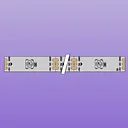
The Raspberry Pi 40-Pin GPIO Double Expansion Board splits your Pi's single GPIO header into two, letting you connect multiple HATs, breakout boards, or accessories simultaneously without stacking conflicts.
Simply connect it to your Raspberry Pi's 40-pin header, and you'll have two full GPIO breakouts ready to use. All 40 pins are passed through to both headers, giving you complete access to power, ground, I2C, SPI, UART, and all GPIO pins on each side.
Key Features
- 1-to-2 GPIO Expansion – Duplicates all 40 pins across two headers
- Full Pin Pass-Through – All GPIO, power, I2C, SPI, and UART pins available on both outputs
- No Software Required – Plug-and-play hardware solution
- 40-Pin Compatible – Works with Raspberry Pi models featuring the standard 40-pin header
Ideal For
- Using multiple HATs or breakout boards at the same time
- Prototyping with breadboard access while a HAT is attached
- Testing and debugging GPIO connections
Package Contents
- 1× 40-Pin GPIO Double Expansion Board
Jargon buster
Plain-language definitions for the technical terms used above.
- breakout
- A breakout board carries a small or fine-pitched component and brings its connections out to standard, breadboard- and header-friendly pins. Describing a part as a breakout means it can be wired into a project without soldering directly to the component's tiny contacts.
- GPIO
- General-purpose input/output pins are microcontroller pins you can set in software to read signals, switch devices on and off, or connect to peripherals. The number of GPIO pins matters because it limits how many buttons, LEDs, sensors, and other parts you can wire directly to the board.
- Headers
- Rows of connector contacts on a fixed pitch (commonly 2.54 mm) used to link a board to a breadboard, jumper wires, or another board. They come as male pin headers and female socket headers; when a module ships with pre-soldered headers it can be used straight away, whereas bare pads require soldering the pins yourself.
- I2C
- I2C is a two-wire communication bus used by many sensors and small modules. It matters because several I2C devices can share the same two wires, but each device needs a compatible address and your controller must support I2C.
- SPI
- A fast serial communication bus often used for displays, memory cards, and sensors. It matters because SPI devices need specific pins for clock and data, plus a separate chip-select line for each device.
- UART
- UART is a simple asynchronous serial interface that sends data over separate transmit and receive wires, usually labelled TX and RX, with both ends set to the same baud rate. It is a common way for microcontrollers and other serial devices to exchange data.
Find this product in
Raspberry Pi
Related Tutorials
Free step-by-step guides