

How We Show Stock, Lead Times & Delivery ETAs
Every product we sell shows you, up front, whether it is on our shelf or coming in from a supplier, how long it takes us to get it out the door, and when it should arrive. We surface this in two places — the product page and the cart — so there are no surprises before you check out. This article walks through exactly what each label means.
Every ETA has two parts
The estimated time of arrival (ETA) we quote is always made up of two separate stages:
- Dispatch lead time — how long until your order leaves our warehouse. For in-stock items this is usually same-day; for supplier items it is the time it takes the stock to reach us first.
- Transit time — how long the carrier (Australia Post or a courier) takes to deliver the parcel once it has been dispatched. This depends on the shipping method you choose.
Add the two together and you get the arrival date we show you. For a deeper explanation of this split, see Dispatch Lead Time vs Transit Time.
On the product page
When an item is ordered in from a supplier rather than held in our Sydney warehouse, the product page spells out the stock position and breaks the delivery estimate into its two parts. The numbered markers below match the callouts on the screenshot.
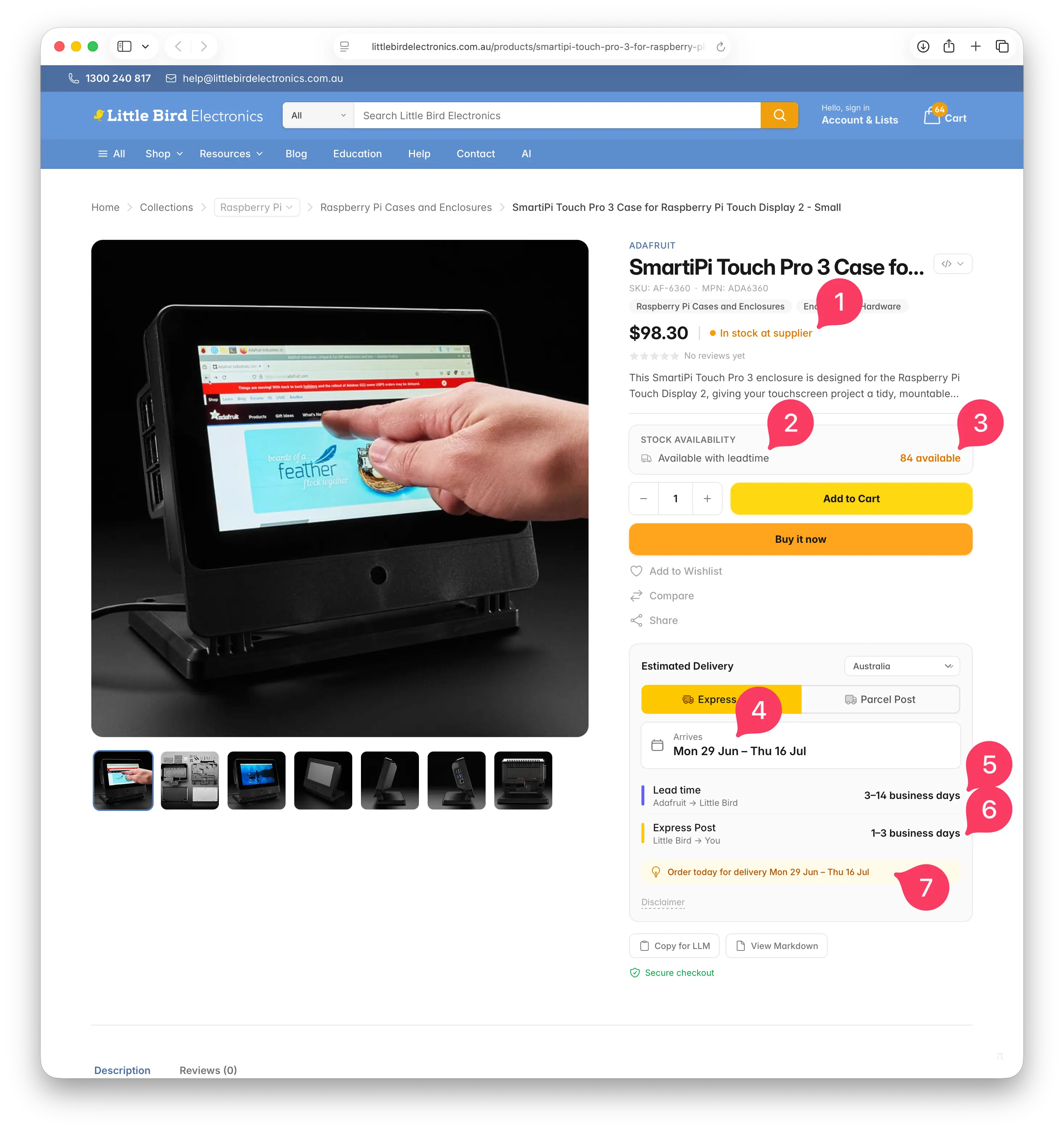
- It is coming from a supplier. A badge under the price — for example "In stock at supplier" — tells you the item is not held in our own warehouse. We order it in from the manufacturer or distributor when you buy.
- It has a lead time. The Stock Availability line reads "Available with leadtime", meaning there is a short wait before we can dispatch it, rather than it shipping the same day.
- The supplier's inventory. Next to that we show how many units the supplier currently holds (for example "84 available"), so you can see the stock genuinely exists and roughly how much is on hand.
- A delivery ETA. The Estimated Delivery panel gives an arrival date range — for example "Arrives Mon 29 Jun – Thu 16 Jul" — calculated from your destination and the shipping method you select (Express or Parcel Post).
- The lead-time component of the ETA. The Lead time row (shown as supplier → Little Bird) is the dispatch side: how long until the stock reaches us and leaves our warehouse — here, 3–14 business days.
- The delivery-method component of the ETA. The shipping row (for example Express Post, Little Bird → You) is the transit side: how long the carrier takes once we have dispatched — here, 1–3 business days.
- The delivery ETA, restated. At the bottom we combine both parts back into one clear line — for example "Order today for delivery Mon 29 Jun – Thu 16 Jul" — so the bottom-line date is never buried.
On the cart page
When your cart mixes in-stock items with supplier items, we group them and let you decide how they ship. Again, the numbered markers match the callouts on the screenshot.
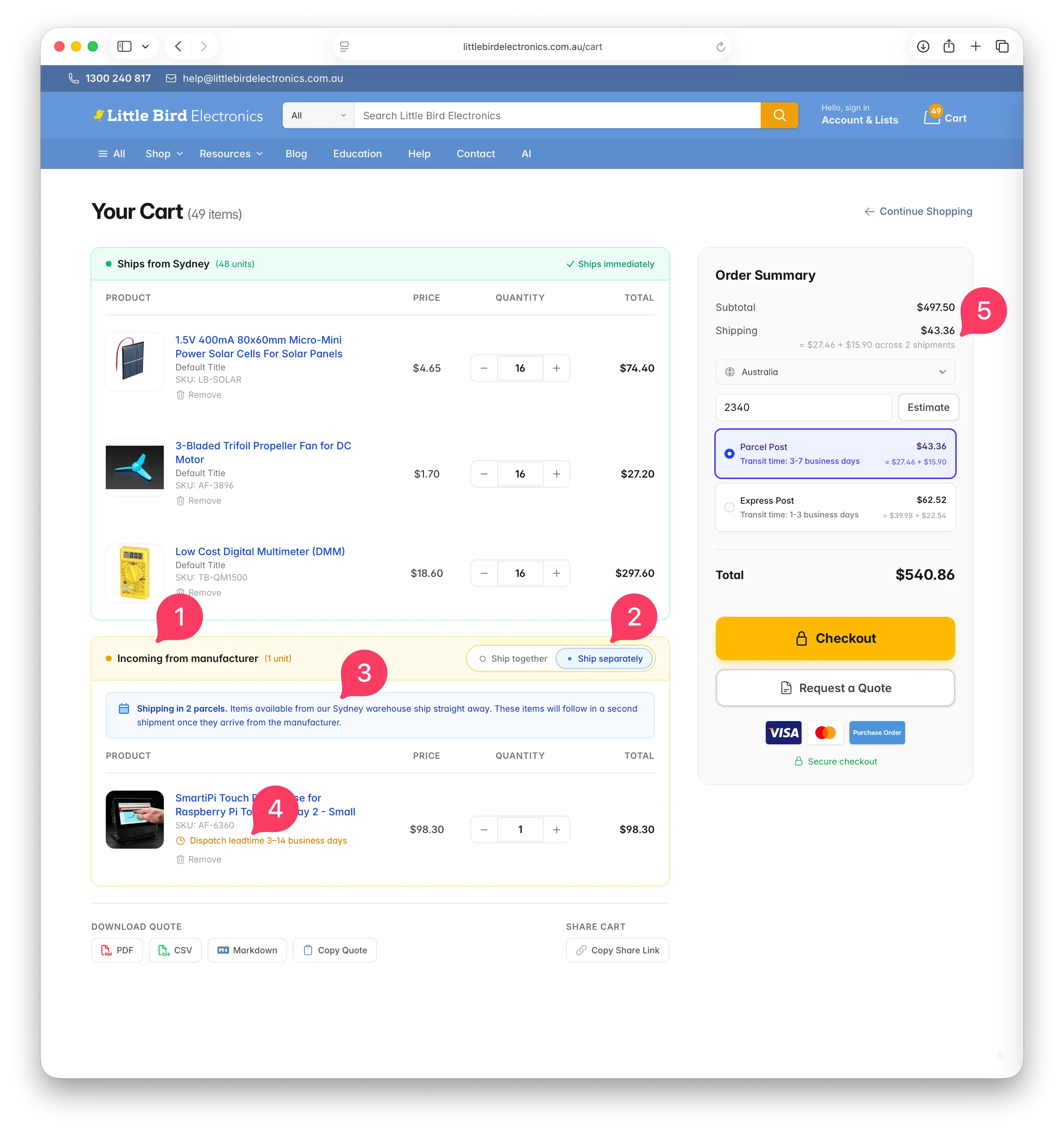
- Which items are coming from a supplier. Your cart is split into groups. A green "Ships from Sydney … Ships immediately" group holds everything in our warehouse, while a separate yellow "Incoming from manufacturer" group lists the items we order in for you.
- You can choose to split-ship. A "Ship together / Ship separately" toggle lets you decide whether to send the whole order in one go, or ship the in-stock items now and let the supplier items follow.
- How it dispatches when split. When you choose Ship separately, we explain what will happen: "Shipping in 2 parcels. Items available from our Sydney warehouse ship straight away. These items will follow in a second shipment once they arrive from the manufacturer."
- The dispatch lead time, reiterated. Each supplier item repeats its dispatch lead time right on the line (for example "Dispatch leadtime 3–14 business days"), so it is always clear which item you are waiting on and for how long.
- How splitting affects the shipping price. The Order Summary shows shipping charged per parcel — for example "$43.36 = $27.46 + $15.90 across 2 shipments". Two parcels means two lots of postage, so you are trading a little extra freight for getting your in-stock items sooner.
Ship together or ship separately?
It is your call, and you can change it in the cart before checkout:
- Ship together — one parcel, one postage charge. Your whole order waits until the supplier stock arrives, then ships as a single shipment.
- Ship separately — your in-stock items leave Sydney straight away, and the supplier items follow in a second parcel. You receive most of your order sooner, but pay postage on each shipment.
For more on backordered and incoming stock, see Split Shipping for Backorders and Product Availability & ETAs. If anything about an item's stock or ETA is unclear, get in touch and we will confirm it for you.
