SparkFun
SparkFun ESP32 Qwiic Pro Mini
·
Say hello to the next generation of Pro Mini boards - the SparkFun ESP32 Qwiic Pro Mini houses the powerful ESP32-PICO-MINI-N8R2 from Espressif on our compac...
Get notified when back in stock
Say hello to the next generation of Pro Mini boards - the SparkFun ESP32 Qwiic Pro Mini houses the powerful ESP32-PICO-MINI-N8R2 from Espressif on our compact Pro Mini footprint with 2MB of PSRAM. With two individually controllable CPU cores, adjustable CPU clock frequency, a co-processor that can be used in situations that require minimal computing power, as well as a rich set of peripherals such as capabilities for an external SD card interface, capacitive touch sensors, ADC, DAC, Two-Wire Automotive Interface, to Ethernet, high-speed SPI, UART, I²S, and I²C, this board is a powerhouse in a tiny little package. Best of all, utilizing our handy Qwiic system, no soldering is required to connect this Pro Mini to the rest of your system.
The integration of Bluetooth® (specifically Bluetooth SPP), Bluetooth LE, and WiFi ensures that a wide range of applications can be targeted and that the module is all-around: using WiFi allows an extensive physical range and direct connection to the Internet through a WiFi router while using Bluetooth allows the user to conveniently connect to the phone or broadcast low energy beacons for its detection. The sleep current of the ESP32 chip is less than 5μA, making it suitable for battery-powered and wearable electronics applications. The module supports a data rate of up to 150Mbps and 20dBm output power at the antenna to ensure the most comprehensive physical range.
Note: Unlike other ESP32 boards, this device requires user interaction to program. To program the device, hold down GP0 while resetting it. This is a simple process, but it is not automatic.
The SparkFun Qwiic Connect System is an ecosystem of I2C sensors, actuators, shields and cables that make prototyping faster and less prone to error. All Qwiic-enabled boards use a common 1mm pitch, 4-pin JST connector. This reduces the amount of required PCB space, and polarized connections mean you can’t hook it up wrong.
Features:
- CPU and OnChip Memory
- ESP32-PICO-V3-02 embedded, Xtensa dual-core 32-bit LX6 microprocessor, up to 240 MHz
- 448KB ROM for booting and core functions
- 520KB SRAM for data and instructions
- 16KB SRAM in RTC
- 8MB SPI flash
- 2MB PSRAM
- WiFi
- 802.11b/g/n
- Bit rate: 802.11n up to 150 Mbps
- A-MPDU and A-MSDU aggregation
- 0.4 µs guard interval support
- Center frequency range of operating channel: 2412 ~ 2484 MHz
- Bluetooth
- Bluetooth V4.2 BR/EDR and Bluetooth LE specification
- Class-1, class-2 and class-3 transmitter
- AFH
- CVSD and SBC
- Peripherals
- UART, SPI, SDIO, I2C, LED PWM, Motor PWM, I2S, IR, pulse counter, GPIO, capacitive touch sensor, ADC, DAC, TWAI® (compatible with ISO 11898-1, i.e. CAN Specification 2.0), Ethernet MAC
- Integrated Components on Module
- 40 MHz crystal oscillator
- Antenna Options
- ESP32-PICO-MINI-02: On-board PCB antenna
- Operating Conditions
- Operating voltage/Power supply: 3.0 ~ 3.6 V
- Operating ambient temperature: –40 ~ 85 °C
- 1x Vertical Qwiic Connector
Documents:
- Schematic
- KiCAD Files
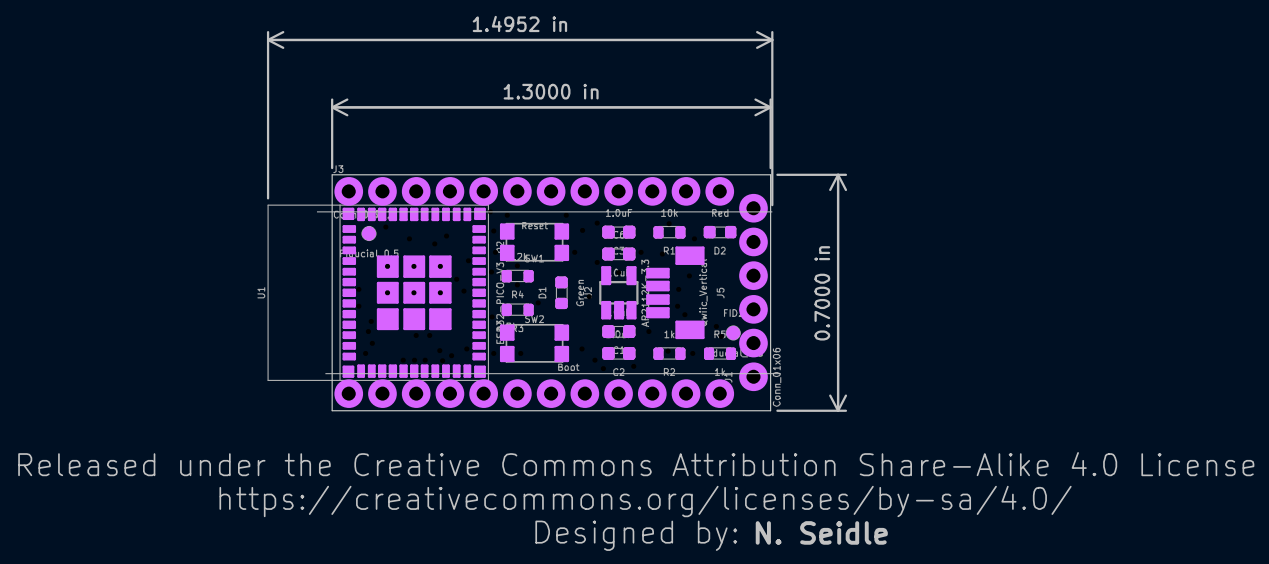
- Board Dimensions
- Hookup Guide
- Datasheet (ESP32-PICO-MINI-02)
- Qwiic Info Page
- GitHub Hardware Respository
Videos
Jargon buster
Plain-language definitions for the technical terms used above.
- ADC
- An analogue-to-digital converter reads a changing voltage and turns it into a number the microcontroller can use. It matters when connecting analogue sensors such as light, sound, or variable-resistor sensors.
- DAC
- A digital-to-analogue converter turns numbers from the microcontroller into a real analogue voltage. It matters if you want to generate simple waveforms, audio-style signals, or variable control voltages rather than just on/off outputs.
- ESP32
- ESP32 is a family of low-cost microcontroller chips and modules from Espressif with built-in WiFi and Bluetooth. They support programmable firmware and over-the-air updates, and are commonly programmed with toolchains such as the Arduino core and ESP-IDF.
- ESP32-PICO-MINI-02
- ESP32-PICO-MINI-02 is a compact system-in-package wireless module from Espressif that integrates an ESP32 chip, flash and supporting components with a PCB antenna. The exact part number helps you check its datasheet for wireless capabilities, antenna type, pinout and long-term availability.
- GPIO
- General-purpose input/output pins are microcontroller pins you can set in software to read signals, switch devices on and off, or connect to peripherals. The number of GPIO pins matters because it limits how many buttons, LEDs, sensors, and other parts you can wire directly to the board.
- I2C
- I2C is a two-wire communication bus used by many sensors and small modules. It matters because several I2C devices can share the same two wires, but each device needs a compatible address and your controller must support I2C.
- I2S
- I2S is a digital audio interface used to send sound data between chips, such as from a microcontroller to an audio amplifier or DAC. It matters if your project needs cleaner digital audio output than a basic buzzer or PWM signal can provide.
- LED
- A light-emitting diode (LED) is a small electronic component that emits light when current flows through it in the correct direction. Because it only conducts one way, its polarity matters, and a through-hole LED must be soldered the correct way around to light up.
- PCB
- A printed circuit board (PCB) is a board, usually rigid, with etched copper tracks that connect electronic components together without loose wiring. Components are mounted on the board and signals route between them through the copper layout.
- PCB antenna
- A PCB antenna is an antenna pattern built directly into the circuit board rather than a separate metal antenna. It matters because placement, nearby metal and enclosure design can affect wireless range.
- PWM
- Pulse Width Modulation is a way for a digital pin to simulate variable output power by switching on and off very quickly. It matters for controlling things like LED brightness, motor speed, or servo-style signals from a microcontroller pin.
- Qwiic
- Qwiic is a plug-in connector system for I2C devices that uses small 4-pin cables, so you can connect compatible sensors without soldering. It matters because your controller or adapter also needs Qwiic, or you will need a cable or breakout to wire it up.
- RTC
- A Real-Time Clock keeps track of time even when the main processor is asleep or powered down, usually with a small backup battery. It matters for data logging and tracking projects that need accurate timestamps.
- SPI
- A fast serial communication bus often used for displays, memory cards, and sensors. It matters because SPI devices need specific pins for clock and data, plus a separate chip-select line for each device.
- SRAM
- Fast temporary memory used by a processor while a program is running. More SRAM helps with projects that handle larger data buffers, networking, displays, or more complex code.
- UART
- UART is a simple asynchronous serial interface that sends data over separate transmit and receive wires, usually labelled TX and RX, with both ends set to the same baud rate. It is a common way for microcontrollers and other serial devices to exchange data.
Find this product in
Brands
Connectivity
SparkFun ESP32 Qwiic Pro Mini Schematic
Schematic · 176.5 KB · Click any page to view full size
ESP32-PICO-MINI-02 Datasheet
Datasheet · 668.0 KB · Click any page to view full size
Supplier page — sparkfun.com
Supplier Description · 689.0 KB · Click any page to view full size
Resources & Downloads
Guides, code examples, and more
Source Code
Open-source libraries, firmware & example projects for this product
The ESP32 Pico in a classic Pro Mini form factor.
096c783
4 months ago
· 47 commits
- .cache Initial checkin of documentation about 3 years ago
- .github Update mkdocs.yml 4 months ago
- docs Autosave did not save- updating sch almost 3 years ago
- Documents Remove old files almost 3 years ago
- Firmware Add firmware tests. about 3 years ago
- Hardware Update 3D models about 2 years ago
- overrides Initial checkin of documentation about 3 years ago
- .gitattributes Initial commit about 3 years ago
- .gitignore Add PWR LED. Change to vertical Qwiic. about 3 years ago
- LICENSE.md Create LICENSE.md almost 3 years ago
- mkdocs.yml Update mkdocs.yml 4 months ago
- README.md Update README.md almost 3 years ago