- 2mm pitch
-
Pitch is the distance between the centres of neighbouring pins on a connector. A 2mm pitch header is smaller than the common 2.54mm breadboard spacing, so you need matching cables and headers rather than standard breadboard jumper leads.
- Bootloader
-
Small starter software on a microcontroller that lets new code be uploaded before the main program runs. Knowing how to enter bootloader mode matters when you need to program the board or recover it after a faulty sketch.
- CircuitPython
-
A beginner-friendly version of Python designed to run directly on microcontroller boards. If a product supports CircuitPython, you can often program it by copying code files onto the board rather than setting up a more complex toolchain.
- GPIO
-
General-purpose input/output pins are microcontroller pins you can set in software to read signals, switch devices on and off, or connect to peripherals. The number of GPIO pins matters because it limits how many buttons, LEDs, sensors, and other parts you can wire directly to the board.
- Headers
-
Rows of connector contacts on a fixed pitch (commonly 2.54 mm) used to link a board to a breadboard, jumper wires, or another board. They come as male pin headers and female socket headers; when a module ships with pre-soldered headers it can be used straight away, whereas bare pads require soldering the pins yourself.
- LED
-
A light-emitting diode (LED) is a small electronic component that emits light when current flows through it in the correct direction. Because it only conducts one way, its polarity matters, and a through-hole LED must be soldered the correct way around to light up.
- LiPo
-
A LiPo (lithium polymer) battery is a rechargeable lithium battery widely used in portable projects because it is light and compact. LiPo cells need correct charging circuitry and careful handling to stay safe, so equipment that supports LiPo generally includes charging or protection hardware suited to that battery type.
- NeoPixel
-
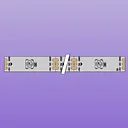
A type of addressable LED system where colour data is sent along a single digital data line from one LED or controller to the next. Compatibility matters because the timing and signal format must match for the lights or driver board to respond correctly.
- PWM
-
Pulse Width Modulation is a way for a digital pin to simulate variable output power by switching on and off very quickly. It matters for controlling things like LED brightness, motor speed, or servo-style signals from a microcontroller pin.
- RP2040
-
The RP2040 is a dual-core Arm Cortex-M0+ microcontroller chip from Raspberry Pi, used on many maker boards and offering programmable I/O, multiple GPIO pins and reasonable processing speed. Code and accessories built for that chip should work where RP2040 compatibility is listed, though demanding tasks such as reading a camera can require careful pin allocation and timing.
- RST
-
RST (reset) is a control pin used to restart or reinitialise a device to a known state. Connecting an RST pin to a microcontroller lets the host reset the device, which can help with reliable start-up or recovery.
- SMD
-
SMD means surface-mount device, a component style designed to be soldered directly onto the surface of a circuit board rather than through holes. SMD parts are compact and mounted flat on the board, which suits smaller and mass-produced designs.
- SRAM
-
Fast temporary memory used by a processor while a program is running. More SRAM helps with projects that handle larger data buffers, networking, displays, or more complex code.
- SWD
-
Serial Wire Debug (SWD) is a two-wire programming and debugging interface used with many ARM Cortex-M microcontrollers. It provides low-level access to program, recover or debug the microcontroller.