SparkFun
SparkFun MicroMod STM32WB5MMG Processor
The MicroMod STM32WB5MMG Processor expands on SparkFun's MicroMod ST product line with a powerful combination of computing and wireless capabilities on one M...
Get notified when back in stock
- Pair of Arm® Cortex® Processors:
- Arm® Cortex®-M4 CPU with FPU (Floating Point Unit)
- Adaptive real-time accelerator (ART Accelerator™) allowing 0-wait state execution from Flash memory
- Frequency up to 64 MHz
- Memory protection unit
- 80 DMIPS/ 1.25 DMIPS/MHz (Dhrystone 2.1)
- DSP instructions
- Arm® Cortex®-M0+ CPU
- Dedicated to 2.4 GHz RF transceiver and security peripherals
- Arm® Cortex®-M4 CPU with FPU (Floating Point Unit)
- 2.4 GHz RF Transceiver
- Bluetooth® 5.3
- IEEE 802.15.4-2011 PHY and MAC
- Output Power: Programmable up to +6 dBm (1 dBm increments)
- RX Sensitivity:
- -96 dBm for BLE @ 1 Mbps
- -100 dBm for 802.15.4
- Max Range: 75 m
- 16 MB External Flash memory
- 256 KB SRAM
- Supply Voltage Range: 1.71 to 3.6 V
- Ultra-Low Power Consumption
- Shutdown Mode: 13 nA
- Stop Mode: 600 nA
- Standby Mode: 600 nA
- Radio: 4.5 mA (Rx) / 5.2 mA (Tx @ 0 dBm)
- Two UART (One low power)
- Two I2C Buses
- SPI
- I2S Audio
- 16-bit Advanced Four-Channel Timer
- Two Dedicated Analog Inputs
- Two Dedicated PWM
- Shared with Timer pins
- Eight General Purpose I/O Pins
- Schematic
- Eagle Files
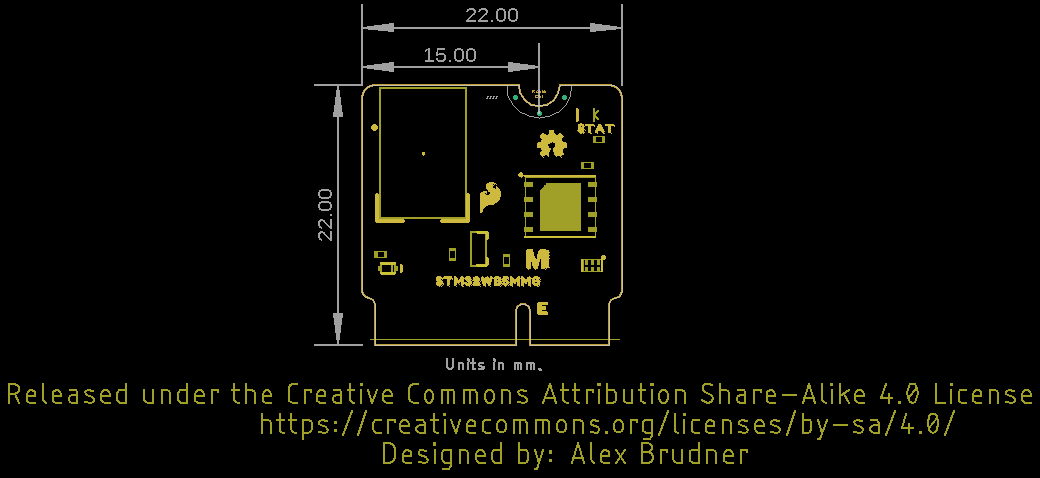
- Board Dimensions
- Datasheet (STM32WB55MMG)
- Datasheet (STM32WB55xx)
- Reference Manual (STM32WB55xx)
- Hookup Guide
- GitHub Hardware Repo
Jargon buster
Plain-language definitions for the technical terms used above.
- BLE
- BLE stands for Bluetooth Low Energy, a Bluetooth mode designed for low power use and broad compatibility with modern phones and computers. It connects well to battery-powered and mobile devices, including Apple hardware, though it behaves differently from Bluetooth Classic and its serial-style profiles.
- DSP
- Digital signal processing means using software or hardware to analyse or modify signals such as audio, vibration, or sensor readings. A board suited to DSP is useful when a project needs fast maths for filtering, synthesis, or real-time signal analysis.
- Flash memory
- Flash memory is non-volatile memory that retains stored data even when power is removed, and can be erased and rewritten in blocks. It lets data such as firmware, settings or saved records persist across power cycles.
- FPU
- A floating-point unit is hardware inside a processor that speeds up calculations with decimal numbers. This helps when projects use maths-heavy tasks such as motion sensing, filtering sensor readings, or audio processing.
- I2C
- I2C is a two-wire communication bus used by many sensors and small modules. It matters because several I2C devices can share the same two wires, but each device needs a compatible address and your controller must support I2C.
- I2S
- I2S is a digital audio interface used to send sound data between chips, such as from a microcontroller to an audio amplifier or DAC. It matters if your project needs cleaner digital audio output than a basic buzzer or PWM signal can provide.
- M.2
- M.2 is a compact edge-connector standard for plugging small modules - such as SSDs, wireless cards or microcontroller modules - into a host board without soldering. The same slot shape can carry different interfaces (for example PCIe, SATA or USB), so keying and the supported module type need to be checked.
- microcontroller
- A microcontroller is a small computer on a single chip that runs a stored program and controls connected inputs and outputs such as buttons, sensors, displays and communication interfaces. In a device built around one, it is the part that executes the code and coordinates the device's behaviour.
- MicroMod
- MicroMod is a modular board system where a small processor board plugs into a separate carrier board (via an M.2 connector) that provides connectors, power, and peripherals. Within the MicroMod system, a board is either a processor board or a carrier board, and you need a matching pair of both before you can run project code.
- MPU
- MPU can refer to a few different things in electronics: a microprocessor unit (a processor powerful enough to run a full operating system such as Linux, with external memory and storage), a motion-processing unit like the MPU-6050 or MPU-9250 inertial sensor modules, or a memory protection unit built into some microcontrollers. The intended meaning depends on the surrounding context.
- PWM
- Pulse Width Modulation is a way for a digital pin to simulate variable output power by switching on and off very quickly. It matters for controlling things like LED brightness, motor speed, or servo-style signals from a microcontroller pin.
- RF
- RF means radio frequency, referring to signals used for wireless communication and other high-frequency electronics. A low-noise, stable power supply is important for RF circuits because power noise can affect signal quality and measurements.
- RX
- RX means receive, usually showing data being received by the board. An RX indicator LED can help with troubleshooting USB or serial communication.
- SPI
- A fast serial communication bus often used for displays, memory cards, and sensors. It matters because SPI devices need specific pins for clock and data, plus a separate chip-select line for each device.
- SRAM
- Fast temporary memory used by a processor while a program is running. More SRAM helps with projects that handle larger data buffers, networking, displays, or more complex code.
- TX
- TX means transmit, usually showing data being sent from the board. A TX indicator LED can help you see when the board is communicating or uploading code.
- UART
- UART is a simple asynchronous serial interface that sends data over separate transmit and receive wires, usually labelled TX and RX, with both ends set to the same baud rate. It is a common way for microcontrollers and other serial devices to exchange data.
- Zigbee
- A low-power wireless standard commonly used by smart home sensors, switches, and lights. It matters if you want the board to communicate with Zigbee devices or act as part of a home automation network.
Find this product in
Brands
Connectivity
Microcontrollers
MicroMod STM32WB5MMG Schematic
Schematic · 131.2 KB · Click any page to view full size
STM32WB5MMG Module Datasheet
Datasheet · 4.5 MB · Click any page to view full size
STM32WB55xx Datasheet
Datasheet · 3.0 MB · Click any page to view full size
STM32WB55xx Reference Manual
User Guide · 17.3 MB · Click any page to view full size
Supplier page — sparkfun.com
Supplier Description · 823.0 KB · Click any page to view full size
SparkFun MicroMod Interface v1.0 Pinout
Pinout · 27.5 KB · Click any page to view full size
SparkFun MicroMod Interface v1.0 Pin Descriptions
Document · 58.2 KB · Click any page to view full size
MicroMod General Pinout v10 Graphical Datasheet
Datasheet · 984.8 KB · Click any page to view full size
MicroMod M.2 Connector Datasheet TE 2199230 4
Datasheet · 336.1 KB · Click any page to view full size
MicroMod Reflowable Standoff
Datasheet · 1.2 MB · Click any page to view full size
AP7361C
Document · 909.5 KB · Click any page to view full size
Resources & Downloads
Guides, code examples, and more
Source Code
Open-source libraries, firmware & example projects for this product
d5b3c4a
over 3 years ago
· 14 commits
- Documentation Added helpful documentation over 3 years ago
- Firmware Added examples. over 3 years ago
- Hardware v10 Update over 3 years ago
- Production v10 Update over 3 years ago
- .gitattributes Initial commit almost 4 years ago
- .gitignore Initial commit almost 4 years ago
- CONTRIBUTING.md Initial commit almost 4 years ago
- ISSUE_TEMPLATE.md Initial commit almost 4 years ago
- LICENSE.md Initial commit almost 4 years ago
- README.md Update README.md over 3 years ago
Related Tutorials
Free step-by-step guides