Little Bird
Pirate Audio: Line-out for Raspberry Pi
Plug Pirate Audio Line-out for Raspberry Pi into your hi-fi amp or powered speakers, then sit back, relax, and soak in the rich, digital audio. ...
Get notified when back in stock
Plug Pirate Audio Line-out for Raspberry Pi into your hi-fi amp or powered speakers, then sit back, relax, and soak in the rich, digital audio. It has a high-quality I2S DAC, high-res colour display, and playback control buttons.
This board is perfect for upgrading an existing hi-fi amp and speakers, or a set of powered monitors, with digital audio from local audio files (MP3, FLAC, etc.) or from streaming services like Spotify. The DAC on Pirate Audio Line-out gives you crisp 24-bit / 192KHz digital audio through its 3.5mm stereo jack.
Pirate Audio is a range of all-in-one audio boards for Raspberry Pi, with high-quality digital audio, beautifully-crisp IPS displays for album art, tactile buttons for playback control, and our custom Pirate Audio software and installer to make setting it all up a breeze.
Features
- Line-level digital audio (24-bit / 192KHz) over I2S
- PCM5100A DAC chip (datasheet)
- 3.5mm stereo jack
- 1.3" IPS colour LCD (240x240px) (ST7789 driver)
- Four tactile buttons
- Mini HAT-format board
- Fully-assembled
- Compatible with all 40-pin header Raspberry Pi models
- Pirate Audio software
- Dimensions: 65x30.5x9.5mm
Software
Our Pirate Audio software and installer installs the Python library for the LCD, configures the I2S audio and SPI, and then installs Mopidy and our custom Pirate Audio plugins to display album art and track info, and to use the buttons for playback control.
Here's how to get started:
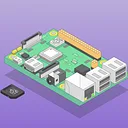
- Set an SD card up with the latest version of Raspbian.
- Connect to Wi-Fi or a wired network.
- Open a terminal and type the following:
git clone https://github.com/pimoroni/pirate-audio
cd pirate-audio/mopidy
sudo ./install.sh
- Reboot your Pi
You can find more detailed instructions here: https://github.com/pimoroni/pirate-audio/tree/master/mopidy or get tonnes more info in our Getting Started with Pirate Audio tutorial.
Notes
Note that our installer, linked above, does all of the below for you, but if you're an intrepid hacker then you might need to know this stuff!
- The DAC can be configured by adding dtoverlay=hifiberry-dac to the /boot/config.txt file.
- There is a DAC enable pin—BCM 25— that must be driven high to enable the DAC. You can do this by adding gpio=25=op,dh to the /boot/config.txt file.
- The buttons are active low, and connected to pins BCM 5, 6, 16, and 20
- The display uses SPI, and you'll need to enable SPI through the Raspberry Pi configuration menu.
- If you want to use these boards with a Pibow Coupé case (either for the Zero / Zero W or Pi 4), then you'll need to use a booster header to raise it up a little.
Jargon buster
Plain-language definitions for the technical terms used above.
- active LOW
- Active LOW describes a signal that is treated as active, asserted or 'on' when it sits at a low voltage near ground, rather than at a high voltage. It applies to inputs, outputs and control lines (such as reset or chip-select), so it matters when wiring devices so that signal levels are interpreted as intended.
- DAC
- A digital-to-analogue converter turns numbers from the microcontroller into a real analogue voltage. It matters if you want to generate simple waveforms, audio-style signals, or variable control voltages rather than just on/off outputs.
- GPIO
- General-purpose input/output pins are microcontroller pins you can set in software to read signals, switch devices on and off, or connect to peripherals. The number of GPIO pins matters because it limits how many buttons, LEDs, sensors, and other parts you can wire directly to the board.
- I2S
- I2S is a digital audio interface used to send sound data between chips, such as from a microcontroller to an audio amplifier or DAC. It matters if your project needs cleaner digital audio output than a basic buzzer or PWM signal can provide.
- IPS
- IPS is a type of LCD panel that keeps colours and contrast more consistent when viewed from an angle. This matters for small displays that may be mounted in a dashboard, handheld project, or enclosure where the viewer is not always looking straight on.
- LCD
- LCD stands for liquid crystal display, a screen technology that uses a backlight and liquid crystals to show images or text. It matters because LCD modules usually need a display driver and enough controller pins or a bus interface to send image data.
- SPI
- A fast serial communication bus often used for displays, memory cards, and sensors. It matters because SPI devices need specific pins for clock and data, plus a separate chip-select line for each device.
- ST7789
- A display controller chip commonly used to drive small colour TFT screens. If a board uses an ST7789, your software needs a compatible display library or driver to draw text, graphics and images correctly.
Find this product in
Audio & Video
Brands
Related Tutorials
Free step-by-step guides