Little Bird
micro:bit v2 Board
The BBC micro:bit v2 is a pocket-sized programmable computer designed for creative digital projects and coding education. Powered by a 64MHz ARM Cortex-M4 pr...
Get notified when back in stock
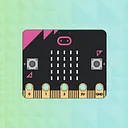
The BBC micro:bit v2 is a pocket-sized programmable computer designed for creative digital projects and coding education. Powered by a 64MHz ARM Cortex-M4 processor with FPU, 512KB flash, and 128KB RAM, it packs an impressive array of sensors and outputs into a board half the size of a credit card.
Program it using MakeCode (block/JavaScript), Python, or Scratch, and send code wirelessly via the micro:bit mobile app over Bluetooth 5.0. The v2 adds a built-in speaker, MEMS microphone, and capacitive touch logo to the feature set.
Key Features
- ARM Cortex-M4 Processor – 64MHz with FPU, 512KB flash, 128KB RAM
- 5×5 LED Matrix – Display text, numbers, images; also functions as a light sensor
- Built-in Speaker – Play sounds and music directly from the board
- MEMS Microphone – Detect and respond to sound, with LED indicator
- Touch-Sensitive Logo – Capacitive touch input on the front
- Two Programmable Buttons – Tactile buttons A and B
- Accelerometer & Compass – Motion detection and heading
- Temperature Sensor – Built into the processor
- Bluetooth 5.0 (BLE) – Wireless code upload and device interaction
- Edge Connector – 25 gold-tabbed pins with 5 ring connectors (3 I/O, 2 power) for alligator clips
- Micro-USB & JST Power – Dual power input options
Ideal For
- Coding education in schools and at home
- STEM projects and creative computing
- Building robots, musical instruments, and interactive devices
- Learning block-based, JavaScript, and Python programming
Package Contents
- 1× BBC micro:bit v2 board
Jargon buster
Plain-language definitions for the technical terms used above.
- ARM Cortex-M4
- The ARM Cortex-M4 is a 32-bit processor core widely used inside microcontrollers, often with hardware support for signal-processing and control tasks. It provides enough processing power to run embedded programs that handle sensors, wireless communication, audio and similar workloads.
- BLE
- BLE stands for Bluetooth Low Energy, a Bluetooth mode designed for low power use and broad compatibility with modern phones and computers. It connects well to battery-powered and mobile devices, including Apple hardware, though it behaves differently from Bluetooth Classic and its serial-style profiles.
- FPU
- A floating-point unit is hardware inside a processor that speeds up calculations with decimal numbers. This helps when projects use maths-heavy tasks such as motion sensing, filtering sensor readings, or audio processing.
- LED
- A light-emitting diode (LED) is a small electronic component that emits light when current flows through it in the correct direction. Because it only conducts one way, its polarity matters, and a through-hole LED must be soldered the correct way around to light up.
- MEMS microphone
- A tiny microphone made using micro-electromechanical systems, the same style of miniature manufacturing used in many phone sensors. It lets the board detect sound without needing an external microphone, which is useful for noise-reactive projects and simple audio input.
- Motion detection
- The ability to sense that something has moved, either by comparing successive camera frames or by using a dedicated sensor such as a PIR (infrared) or radar module. When a product lists motion detection, movement can be used as a trigger so a system only acts or records when there is activity rather than running continuously.
- RAM
- RAM (random-access memory) is fast, temporary memory a device uses for working data while it is running; in its common volatile form, its contents are lost when power is removed. Some devices offer a mode that applies settings to RAM only, which is handy for testing changes temporarily because they are not stored permanently and disappear at power-off.
Find this product in
STEM & Education
Related Tutorials
Free step-by-step guides