Kitronik
Kitronik Compact All-In-One Robotics Board for BBC micro:bit
All Products
New Arrivals
Robotics & Coding
Brands and Manufacturers
Micro:Bit Accessories
micro:bit
Micro:bit Expansion Boards
Digital Technologies
Micro:Bit Robots
Robotics & Motion
Education
Motor Drivers and Controllers
Robotics
Kitronics
Kitronik
STEM Education Kits
$29.85
|
In stock
With the Kitronik Compact Robotics Board, the BBC micro:bit can be used to drive 4 motors (or 2 stepper motors) and 8 servos. Coupled with 17 other I/O expan...
Get notified when back in stock
Estimated Delivery
Arrives
Order within 1h 58m for same-day dispatch
Disclaimer
Secure checkout
With the Kitronik Compact Robotics Board, the BBC micro:bit can be used to drive 4 motors (or 2 stepper motors) and 8 servos. Coupled with 17 other I/O expansion points, this means the BBC micro:bit can very easily become the core of a whole variety of robotics projects. The board is small on footprint but big on features and connectivity. Please note, when used with a stepper motor, half-stepping is supported - but not micro-stepping.
The Robotics Board features 2 Dual H Bridge Motor Driver ICs (capable of driving 2 standard motors or 1 stepper motor each) and 8 servo outputs (capable of driving standard and continuous rotation servos), all controlled from the BBC micro:bit using the I2C protocol via a 16 channel driver IC. Our custom MakeCode blocks make using I2C easy, even for novice users.
The Link header breaks out all the usable pins from the BBC micro:bit, and is designed to allow 2.54mm pitch pin header to be easily soldered into place. The 17 available I/O pins allow other input devices, for example, sensors, or output devices, such as ZIP LEDs, to be added to the board. The I2C communication lines are also broken out (Pins 19 & 20), which means other I2C compatible devices can also be added to the board and controlled by the BBC micro:bit.
Power is provided via either a terminal block or servo style connector. The supply is then controlled by an on/off power switch to the board. There is also a green LED to indicate when the board is turned on. The board then produces a regulated 3.3V supply which is fed into the 3V and GND connections to power the connected BBC micro:bit. This removes the need to power the BBC micro:bit separately. The 3V and GND pins are also broken out on the Link header, which means external devices can also be powered.
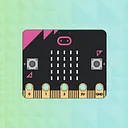
To use the compact robotics board, the BBC micro:bit should be inserted firmly into the edge connector, with the LEDs and buttons visible from the front.
Kitronik has produced a set of custom blocks for the MakeCode editor to simplify using the Compact Robotics Board for BBC micro:bit. To add them to the editor, select the cog icon in the top right of the editor. Then, select Extensions from the drop-down menu and in the search bar type and enter Kitronik. Pick the Kitronik robotics Board from the list and the new blocks will be added to the menu in the editor.
Jargon buster
Plain-language definitions for the technical terms used above.
- GND
- GND is the ground or reference connection (0 V) for a circuit. When connecting two devices together, their grounds must be joined so both agree on what counts as a low or high signal.
- I2C
- I2C is a two-wire communication bus used by many sensors and small modules. It matters because several I2C devices can share the same two wires, but each device needs a compatible address and your controller must support I2C.
- LED
- A light-emitting diode (LED) is a small electronic component that emits light when current flows through it in the correct direction. Because it only conducts one way, its polarity matters, and a through-hole LED must be soldered the correct way around to light up.
- motor driver
- An electronic circuit that lets a low-power controller switch and control a motor that needs more current than the controller pins can safely provide. Checking motor driver support matters because pumps and motors usually cannot be connected directly to a microcontroller output.
- servo
- A servo is a motor with built-in position control, usually told to move to a specific angle by a control signal. It matters when you need repeatable movement, such as steering, arms, flaps, or linkages, rather than continuous spinning.
- Terminal block
- A terminal block is a connector that joins wires together in a neat, removable, or serviceable way, usually clamping each wire under a screw or spring instead of soldering. It makes it easier to connect, change, or service wiring without permanent joints.
Find this product in
Robotics & Motion
STEM & Education
Related Tutorials
Free step-by-step guides