Little Bird
TT Gearbox Motor
·
The classic yellow "TT" plastic gearbox motor, in every gear ratio and lead termination we can get. Dual output shafts, 3–6VDC, and the standard TT footprint...
Get notified when back in stock
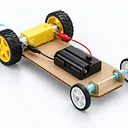
The classic yellow "TT" plastic gearbox motor, in every gear ratio and lead termination we can get. Dual output shafts, 3–6VDC, and the standard TT footprint that fits every common bracket, wheel and chassis.
Choose the gear ratio first
The ratio decides the trade between speed and torque. It is the single most important choice on this page, and the three motors are physically identical from the outside — so pick deliberately.
- 48:1 — about 200 RPM at 6V, 120 RPM at 3V. The standard buggy motor: fastest, lowest torque, and the highest stall current (~1.1A at 3V).
- 120:1 — about 100 RPM at 6V, with roughly 2.5× the torque of the 48:1. The right pick for lifts, geared mechanisms, and anything running from two AA cells.
- 220:1 — about 45 RPM at 6V. Maximum torque, slow. For winches, screw drives and heavily loaded mechanisms.
Running from batteries
Two AA cells give 3V nominal, and that voltage sags under load. If your mechanism is geared, loaded, or lifting anything, use four AA cells (6V) or step up to the 120:1 or 220:1 — a 48:1 on two AAs is the most common reason a project "doesn't have enough power".
Lead options
- Bare tinned leads — for soldering or screw terminals
- 10cm male Dupont — 0.1" pins, straight into a breadboard
- 10cm female Dupont — sockets, straight onto header pins
- 15cm JST PH 2.0 — for driver boards that use the JST PH connector
Specifications
- Operating voltage: 3–6VDC (6V recommended)
- Dual (biaxial) output shafts, standard TT 3mm double-D
- Body: 70 × 22 × 18mm
- No encoder, no speed control and no positional feedback
These cannot be driven directly from a microcontroller pin — you need a motor driver. A DRV8833 works all the way down to 3V; a TB6612 needs 4.5V or more.
Jargon buster
Plain-language definitions for the technical terms used above.
- encoder
- An encoder is a sensor that converts the rotation or position of a shaft, knob or dial into electrical signals, reporting movement as incremental steps and direction, or as an absolute position. It is used to track how far something has turned, which matters for precise positioning, speed control, repeatable movement, or using a rotary knob as an input.
- JST PH
- A small keyed plug-and-socket connector with 2 mm pin spacing, often used for low-power electronics connections. You need the correct JST PH cable, and its current rating limits how much power should be passed through it.
- microcontroller
- A microcontroller is a small computer on a single chip that runs a stored program and controls connected inputs and outputs such as buttons, sensors, displays and communication interfaces. In a device built around one, it is the part that executes the code and coordinates the device's behaviour.
- motor driver
- An electronic circuit that lets a low-power controller switch and control a motor that needs more current than the controller pins can safely provide. Checking motor driver support matters because pumps and motors usually cannot be connected directly to a microcontroller output.
- pH
- A measure of how acidic or alkaline a liquid is, on a scale from 0 to 14 where 7 is neutral, lower is acidic and higher is alkaline. When a probe or sensor quotes a pH range and accuracy, check they cover the readings your project needs.
- Torque
- A twisting force that causes something to rotate, usually measured in newton-metres or kilogram-centimetres. It matters when choosing motors, servos, gears, and tools because higher torque is needed to lift heavier loads, turn larger wheels, or move mechanisms without stalling.
Find this product in
Robotics & Motion
Project Guides
Step-by-step builds that use this part