

Yahboom
Tiny:bit Pro AI visual robot car
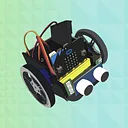
The Tiny:bit Pro is a micro:bit-powered robot car combined with a K210 AI vision module. The car integrates infrared sensors, an ultrasonic module, a sound s...
Get notified when back in stock
The Tiny:bit Pro is a micro:bit-powered robot car combined with a K210 AI vision module. The car integrates infrared sensors, an ultrasonic module, a sound sensor, buzzer, and RGB LEDs, while the K210 module adds HD image capture for machine learning, image recognition, colour detection, and target tracking.
Program the robot car using MakeCode graphical programming and the K210 module using MicroPython. An adjustable bracket lets you freely position the K210 camera angle for different vision tasks.
Key Features
- AI Vision Module (K210) – QR code detection, face recognition, mask detection, colour following, and more
- Adjustable Camera Bracket – Freely adjust the K210 module's camera angle
- Infrared Tracking – Line-following using infrared sensors
- Ultrasonic Obstacle Avoidance – Detect and avoid obstacles automatically
- Sound Detection & Buzzer – Respond to sound and play melodies
- RGB Lighting Effects – Programmable LED effects
- Three Remote Control Methods – APP, IR controller, and micro:bit handle
- Dual Programming – MakeCode for the car, MicroPython for the K210 module
- Track Map Included – Simulated scene with 6 different road signs
Ideal For
- Learning AI and machine vision concepts
- micro:bit robotics and coding education
- STEM classrooms exploring image recognition and automation
- Competitions and project-based learning
Resources
Jargon buster
Plain-language definitions for the technical terms used above.
- LED
- A light-emitting diode (LED) is a small electronic component that emits light when current flows through it in the correct direction. Because it only conducts one way, its polarity matters, and a through-hole LED must be soldered the correct way around to light up.
- MicroPython
- A version of the Python programming language made to run on microcontrollers. It matters because it lets beginners write readable code to control LEDs, sensors, motors and displays without needing to start with lower-level languages.
- RGB
- Short for red, green and blue, the three primary colours of light that are mixed in varying amounts to make a wide range of colours. In electronics RGB can refer to an LED or pixel that blends these three colours, or to a colour signal or interface that carries separate red, green and blue channels.
- Ultrasonic module
- An ultrasonic module measures distance by sending out high-frequency sound pulses and timing their echo. It is commonly used for obstacle detection and simple range-finding projects, but it needs a clear path to the target.
Find this product in
Brands
STEM & Education
Related Tutorials
Free step-by-step guides
Featured in buying guides
Comparison guides this product appears in

