

Adafruit
Surface Mount Rotary Encoder
·
For projects that need a rotary encoder but need to keep it single-sided or need to avoid interrupting traces or devices on the other side, here's an all-...
Get notified when back in stock
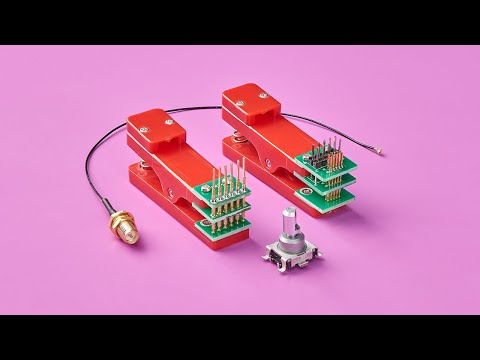
For projects that need a rotary encoder but need to keep it single-sided or need to avoid interrupting traces or devices on the other side, here's an all-SMT rotary encoder! It's a high-quality 30-detents encoder from Alps, with detents and a nice feel. There's a nice smooth bushing for placement in a box.
Knob not included, but you can pick one up here.
This encoder also has a push-button built into it so you can press onto the knob to close a separate switch. One side has a 3 pad connector (ground and two coding pins) and the other side has two pads for a normally open switch. There's also 6 large mechanical pads for making a strong physical connection: best to use a ground plane with 6 open pads so that there's a solid sheet to protect against the encoding shearing off.
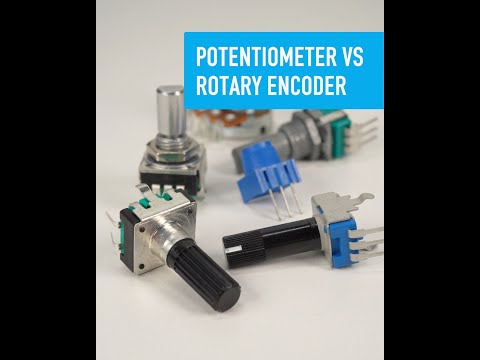
Rotary encoders are useful as rotation sensors or selectors and look similar to potentiometers. However they are not like potentiometers at all, so it's important to realize the difference! These rotary encoders rotate all the way around continuously and are divided up into 30 'segments'. Each segment has a clicky feeling to it, and each movement clockwise or counter-clockwise causes the two switches to open and close. There is no way to know what the current 'position' is - instead you would use a microcontroller to count how many 'clicks' left or right it has been turned. If you need to detect rotational 'position' a potentiometer would be a better choice.
Jargon buster
Plain-language definitions for the technical terms used above.
- encoder
- An encoder is a sensor that converts the rotation or position of a shaft, knob or dial into electrical signals, reporting movement as incremental steps and direction, or as an absolute position. It is used to track how far something has turned, which matters for precise positioning, speed control, repeatable movement, or using a rotary knob as an input.
- ground plane
- A ground plane is a large area of copper on a circuit board connected to ground. It helps provide a stable return path for signals and is especially important for reducing noise in high-speed connections.
- microcontroller
- A microcontroller is a small computer on a single chip that runs a stored program and controls connected inputs and outputs such as buttons, sensors, displays and communication interfaces. In a device built around one, it is the part that executes the code and coordinates the device's behaviour.
- potentiometer
- A variable resistor usually turned with a knob or shaft to create an adjustable electrical signal. It is often used for inputs such as volume, brightness or position, so it helps beginners learn how a microcontroller reads changing values.
Find this product in
Brands

