SparkFun
SparkFun Micro Magnetometer - MMC5983MA (Qwiic)
The SparkFun Qwiic Micro MMC5983MA Magnetometer is a micro-sized, 0.75in. by 0.30in. sensor that utilizes the highly sensitive triple-axis magnetometer by ME...
Get notified when back in stock
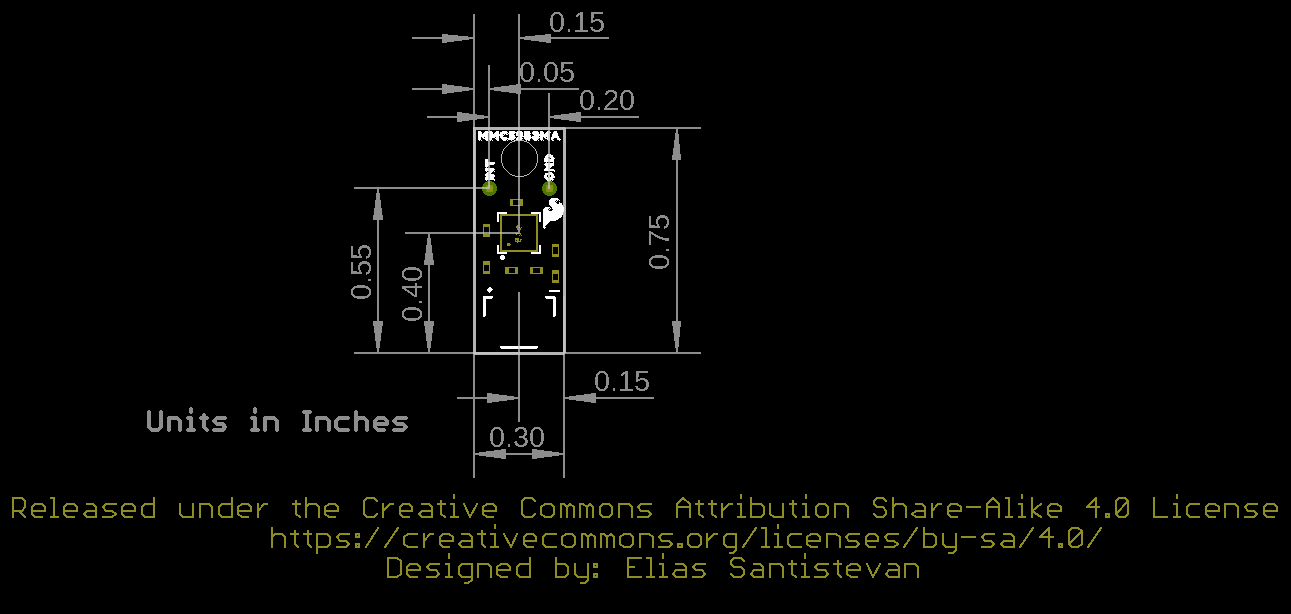
The SparkFun Qwiic Micro MMC5983MA Magnetometer is a micro-sized, 0.75in. by 0.30in. sensor that utilizes the highly sensitive triple-axis magnetometer by MEMSIC. We've attached the magnetometer IC onto an incredibly small Qwiic board form factor that we like to call Qwiic Micro! The MMC5983MA is capable of sensing down to 0.4mG, enabling a heading accuracy of ±0.5°. The Qwiic MMC5983MA IMU communicates over I2C by default utilizing our handy Qwiic Connect System, so no soldering is required to connect it to the rest of your boards.
Saturation is a problem for all mag sensors. The MMC5983MA has built-in degaussing circuitry to clear any residual magnetization. Output rates of 1000Hz, ±8G FSR, and 18-bit resolution make the MMC5983MA a phenomenal magnetic sensor for electronic compass applications.
We've also written a feature complete Arduino library supporting I2C and SPI. Just search "SparkFun MMA5983MA" in the library manager and start measuring within minutes.
The SparkFun Qwiic Connect System is an ecosystem of I2C sensors, actuators, shields and cables that make prototyping faster and less prone to error. All Qwiic-enabled boards use a common 1mm pitch, 4-pin JST connector. This reduces the amount of required PCB space, and polarized connections mean you can’t hook it up wrong.
Qwiic Micro is our smallest I2C-supported board form-factor yet! At only 0.75in. by 0.30in. (or 24.65mm by 7.62mm for metric friends), Qwiic Micro is perfect for projects and applications that have space or weight concerns. With just a single Qwiic connector, Micro boards work great alongside the Qwiic Multiport or at the end of a Qwiic daisy chain.
Features:
- Qwiic Micro Sized Board (0.75in x 0.30in / 19.05mm x 7.62mm)
- 2.8V to 3.6V supply voltage
- 1µA power down current
- Fully integrated 3-axis magnetic sensor
- Dynamic range and accuracy:
- ±8G FSR
- 18bits operation
- 0.4mG total RMS noise
- Enables heading accuracy of ±0.5º
- Max output data rate of 1000Hz
- On-chip sensitivity compensation
- On-chip temperature sensor
- I2C Address: 0x30
- 1x Horizontal Qwiic Connection Port
Documents:
- Schematic
- Eagle Files
- Board Dimensions
- Hookup Guide
- Datasheet (MMC5983MA)
- Qwiic Info Page
- Arduino Library
- GitHub Hardware Repo
Videos
Jargon buster
Plain-language definitions for the technical terms used above.
- Daisy chain
- A wiring layout where devices are connected one after another in a line. It matters because long or awkward chains can make projects messy or less convenient, while a hub lets several devices branch out from one point.
- dynamic range
- Dynamic range describes how wide a span of values a sensor can measure, from very low to very high. For a light sensor, a wide dynamic range means it can work in dim indoor settings as well as bright sunlight without changing hardware.
- FSR
- FSR usually means full-scale range, the total span between the lowest and highest value a converter can output or measure, so error figures quoted as a percentage of FSR depend on the selected range such as 2.5 V or 5 V. In other contexts FSR can instead mean a force-sensing resistor, a component whose resistance changes with applied pressure, so check which sense is meant.
- IMU
- An IMU (Inertial Measurement Unit) combines motion sensors, typically an accelerometer and gyroscope and sometimes a magnetometer, to measure movement and orientation. It can sense motion, tilt, vibration, rotation, and changes in direction, which is useful for tasks such as navigation, stabilisation, gesture detection, and asset tracking.
- magnetometer
- A sensor that measures magnetic fields, often used to work out compass direction. It matters because nearby magnets, motors, or metal objects can affect readings and may require calibration.
- PCB
- A printed circuit board (PCB) is a board, usually rigid, with etched copper tracks that connect electronic components together without loose wiring. Components are mounted on the board and signals route between them through the copper layout.
- Qwiic
- Qwiic is a plug-in connector system for I2C devices that uses small 4-pin cables, so you can connect compatible sensors without soldering. It matters because your controller or adapter also needs Qwiic, or you will need a cable or breakout to wire it up.
- RMS
- RMS is a way of describing the effective level of an AC signal, such as an audio output voltage. It helps compare audio output levels more meaningfully than a peak voltage number.
- SPI
- A fast serial communication bus often used for displays, memory cards, and sensors. It matters because SPI devices need specific pins for clock and data, plus a separate chip-select line for each device.
Find this product in
Sensors & Input
SparkFun Micro Magnetometer MMC5983MA Schematic
Schematic · 81.0 KB · Click any page to view full size
MMC5983MA Magnetometer Datasheet
Datasheet · 574.2 KB · Click any page to view full size
Supplier page — sparkfun.com
Supplier Description · 623.9 KB · Click any page to view full size
Resources & Downloads
Guides, code examples, and more
Source Code
Open-source libraries, firmware & example projects for this product
a6d2ec7
about 4 years ago
· 17 commits
- Hardware Adds Production Files over 4 years ago
- Production Adds Production Files over 4 years ago
- license.md Create license.md over 4 years ago
- README.md Update README.md about 4 years ago
Qwiic 3 axis High Performance Magnetometer.
6e5c914
4 months ago
· 57 commits
- .github Create add_issue_to_project.yml almost 3 years ago
- documents Initial version upload. over 4 years ago
- examples Update examples: replace "normalized" with "scaled"; add extra comments over 3 years ago
- firmware Added SPI support - partial over 4 years ago
- src clear shadow registers during softReset 4 months ago
- .gitattributes Initial version upload. over 4 years ago
- keywords.txt Add readFieldsXYZ and clearMeasDoneInterrupt. Improved error reporting almost 4 years ago
- library.properties v1.1.5 4 months ago
- LICENSE.md Initial version upload. over 4 years ago
- README.md Update README.md about 4 years ago
This repository implements a Python package for the SparkFun Qwiic MMC5983MA.
2e669fa
over 1 year ago
· 24 commits
- .github Update workflow branches over 1 year ago
- docs Autogenerated. Convert PyPi packaging and add Readme Updates over 1 year ago
- examples Update links over 1 year ago
- .readthedocs.yml Initial commit almost 3 years ago
- DESCRIPTION.rst Autogenerated: Bump version number to 2.0.0 over 1 year ago
- DOCUMENTATION.md Initial commit almost 3 years ago
- LICENSE Initial commit almost 3 years ago
- package.json Autogenerated: Bump version number to 2.0.0 over 1 year ago
- pyproject.toml Autogenerated: Bump version number to 2.0.0 over 1 year ago
- qwiic_mmc5983ma.py Autogenerated: Convert comments to doxygen and add doxygen configs over 1 year ago
- README.md Autogenerated: Update supported boards. over 1 year ago
- requirements.txt Autogenerated: Add requirements.txt for circup packaging dependencies over 1 year ago