SparkFun
SparkFun GNSS L1/L5 Breakout - NEO-F10N, SMA
·
The SparkFun GNSS L1/L5 Breakout - NEO-F10N, SMA is a standard precision GNSS board with meter-level positional accuracy. The NEO-F10N uses the L1/L5 bands i...
Get notified when back in stock
The SparkFun GNSS L1/L5 Breakout - NEO-F10N, SMA is a standard precision GNSS board with meter-level positional accuracy. The NEO-F10N uses the L1/L5 bands instead of the more commonly seen L1/L2 bands. Utilizing the L5 band, the NEO-F10N delivers improved performance under challenging urban environments. The L5 signals fall within the protected ARNS (aeronautical radio navigation service) frequency band, leading to less RF interference.
This breakout supports the concurrent reception of three GNSS constellations: GPS, Galileo, and BeiDou. The proprietary dual-band multipath mitigation technology from the u-blox F10 allows the module to choose the best signals from both bands to achieve a significantly better position accuracy in challenging urban environments than with the L1 band alone.
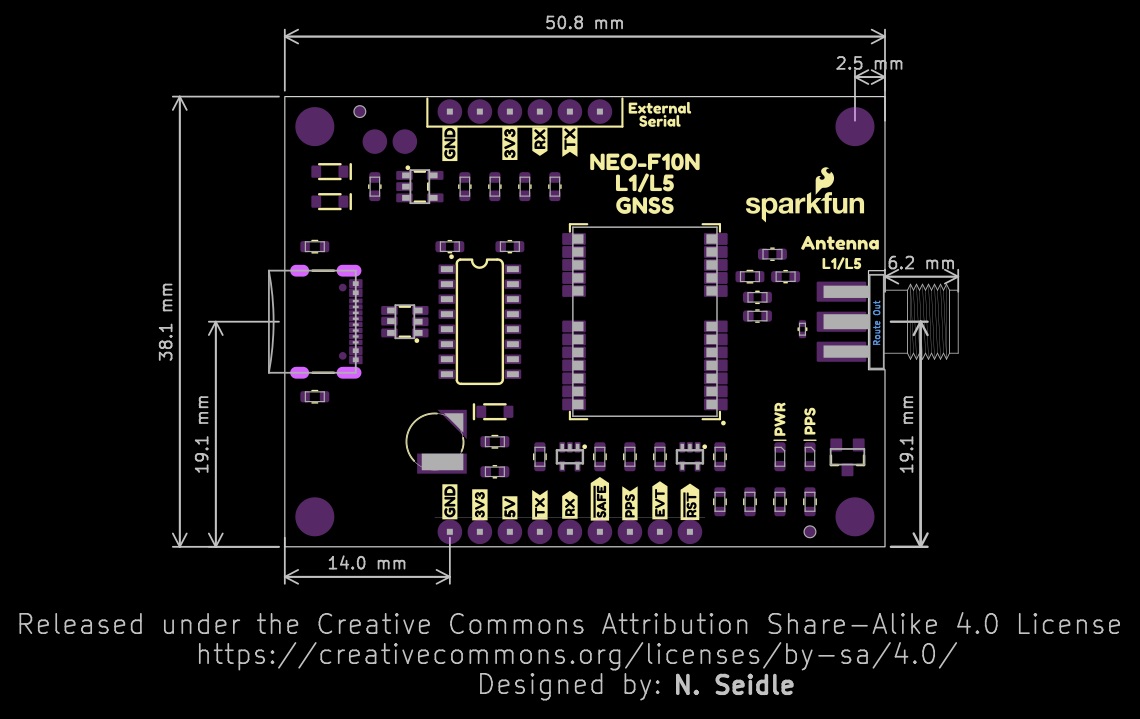
What's different from other u-blox modules is that the NEO-F10N module only supports one serial UART communication port. We included a CH340 USB-to-serial converter to connect the board to a computer's USB port easily. For users connecting the board's serial UART pins to a microcontroller or radio, you will need to cut the USB-TX and USB-RX jumpers to avoid bus contention. Pins for power, serial, pulse per second, and control pins are broken out to 0.1"-spaced pins on the board's edge. We have also conveniently included a 1x6 header should you connect a BlueSMiRF v2 to transmit data wirelessly!
The breakout is also has an on-board rechargeable battery that provides power to the RTC on the NEO-F10N. This reduces the time-to-first fix from a cold start (~28s) to a hot start (2s). The battery will maintain RTC and GNSS orbit data without being connected to power for plenty of time. We have included an SMA connector for a secure connection.
U-blox-based GPS products are configurable using the popular but dense Windows program u-center. Plenty of different functions can be configured on the NEO-F10N: baud rates, update rates, spoofing detection, external interrupts, SBAS, etc. To get started, we've included a few basic UART examples with our SparkFun Arduino Library.
Features:
- 1x USB Type C Connector
- ESD Protection Diodes for USB Data Lines
- CH340C USB-to-Serial Converter
- Integrated SMA Connector
- Concurrent Reception of GPS, Galileo, and Beidou
- Receives L1/L5 Bands
- Voltage: 5V or 3.3V but all logic is 3.3V
- Current: 21mA-26mA (varies with constellations and tracking state)
- AP2112K 3.3V/600mA Voltage Regulator
- Backup Battery to Aid in Hot Starts
- Time to First Fix: 28s (cold), 2s (hot)
- Max Navigation Rate for Single GNSS Configuration (GPS): 20 Hz
- Positional Accuracy (GPS): 1.5m
- Time Pulse Accuracy: 30ns
- Operational Limits
- Max G: ≤ 4G
- Max Altitude: 80km (49.7 miles)
- Max Velocity: 500m/s (1118mph)
- Software Configurable
- Baud Rate (38400 Baud, default)
- Odometer
- Spoof Detection
- External Interrupt
- Pin Control
- Many others!
- Supports: NMEA, UBX over UART
- LED
- Power
- Pulse Per Second (PPS)
- Jumpers
- USB Shield (SHLD)
- USB 5V (USB-5V)
- Measure (MEAS)
- USB Transmit (USB-TX)
- USB Receive (USB-RX)
- External 3.3V (EXT-3V3)
- Power LED (PWR)
- PPS LED (PPS)
- Board Dimensions (not including SMA connector)
- 50.8mm x 38.1mm
- Weight: 9.75g
Documents:
SparkFun Resources
- Schematic
- KiCad Files
- Board Dimensions
- Hookup Guide
- Building a GPS System
- Arduino Library
- GitHub Hardware Repo
u-blox NEO-F10N Resources
- Product Summary
- Datasheet
- Integration Manual
- Interface Description
- White Paper: Modern GNSS/GPS signals: Moving from Single-Band to Dual-Band
- u-blox ECCN
Videos
Jargon buster
Plain-language definitions for the technical terms used above.
- AP2112K
- AP2112K is a small low-dropout (LDO) voltage regulator that supplies a stable fixed output (commonly 3.3V) from a higher input such as USB 5V. Its ratings matter for checking the acceptable input voltage range and the maximum current available to the powered electronics.
- baud
- Baud is the signalling rate of a serial connection, often used as the speed setting for UART communication. Matching the baud rate matters because both connected devices must use the same setting for readable data.
- breakout
- A breakout board carries a small or fine-pitched component and brings its connections out to standard, breadboard- and header-friendly pins. Describing a part as a breakout means it can be wired into a project without soldering directly to the component's tiny contacts.
- ESD protection
- ESD protection helps protect electronics from damage caused by static electricity discharges. It is useful on development boards because cables, sensors and modules are often plugged and unplugged during prototyping.
- Galileo
- Europe’s satellite navigation system. Galileo support can improve satellite availability and accuracy, especially when combined with GPS and other constellations.
- GNSS
- GNSS stands for Global Navigation Satellite System, an umbrella term for satellite positioning networks such as GPS, GLONASS, Galileo and BeiDou. Receivers use these satellites to determine position, and high-precision units can output a steady stream of serial position data.
- GPS
- The US satellite navigation system used by GNSS receivers to calculate position and time. Support for GPS is important because it is widely available and often used together with other constellations for more reliable positioning.
- L5
- A modern GNSS signal band used by several satellite systems for more accurate and robust positioning. Dual-band receivers that include L5 can often perform better than single-band receivers, especially for RTK and areas with reflected signals.
- LED
- A light-emitting diode (LED) is a small electronic component that emits light when current flows through it in the correct direction. Because it only conducts one way, its polarity matters, and a through-hole LED must be soldered the correct way around to light up.
- microcontroller
- A microcontroller is a small computer on a single chip that runs a stored program and controls connected inputs and outputs such as buttons, sensors, displays and communication interfaces. In a device built around one, it is the part that executes the code and coordinates the device's behaviour.
- RF
- RF means radio frequency, referring to signals used for wireless communication and other high-frequency electronics. A low-noise, stable power supply is important for RF circuits because power noise can affect signal quality and measurements.
- RTC
- A Real-Time Clock keeps track of time even when the main processor is asleep or powered down, usually with a small backup battery. It matters for data logging and tracking projects that need accurate timestamps.
- RX
- RX means receive, usually showing data being received by the board. An RX indicator LED can help with troubleshooting USB or serial communication.
- SBAS
- Satellite-Based Augmentation System, a set of regional services that broadcast correction information for GNSS receivers. SBAS can improve ordinary GPS-style positioning, although it is not the same as centimetre-level RTK correction.
- Shield
- An add-on board that plugs into a main controller board to give it extra features such as sensing, motor control or communication. Knowing a product supports shields helps you judge whether it can connect neatly into an existing maker-board setup.
- SMA
- SMA is a small threaded coaxial (RF) connector widely used to attach antennas and other radio-frequency cables. A device with SMA antenna ports needs antennas or pigtails with matching SMA connectors, or a suitable adapter, to connect to them.
- TX
- TX means transmit, usually showing data being sent from the board. A TX indicator LED can help you see when the board is communicating or uploading code.
- UART
- UART is a simple asynchronous serial interface that sends data over separate transmit and receive wires, usually labelled TX and RX, with both ends set to the same baud rate. It is a common way for microcontrollers and other serial devices to exchange data.
Find this product in
Brands
Sensors & Input
SparkFun NEO-F10N Breakout Schematic
Schematic · 209.4 KB · Click any page to view full size
NEO-F10N Datasheet
Datasheet · 863.3 KB · Click any page to view full size
NEO-F10N Product Summary
Product Brief · 109.7 KB · Click any page to view full size
NEO-F10N Integration Manual
User Guide · 3.8 MB · Click any page to view full size
F10 Interface Description
User Guide · 2.1 MB · Click any page to view full size
Dual-Band GNSS Signals White Paper
Document · 2.1 MB · Click any page to view full size
u-blox ECCN Document
Compliance · 27.8 KB · Click any page to view full size
Supplier page — sparkfun.com
Supplier Description · 832.5 KB · Click any page to view full size
Resources & Downloads
Guides, code examples, and more
Source Code
Open-source libraries, firmware & example projects for this product
Documentation and hardware files for the low cost SparkFun GNSS L1/L5 Breakout - NEO-F10N.
398e16d
3 months ago
· 41 commits
- .github Update mkdocs.yml 3 months ago
- docs Update introduction.md about 1 year ago
- Hardware Update 3D Model with KiCad Library almost 2 years ago
- overrides Push Initial Tutorial to GitHub Pages and Update Revised u-blox Documents over 2 years ago
- .gitattributes Initial commit almost 3 years ago
- .gitignore Update .gitignore almost 3 years ago
- LICENSE.md Initial commit almost 3 years ago
- mkdocs.yml Update mkdocs.yml 3 months ago
- README.md Update README.md almost 2 years ago
An Arduino library which allows you to communicate seamlessly with u-blox GNSS modules using the Configuration Interface
7610634
3 months ago
· 314 commits
- .github Update compile-sketch.yml 11 months ago
- examples Create Example1_Galileo_HAS.ino 3 months ago
- img Initial commit over 3 years ago
- keys v3.1.14 : Add keys from u-blox-X20-HPG-2.10 3 months ago
- src Add getPositionAccuracyPOSECEF helper method 3 months ago
- Utils UBX_Integrity_Checker improvements: over 1 year ago
- .gitattributes Initial commit over 3 years ago
- .gitignore Initial commit over 3 years ago
- Adding_New_Messages.md Update Adding_New_Messages.md over 3 years ago
- CONTRIBUTING.md Markdown updates over 3 years ago
- ISSUE_TEMPLATE.md Initial commit over 3 years ago
- keywords.txt Add getPositionAccuracyPOSECEF helper method 3 months ago
- library.properties v3.1.14 : Add keys from u-blox-X20-HPG-2.10 3 months ago
- LICENSE.md Initial commit over 3 years ago
- README.md Update README.md 9 months ago