SparkFun
SparkFun DataLogger IoT
The SparkFun DataLogger IoT is a data logger that comes preprogrammed to automatically log GPS and various pressure, humidity, and distance sensors. All with...
Get notified when back in stock
- Any u-Blox GNSS Modules (Lat/Long, Altitude, Velocity, SIV, Time, Date) such as:
- Distance:
- Pressure, Altitude, Humidity, and Temperature Data:
- BME280 Atmospheric
- LPS25HB Absolute Pressure
- MPR Series - MPRLS0025PA00001A MicroPressure
- MS8607 Pressure, Humidity, and Temperature
- MS5637 Barometric Pressure and Temperature
- AHT20 Humidity and Temperature
- SHTC3 Humidity and Temperature
- SDP31 Differential Pressure
- BMP384 Pressure and Temperature
- BMP581 Pressure and Temperature
- Air Quality and Environmental Sensors:
- CCS811 Air Quality (CO2 and VOC)
- SGP30 Air Quality (TVOC, CO2, H2, Ethanol)
- SGP40 Air Quality (VOC, Humidity, Temperature)
- SCD30 CO2, Humidity, and Temperature
- SCD40 CO2, Humidity, and Temperature
- BME680 Air Quality (Pressure, Humidity, Temperature, Gas, VOCs)
- BME688 Air Quality (Pressure, Humidity, Temperature, Gas, VOCs, VSC, CO, Gas)
- FS3000 Air Velocity
- SEN54 Environmental Sensor Node (Particle, VOC, Humidity, and Temperature)
- STC31 CO2 and Temperature sensor
- VEML6075 UV
- VEML7700 Ambient Light and Lux
- Temperature:
- AMG8833 Grid-EYE Infrared Array
- MCP9600 Thermocouple Amplifier
- PT100 ADS122C04 PR Temperature
- TMP117 High Precision Temperature
- Power:
- Real-Time Clock:
- RV8803 RTC Module
- NFC/RFID:
- ST25DVxxKC Dynamic NFC/RFID Tag
- Biometric Sensors:
- Weight:
- NAU7802 Qwiic Scale Load Cell Amplifier
- Miscellaneous:
- Qwiic Button
- Qwiic Twist RGB Rotary Encoder
- Analog Voltage:
- MQTT Client
- MQTT Secure Client
- AWS IoT
- ThingSpeak MQTT
- Azure IoT
- HTTP IoT
- MachineChat
- ESP32-WROOM-32E Module
- Integrated 802.11b/g/n WiFi 2.4GHz transceiver
- Configurable via CH340C
- Operating voltage range
- 3.3V to 6.0V (via VIN)
- 5V with USB (via 5V or USB type C)
- 3.6V to 4.2V with LiPo battery (via BATT or 2-pin JST)
- Built-in MCP73831 single cell LiPo charger
- Minimum 500mA charge rate
- 3.3V (via 3V3)
- MAX17048 LiPo Fuel Gauge
- Ports
- 1x USB type C
- 1x JST style connector for LiPo battery
- 2x Qwiic enabled I2C
- 1x microSD socket
- Support for 4-bit SDIO and microSD cards formatted to FAT32
- LEDs
- Charge (CHG)
- Status (STAT)
- 1-Wire B3DQ3BRG Addressable RGB
- Jumpers
- Measure
- RGB LED
- Status LED
- Charge LED
- I2C pull-up resistors
- USB Shield
- Buttons
- Reset
- Boot
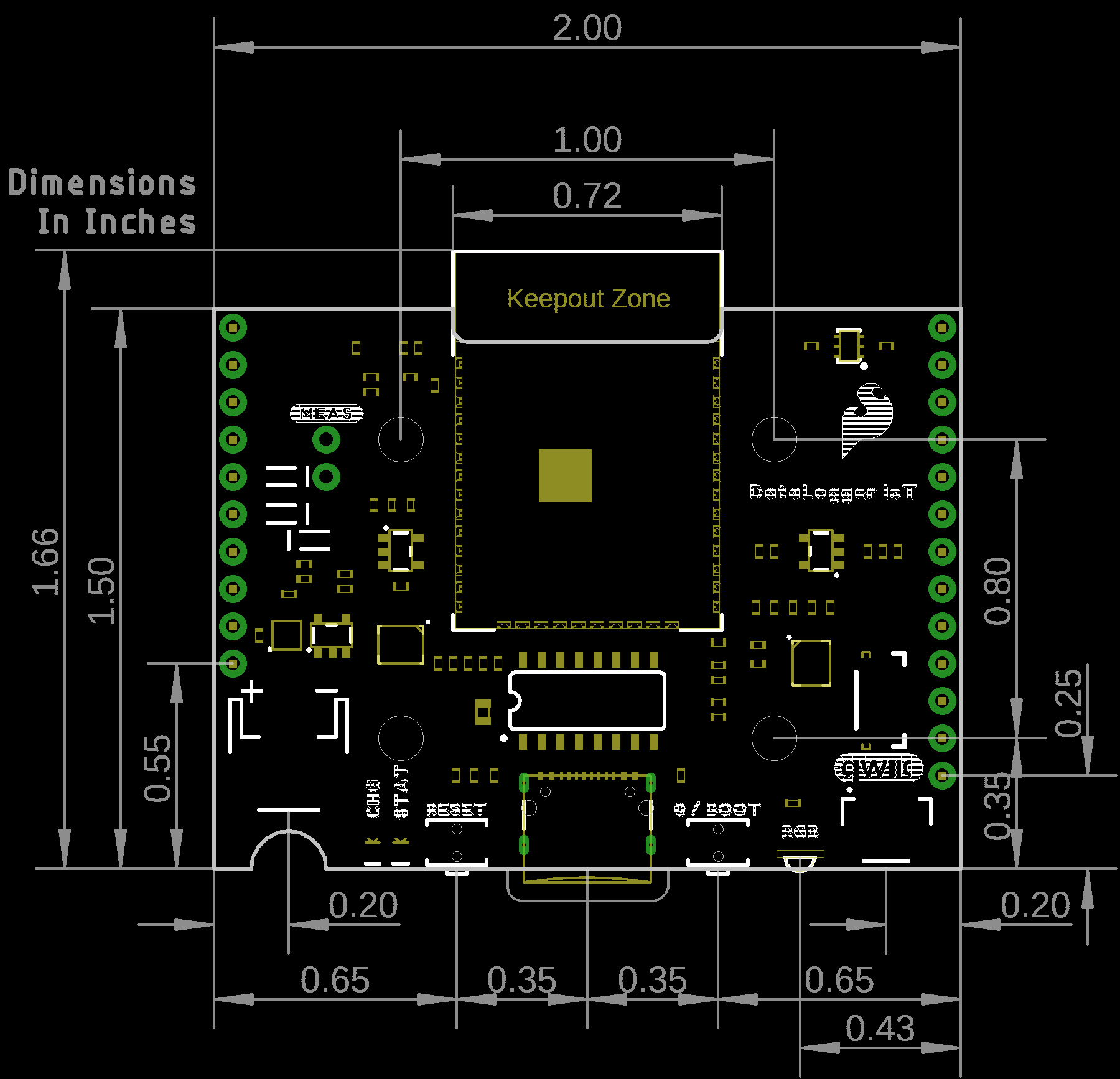
- Dimensions: 1.66in. x 2.00in.
- Weight: 10.65g
Jargon buster
Plain-language definitions for the technical terms used above.
- 1-Wire
- 1-Wire is a communication method where devices share a single data line, often with each device having its own address. It matters because several temperature modules can be connected to one microcontroller pin instead of needing a separate pin for each probe.
- 2.4GHz WiFi
- 2.4GHz WiFi is a common wireless networking band used by many routers and embedded devices, offering good range but more congestion than the 5GHz band. Devices on this band can join networks to transfer data or receive firmware updates.
- ADC
- An analogue-to-digital converter reads a changing voltage and turns it into a number the microcontroller can use. It matters when connecting analogue sensors such as light, sound, or variable-resistor sensors.
- baud
- Baud is the signalling rate of a serial connection, often used as the speed setting for UART communication. Matching the baud rate matters because both connected devices must use the same setting for readable data.
- encoder
- An encoder is a sensor that converts the rotation or position of a shaft, knob or dial into electrical signals, reporting movement as incremental steps and direction, or as an absolute position. It is used to track how far something has turned, which matters for precise positioning, speed control, repeatable movement, or using a rotary knob as an input.
- ESP32
- ESP32 is a family of low-cost microcontroller chips and modules from Espressif with built-in WiFi and Bluetooth. They support programmable firmware and over-the-air updates, and are commonly programmed with toolchains such as the Arduino core and ESP-IDF.
- GNSS
- GNSS stands for Global Navigation Satellite System, an umbrella term for satellite positioning networks such as GPS, GLONASS, Galileo and BeiDou. Receivers use these satellites to determine position, and high-precision units can output a steady stream of serial position data.
- GPS
- The US satellite navigation system used by GNSS receivers to calculate position and time. Support for GPS is important because it is widely available and often used together with other constellations for more reliable positioning.
- I2C
- I2C is a two-wire communication bus used by many sensors and small modules. It matters because several I2C devices can share the same two wires, but each device needs a compatible address and your controller must support I2C.
- IMU
- An IMU (Inertial Measurement Unit) combines motion sensors, typically an accelerometer and gyroscope and sometimes a magnetometer, to measure movement and orientation. It can sense motion, tilt, vibration, rotation, and changes in direction, which is useful for tasks such as navigation, stabilisation, gesture detection, and asset tracking.
- IoT
- Short for Internet of Things, meaning physical devices that connect to networks or the internet to send data or be controlled remotely. It matters if you want projects such as connected sensors, remote controls or classroom data-logging activities.
- LED
- A light-emitting diode (LED) is a small electronic component that emits light when current flows through it in the correct direction. Because it only conducts one way, its polarity matters, and a through-hole LED must be soldered the correct way around to light up.
- LiPo
- A LiPo (lithium polymer) battery is a rechargeable lithium battery widely used in portable projects because it is light and compact. LiPo cells need correct charging circuitry and careful handling to stay safe, so equipment that supports LiPo generally includes charging or protection hardware suited to that battery type.
- lux
- Lux is the standard unit for measuring how much light falls on a surface, similar to how a light meter reports brightness. A sensor that outputs lux gives readings that are easier to compare between rooms, outdoor conditions, and different projects.
- MAX17048
- A battery fuel-gauge chip that estimates how much charge is left in a LiPo battery. It matters for portable projects because your software can monitor battery level instead of only measuring voltage.
- MCP73831
- A lithium battery charger chip used to safely charge a single-cell LiPo battery. It matters because it lets the board recharge a battery from USB or another input without needing a separate charger module.
- microSD card
- A microSD card is a small removable flash memory card used to store data such as audio, images, logs or program files. Its capacity and formatting (often FAT32 or exFAT) affect how much can be stored and whether the card needs preparing before use.
- MQTT
- A lightweight messaging protocol often used for IoT devices to publish and receive data through a server called a broker. It matters for home automation and sensor networks because it is simple, efficient, and widely supported.
- PCB
- A printed circuit board (PCB) is a board, usually rigid, with etched copper tracks that connect electronic components together without loose wiring. Components are mounted on the board and signals route between them through the copper layout.
- Qwiic
- Qwiic is a plug-in connector system for I2C devices that uses small 4-pin cables, so you can connect compatible sensors without soldering. It matters because your controller or adapter also needs Qwiic, or you will need a cable or breakout to wire it up.
- RGB
- Short for red, green and blue, the three primary colours of light that are mixed in varying amounts to make a wide range of colours. In electronics RGB can refer to an LED or pixel that blends these three colours, or to a colour signal or interface that carries separate red, green and blue channels.
- RTC
- A Real-Time Clock keeps track of time even when the main processor is asleep or powered down, usually with a small backup battery. It matters for data logging and tracking projects that need accurate timestamps.
- Shield
- An add-on board that plugs into a main controller board to give it extra features such as sensing, motor control or communication. Knowing a product supports shields helps you judge whether it can connect neatly into an existing maker-board setup.
- Thermocouple
- A temperature sensor made from two different metals that produces a very small voltage depending on temperature. Because the signal is tiny, it usually needs careful amplification and accurate measurement hardware.
- USB-C
- USB-C is a small, reversible USB connector that can carry power, data and, on some devices, video over a single cable. The same connector can range from charging only to high-speed data, so the functions a given port actually supports vary.
- VOC
- Volatile organic compounds are gases released from things like paints, cleaners, smoke, and some plastics. A VOC reading helps indicate indoor air quality, but it is usually an index or estimate rather than a direct identification of each chemical.
Find this product in
Connectivity
Sensors & Input
Supplier page — sparkfun.com
Supplier Description · 1.9 MB · Click any page to view full size
Source Code
Open-source libraries, firmware & example projects for this product
This repo houses all of the SFE Fritzing parts for use in diagrams in tutorials. If you create a new part in Fritzing that correlates to an SFE part, please add it here so others may use it and to avoid duplication.
71b17bb
about 2 years ago
· 339 commits
- kits Include SparkFun Inventor's Kit V4.1 almost 3 years ago
- parts Add Horizontal and Vertical Qwiic Connector and Cable to Breadboard Half (Top View) over 6 years ago
- products Update 13664_sfe_samd21_mini_breakout.fzpz about 2 years ago
- templates Renamed over 11 years ago
- License.md Create License.md over 7 years ago
- README.md Update README.md over 7 years ago
- SparkFun Plus.fzbz First Pass on SparkFun Plus bin file almost 7 years ago
- SparkFun_Plus.png Adding png for fzbz use almost 7 years ago
Documentation and firmware for the SparkFun DataLogger IoT line of products.
7c557d9
5 months ago
· 311 commits
- .github cleaning up secrets for docs 7 months ago
- docs okay, this? 5 months ago
- firmware putting v1.5.0 firmware file in place for ota updates 7 months ago
- overrides cleaning up print page 9 months ago
- .gitignore Skip the build files 7 months ago
- README.md 1.5 release 7 months ago
An ESP32-based logger. The microSD interface is full 4-bit SDIO for fast logging.
7e94fd8
about 3 years ago
· 23 commits
- Examples Restructure HW Tests about 3 years ago
- Hardware Update VREG about 3 years ago
- Production Update for v11 PCB over 3 years ago
- .gitattributes Initial commit over 3 years ago
- .gitignore Initial commit over 3 years ago
- CONTRIBUTING.md Initial commit over 3 years ago
- ISSUE_TEMPLATE.md Initial commit over 3 years ago
- LICENSE.md Initial commit over 3 years ago
- README.md Update README.md about 3 years ago