

DFRobot
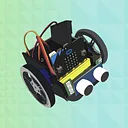
micro:Maqueen Plus V2 (Ni-MH) with Mechanic and micro:bit V2
·
This DFRobot bundle brings together the micro:Maqueen Plus V2 AA robot platform, the micro:Maqueen Mechanic kit and a micro:bit V2 board, giving students a r...
Get notified when back in stock
This DFRobot bundle brings together the micro:Maqueen Plus V2 AA robot platform, the micro:Maqueen Mechanic kit and a micro:bit V2 board, giving students a ready-to-build STEM robot set for classroom projects, after-school activities and robot competitions. Batteries are not included.
Maqueen Plus V2 is an updated STEAM educational robot with a larger body, more expansion ports and a larger capacity power supply design. It is made to work with peripheral components such as the HuskyLens AI camera and Maqueen Mechanic Kits, while remaining approachable for beginners.
The robot includes line tracking, ultrasonic sensing, IR reception, lights, a buzzer and motor drive hardware, and the pack also includes a Type-C & Micro 2-in-1 USB cable. Programming is supported through Mind+ and MakeCode, with the MakeCode library address listed in the specifications below.
Features:
- Two versions to choose from: 4 AA battery and 18650 battery
- New plastic box with a deeper base, enough room for the assembled car
- Frosted acrylic protective plate at the bottom, more durable and reliable
- The number of Line-tracking sensors has changed from 6 to 5, more convenient to program and optimize line-tracking codes
- Employs the motors whose parameters are the same as previous Maqueen, running steadily and smoothly
- Changes ultrasonic sensor to SR04, easier to install
- Add 4 RGB ambient lights at the base, RGB car lights have been changed to LEDs
- Delete the less usable magnetic encoder
- No complex assembly, get started in minutes
- More IO expansion ports: 3.3V IOx7, 5V IOx3, I2Cx3
- 5 line-tracking sensors, reliable and flexible
- Larger body, more flexible expansion methods
- Two versions to choose from: AA battery and 18650 battery
- AA battery version supports 1.2V Ni MH battery or 1.5V alkaline battery, while 18650 battery version supports 3.7V 18650 battery
- Works well with HuskyLens AI camera
- Rich peripherals: IR receiver, LED car lights, RGB ambient lights, buzzer, ultrasonic sensor, etc.
- Frosted acrylic protective plate at the bottom
- Storage box with a deeper base to provide enough room for the assembled Maqueen Plus car
Specifications:
- Power Supply: 1.5V AA alkaline battery x 4 or 1.2V AA Ni-MH battery x 4
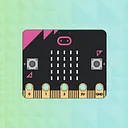
- Support: micro: bit V1 and V2
- N20 All-metal Gear Motor: x 2
- Buzzer: x 1
- 5V IO: (P0 P1 P2) x 3
- 3.3V IO: (P0 P1 P2 P8 P12 P13 P14 P15)
- 3.3V I2C: x 2
- 5V I2C: x 1
- Large Size LED Car Lights: x 2
- RGB Ambient Lights: x 4
- Line-tracking Sensor: x 5
- Line-tracking Sensor with One-key Calibration:
- IR Receiver: x 1
- SRO4 Ultrasonic Module: x 1
- Dimension: 136mm×65mm/5.35×2.56"
- Programming Platform: Mind+, MakeCode
- Wiki Address:
- MakeCode Library Address: https://github.com/DFRobot/pxt-DFRobot_MaqueenPlus_v20
Use it for STEM education, line-following challenges, mechanism builds and introductory coding lessons with micro:bit.
Jargon buster
Plain-language definitions for the technical terms used above.
- encoder
- An encoder is a sensor that converts the rotation or position of a shaft, knob or dial into electrical signals, reporting movement as incremental steps and direction, or as an absolute position. It is used to track how far something has turned, which matters for precise positioning, speed control, repeatable movement, or using a rotary knob as an input.
- I2C
- I2C is a two-wire communication bus used by many sensors and small modules. It matters because several I2C devices can share the same two wires, but each device needs a compatible address and your controller must support I2C.
- LED
- A light-emitting diode (LED) is a small electronic component that emits light when current flows through it in the correct direction. Because it only conducts one way, its polarity matters, and a through-hole LED must be soldered the correct way around to light up.
- line-tracking sensor
- A line-tracking sensor detects contrast between a dark line and a lighter surface, usually using infrared light. It matters for robot activities where the robot follows a track, such as classroom challenges or competitions.
- Ni-MH battery
- A Ni-MH battery is a rechargeable nickel-metal hydride cell, available in standard sizes such as AA and AAA and often used in place of disposable alkaline cells. Each cell supplies about 1.2 volts rather than the roughly 1.5 volts of an alkaline, so it is worth checking that a device tolerates this slightly lower voltage before relying on Ni-MH cells.
- RGB
- Short for red, green and blue, the three primary colours of light that are mixed in varying amounts to make a wide range of colours. In electronics RGB can refer to an LED or pixel that blends these three colours, or to a colour signal or interface that carries separate red, green and blue channels.
- Type-C
- USB Type-C (USB-C) is a small, reversible USB connector used for charging, power, and data transfer on many modern devices. A Type-C port or plug indicates the cable and charger connection needed to power, charge, or communicate with a device.
- Ultrasonic module
- An ultrasonic module measures distance by sending out high-frequency sound pulses and timing their echo. It is commonly used for obstacle detection and simple range-finding projects, but it needs a clear path to the target.
- ultrasonic sensing
- Ultrasonic sensing uses high-frequency sound waves to estimate distance to nearby objects. For a robot kit, this helps with obstacle avoidance and simple navigation activities.
Find this product in
Robotics & Motion
STEM & Education
Supplier page — dfrobot.com
Supplier Description · 148.8 KB · Click any page to view full size
Related Tutorials
Free step-by-step guides
Featured in buying guides
Comparison guides this product appears in

