DFRobot
DF15RSMG 360 Degree Motor (20kg)
$31.50
|
Out of stock
This is the most powerful standard servo sized motor from DFRobot so far. The DF15RSMG equips with two pairs of the servo shells. One is a stardard shell wi...
Get notified when back in stock
Estimated Delivery
Arrives
Disclaimer
Secure checkout
This is the most powerful standard servo sized motor from DFRobot so far. The DF15RSMG equips with two pairs of the servo shells. One is a stardard shell with four M4 mounting holes. And the other one includes a shell with double bearing which is specially designed for the application of the robot arm or the joints.The shells of this kit are thickened to make it stable enough for motion system.
The torque of this motor is about 19kg.cm at 7.4v power supply.Using the Arduino servo library, you could drive this servo motor easily.To reduce the consumption of your microcontroller, this servo has a lock function for the pulse detection. So driving it to a target position just requires one PPM controlling signal. NOTE: This Servo Motor is not a servo which allows you control position, but it is actually a motor with servo appearance. You could use servo.h to make adjust its speed and rotation direction. For more, you could find it in Comment below.
Cable definition
- Brown - GND
- Red - VCC
- Orange - Signal(PPM input wire)
SPECIFICATIONS
Mechanical specification
- Rotation angle range: 360°
- No-load speed:60°/0.16s @7.4v
- Stall torque:19.3kg.cm (7.4v)
- Dynamic torque:15.1kg.cm (7.4v)
- Gear:steel,copper mixed gear
- Assembly method:fastening with double layer 4 screws
- Equip 2 pairs of shells,2 metal servo horns and 2 servo support
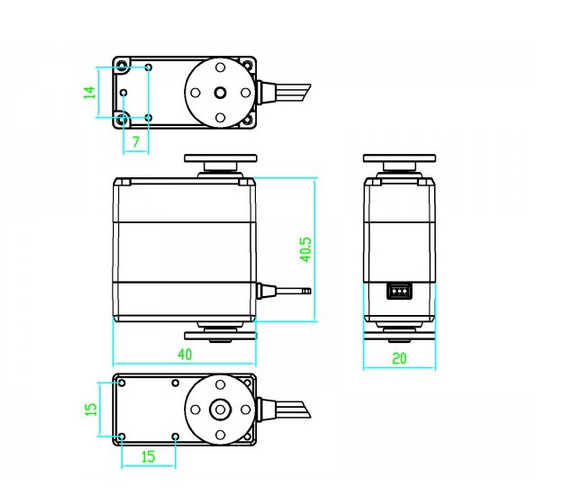
- Size: 40x40x20mm (1.57x1.57x0.79")
Electrical specification
- Working Voltage: 5-7.4v
- Stall current:3A(@8.5V - Limit test)
- PPM Voltage:3V-5V
- PPM Resolution:2us
- PWM driver frequency:4KHZ
- Range of PPM positive pulse width:400us-2550us
- Minimum value of PPM negative pulse width:400us
DOCUMENTS
SHIPPING LIST
- DF15RSMG Servo x1
- Servo Shell x2
- Fitting package x1
Jargon buster
Plain-language definitions for the technical terms used above.
- GND
- GND is the ground or reference connection (0 V) for a circuit. When connecting two devices together, their grounds must be joined so both agree on what counts as a low or high signal.
- microcontroller
- A microcontroller is a small computer on a single chip that runs a stored program and controls connected inputs and outputs such as buttons, sensors, displays and communication interfaces. In a device built around one, it is the part that executes the code and coordinates the device's behaviour.
- ppm
- ppm means parts per million, a common way to express very small gas concentrations in air. For CO₂ sensors, the ppm range tells you what levels the sensor can measure, such as normal indoor air through to poorly ventilated spaces.
- PWM
- Pulse Width Modulation is a way for a digital pin to simulate variable output power by switching on and off very quickly. It matters for controlling things like LED brightness, motor speed, or servo-style signals from a microcontroller pin.
- servo
- A servo is a motor with built-in position control, usually told to move to a specific angle by a control signal. It matters when you need repeatable movement, such as steering, arms, flaps, or linkages, rather than continuous spinning.
- servo motor
- A motor module that moves to a commanded angle rather than simply spinning freely. It matters for robotics and mechanisms because it is useful for steering, arms, gates and other parts that need controlled position.
- Stall torque
- The maximum twisting force a servo can produce when its output is held still and cannot move. It helps you judge whether the servo is strong enough for a robot joint, steering linkage, or other load.
- Torque
- A twisting force that causes something to rotate, usually measured in newton-metres or kilogram-centimetres. It matters when choosing motors, servos, gears, and tools because higher torque is needed to lift heavier loads, turn larger wheels, or move mechanisms without stalling.
- VCC
- VCC is the positive power-supply connection on a chip or module. Connecting it to the correct supply voltage is needed for the part to power on and helps avoid damaging the electronics.
Find this product in
Robotics & Motion
Supplier page — dfrobot.com
Supplier Description · 386.2 KB · Click any page to view full size
Related Tutorials
Free step-by-step guides