Adafruit
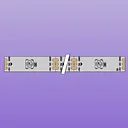
40-pin 0.5mm pitch FPC Flex Cable with A-B Connections - 25cm long
·
A 25cm flexible flat cable (FFC) with 40 pins at 0.5mm pitch and Type A-B connections (contacts on opposite sides at each end). Designed for use with 40-pin ...
Get notified when back in stock
A 25cm flexible flat cable (FFC) with 40 pins at 0.5mm pitch and Type A-B connections (contacts on opposite sides at each end). Designed for use with 40-pin FPC-to-IDC adapter PCBs to extend Raspberry Pi GPIO connections or other 40-pin ribbon cable applications.
Pair this cable with compatible FPC-to-2×20 IDC adapter boards to route your Raspberry Pi's GPIO header through a flexible, low-profile cable. The cable can also be extended further using a 40-pin FPC extender.
Key Features
- 40-Pin, 0.5mm Pitch – Standard FPC/FFC sizing
- Type A-B Connections – Contacts on opposite sides at each end
- 25cm Length – Flexible routing between boards and enclosures
Specifications
- Pin Count – 40
- Pitch – 0.5mm
- Cable Type – A-B (contacts on opposite sides)
- Length – 25cm
Compatible Adapter Types
- 40-pin FPC to straight 2×20 IDC male plug header
- 40-pin FPC to right-angle 2×20 IDC male plug header
- 40-pin FPC to straight 2×20 IDC female socket header
- 40-pin FPC to right-angle 2×20 IDC female socket header
Ideal For
- Extending Raspberry Pi GPIO connections
- Low-profile cable routing between boards
- Enclosure builds requiring flexible connections
Package Contents
- 1× 40-pin 0.5mm FPC Flex Cable (A-B, 25cm)
Jargon buster
Plain-language definitions for the technical terms used above.
- FPC
- FPC stands for flexible printed circuit, a thin flat flexible cable or connector style often used where space is tight or some movement is needed, commonly for displays, cameras and other high-density connections. Connecting to an FPC connector generally needs a matching cable with the correct pin count, pitch and contact orientation.
- GPIO
- General-purpose input/output pins are microcontroller pins you can set in software to read signals, switch devices on and off, or connect to peripherals. The number of GPIO pins matters because it limits how many buttons, LEDs, sensors, and other parts you can wire directly to the board.
Find this product in
Related Tutorials
Free step-by-step guides