Store

Title The Maker's Guide to ADCs: Resolution, Speed, and Interface Compared

Compare analogue-to-digital converters by bit depth, sample rate, and bus (I²C vs SPI) to pick the right chip for your Arduino, Raspberry Pi, or microcontroller project.

MS By Marcus Schappi, Co-founder, Little Bird Electronics
· Updated · 10 min read · Compares 16 products Markdown

External analogue-to-digital converters, or ADCs, are one of the easiest ways to improve sensor reading quality in an Arduino, Raspberry Pi or other microcontroller project. They let you add more analogue inputs, increase resolution beyond what your board offers on-board, or handle specialised jobs such as reading load cells and other very small differential signals.

In this guide, we compare popular ADC breakout boards by the specs that matter most to makers: bit depth, channel count, interface, and intended use. We also cover when I2C is the simpler choice, when SPI or other interfaces make more sense, and which boards are better suited to general sensing versus precision measurement. For AU makers, these breakout-style modules are also practical because they are easy to prototype, breadboard and integrate without long lead times.

Quick comparison snapshot:

  • For general-purpose projects: ADS1115 and ADS1015 are the most straightforward picks.
  • For lots of analogue inputs: ADS7830 gives you 8 channels over I2C.
  • For precision differential measurement: MCP3421, MCP3424 and ADS122C04 focus on higher resolution.
  • For load cells and strain gauges: HX711 and NAU7802 are purpose-built options.
  • For PC-connected workflows: MCP2221A is different again, acting as a USB bridge with built-in ADC inputs.

Our picks

Side-by-side comparison

ADS7830 8-Channel 8-Bit I2C ADC Breakout MCP3421 18-Bit ADC Breakout - STEMMA QT / Qwiic Adafruit MCP2221A Breakout - General Purpose USB to GPIO ADC I2C - Stemma QT / Qwiic Adafruit NAU7802 24-Bit ADC - STEMMA QT / Qwiic Adafruit HX711 24-bit ADC for Load Cells / Strain Gauges MCP3424 18-Bit ADC-4 Channel with Programmable Gain Amplifier
  ADS7830 8-Channel 8-Bit I2C ADC Breakout — Adafruit — ADC Breakout Board | Little Bird Electronics MCP3421 18-Bit ADC Breakout - STEMMA QT / Qwiic — Adafruit — ADC Breakout Board | Little Bird Electronics Adafruit MCP2221A Breakout - General Purpose USB to GPIO ADC I2C - Stemma QT / Qwiic — Adafruit — physical | Little Bird Electronics Adafruit NAU7802 24-Bit ADC - STEMMA QT / Qwiic — Adafruit — physical | Little Bird Electronics Adafruit HX711 24-bit ADC for Load Cells / Strain Gauges — Adafruit — physical | Little Bird Electronics MCP3424 18-Bit ADC-4 Channel with Programmable Gain Amplifier — DFRobot — physical | Little Bird Electronics
Best for Best for many analogue inputs Best for single-channel precision Best for USB-connected projects Best load-cell ADC over I2C Best for load cells Best for multi-channel precision over I2C
Price $14.20 $14.20 $12.68 $12.30 $19.28 $20.34
Device type General-purpose ADC breakout Precision differential ADC breakout USB bridge with ADC inputs Load-cell / bridge-sensor ADC breakout Load-cell / bridge-sensor ADC breakout Precision ADC breakout
Resolution 8-bit 18-bit 10-bit 24-bit 24-bit 18-bit
Channels 8 1 2 4
Interface I2C I2C USB, I2C / STEMMA QT, Analog, GPIO I2C / STEMMA QT SPI I2C / STEMMA QT / Qwiic
Operating voltage 2.7V to 5.25V 3.3V / 5V 3.3V / 5V
  View product → View product → View product → View product → View product → View product →

Showing the top 6 of 16. See every product compared in detail below.

Best for many analogue inputs

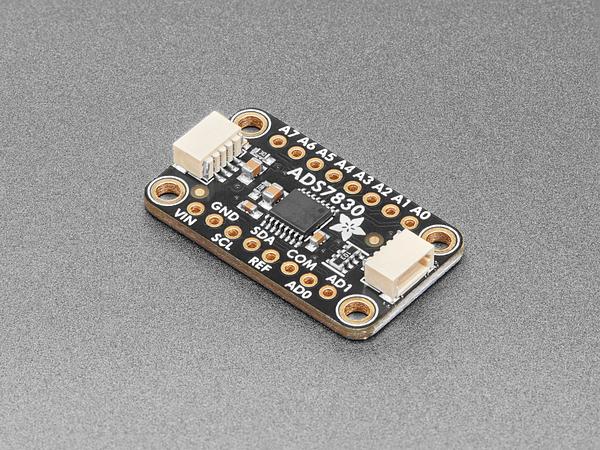
ADS7830 8-Channel 8-Bit I2C ADC Breakout

$14.20 Out of stock

The ADS7830 is aimed at projects where channel count matters more than fine resolution. With 8 analogue inputs over I2C, it is a practical way to add basic sensor reading to a Raspberry Pi or expand a microcontroller that has run out of ADC pins.

Its 8-bit resolution is the main trade-off, so it suits knobs, LDRs, flex sensors and other simple inputs better than precision measurement. If you need cleaner gradation or small-signal work, the 12-bit, 16-bit and higher-resolution options below are more suitable.

Device type
General-purpose ADC breakout
Resolution
8-bit
Channels
8
Interface
I2C
Operating voltage
2.7V to 5.25V

Pros

  • 8 analogue input channels on one board
  • Simple I2C connection
  • Useful for Raspberry Pi projects without built-in analogue input
  • STEMMA QT / Qwiic ecosystem support

Cons

  • 8-bit resolution is limited for precision sensing
  • Better suited to simple sensors than low-level measurement
Best for single-channel precision

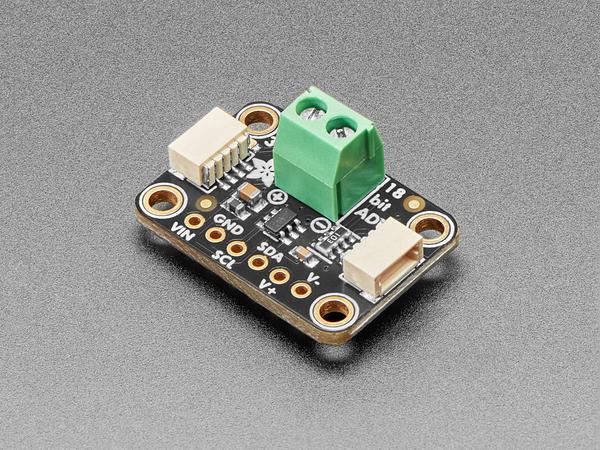
MCP3421 18-Bit ADC Breakout - STEMMA QT / Qwiic

$14.20 Available

The MCP3421 takes the opposite approach to multi-channel ADCs: it focuses on one high-resolution differential input instead of trying to do everything. That makes it a good fit for precision sensing where channel count is less important than extracting small changes cleanly.

Because it includes adjustable gain and a built-in precision reference voltage, it is more specialised than an ADS1015 or ADS1115. If you only need one channel and your signal is small, it is a more targeted option than a general-purpose ADC breakout.

Device type
Precision differential ADC breakout
Resolution
18-bit
Channels
1
Interface
I2C

Pros

  • 18-bit resolution for finer measurement
  • Differential input suits small signals
  • Built-in precision reference voltage
  • Adjustable gain
  • Easy I2C integration with STEMMA QT / Qwiic

Cons

  • Only 1 channel
  • Less versatile for multi-sensor projects
View product
Best for USB-connected projects

Adafruit MCP2221A Breakout - General Purpose USB to GPIO ADC I2C - Stemma QT / Qwiic

$12.68 In stock

The MCP2221A is not a normal external ADC breakout in the same mould as the others here. Its main role is bridging a computer to I2C and GPIO over USB, with built-in 10-bit ADC inputs as part of that broader feature set.

That makes it interesting for Python-on-PC workflows, lab setups or quick sensor experiments without a separate microcontroller. As a pure ADC choice, though, it is less direct than the dedicated converter boards in this comparison.

Device type
USB bridge with ADC inputs
Resolution
10-bit
Interface
USB, I2C / STEMMA QT, Analog, GPIO
Operating voltage
3.3V / 5V

Pros

  • Works directly with a computer over USB
  • Includes built-in ADC capability
  • Also provides USB-to-I2C and GPIO functions
  • Breadboard-friendly and suitable for quick prototyping

Cons

  • Not a dedicated general-purpose ADC board
  • 10-bit ADC resolution is modest
View product
Best load-cell ADC over I2C

Adafruit NAU7802 24-Bit ADC - STEMMA QT / Qwiic

$12.30 Available

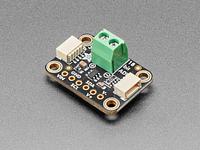
The NAU7802 is built specifically for strain gauges, load cells and Wheatstone bridge sensors, rather than being a general sensor ADC. Its 24-bit resolution, differential design and built-in gain and calibration features make it a strong match for scales and force-measurement projects.

Compared with a generic ADC, it is far better aligned to tiny bridge-sensor signals. If your project is weight or force measurement and you prefer I2C wiring, this is one of the most targeted options in the group.

Device type
Load-cell / bridge-sensor ADC breakout
Resolution
24-bit
Interface
I2C / STEMMA QT
Operating voltage
3.3V / 5V

Pros

  • Designed specifically for load cells and strain gauges
  • 24-bit resolution
  • Built-in gain amplification and calibration circuitry
  • I2C interface is simple to wire
  • Includes screw terminals for sensor connection

Cons

  • Not intended as a general-purpose multi-sensor ADC
  • Application is narrow compared with ADS1115-style boards
View product
Best for load cells

Adafruit HX711 24-bit ADC for Load Cells / Strain Gauges

$19.28 Available

The HX711 is one of the standard choices for load-cell and strain-gauge projects, and for good reason: it is built around that exact task. It offers 24-bit conversion, two channels, and gain settings tailored to the tiny signals you get from bridge-based sensors.

For scales and force sensors, it is usually a more logical choice than a general ADC breakout. Its main limitation is that it is specialised, so it is not the board you would pick for reading a mix of everyday analogue sensors.

Device type
Load-cell / bridge-sensor ADC breakout
Resolution
24-bit
Channels
2
Interface
SPI

Pros

  • Purpose-built for load cells and strain gauges
  • 24-bit resolution
  • Two channels available
  • Gain options suit very small bridge outputs
  • Breadboard-friendly breakout format

Cons

  • Specialised rather than general-purpose
  • Less suitable for ordinary analogue sensor expansion
View product
Best for multi-channel precision over I2C

MCP3424 18-Bit ADC-4 Channel with Programmable Gain Amplifier

$20.34 Available

The MCP3424 is a useful middle ground between single-channel precision converters and mainstream 4-channel ADC boards. It gives you 4 channels, 18-bit delta-sigma conversion and a programmable gain amplifier, which makes it appealing for slower but more detailed measurements.

If your project needs several precision channels over I2C, this is a stronger fit than an ADS1015. It is less of a plug-and-play generalist than the ADS1115, but more capable for weak-signal measurement.

Device type
Precision ADC breakout
Resolution
18-bit
Channels
4
Interface
I2C / STEMMA QT / Qwiic

Pros

  • 18-bit resolution
  • 4 channels
  • Programmable gain amplifier
  • I2C interface suits Arduino and Raspberry Pi
  • Good fit for weak-signal measurement

Cons

  • More specialised than common entry-level ADC boards
  • Not the obvious choice if simple sensor reading is the goal
View product
Best for faster general sensing

ADS1015 12-Bit ADC - 4 Channel with Programmable Gain Amplifier

$19.41 In stock

The ADS1015 is a straightforward general-purpose ADC for makers who want easy I2C wiring, four channels and faster updates than the ADS1115. Its 12-bit resolution is enough for many classroom and hobby projects, especially where responsiveness matters more than squeezing out extra detail.

At up to 3,300 samples per second, it is the better pick for quicker-changing analogue signals in this I2C family. The trade-off is lower resolution, so it is less attractive for fine measurement than the 16-bit ADS1115.

Device type
General-purpose ADC breakout
Resolution
12-bit
Channels
4
Interface
I2C / STEMMA QT
Operating voltage
3.3V / 5V

Pros

  • 4 channels with single-ended or differential options
  • Up to 3,300 samples per second
  • Programmable gain amplifier
  • Simple I2C wiring
  • STEMMA QT / Qwiic support

Cons

  • 12-bit resolution is lower than ADS1115
  • Less suitable for precision measurement
View product
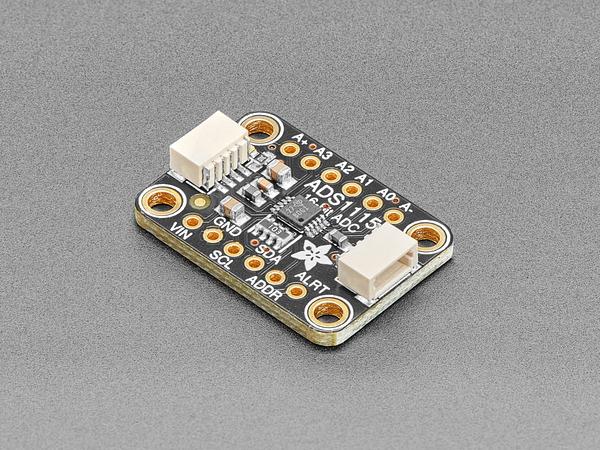
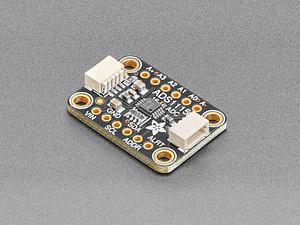
Best overall

ADS1115 16-Bit ADC - 4 Channel with Programmable Gain Amplifier

$31.31 Out of stock

The ADS1115 is the most balanced option here for everyday maker use. It gives you 16-bit resolution, four channels, differential measurement options and a programmable gain amplifier, all over a simple I2C connection that plays nicely with Arduino, Raspberry Pi and other boards.

It is not the fastest converter in the group, but for most sensor projects that is a worthwhile trade-off for the extra detail over a 12-bit part. If you are not sure where to start, this is the safest all-round choice.

Device type
General-purpose ADC breakout
Resolution
16-bit
Channels
4
Interface
I2C / STEMMA QT
Operating voltage
3.3V / 5V

Pros

  • 16-bit resolution suits a wide range of sensor projects
  • 4 channels with single-ended or differential modes
  • Programmable gain amplifier
  • Easy I2C integration
  • Well suited to Arduino, Raspberry Pi and general microcontrollers

Cons

  • Slower than ADS1015 at 860 samples per second
  • Costs more than entry-level ADC options
Best high-resolution general ADC

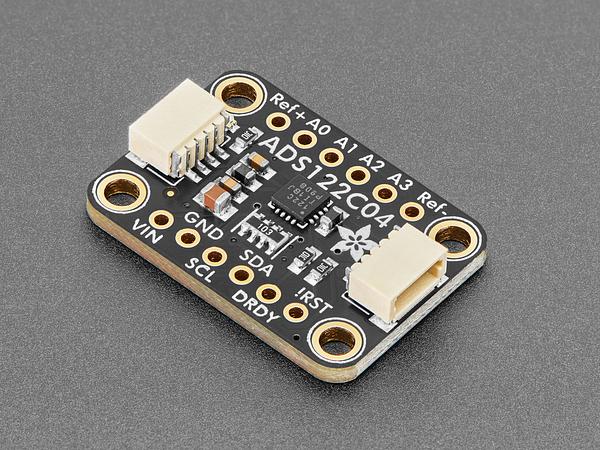
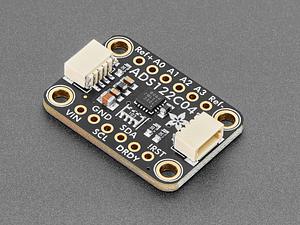
ADS122C04 24-Bit 4-Channel I2C ADC Breakout

$47.62 Out of stock

The ADS122C04 is a more advanced high-resolution option for makers who need more than a typical 16-bit I2C ADC can offer. It combines 24-bit conversion, 4 channels and data rates up to 2 kSPS, which makes it one of the more capable general ADC breakouts in this lineup.

It sits above boards like the ADS1115 in both capability and cost. For demanding low-level measurement, scientific logging or more instrument-style projects, it makes sense; for everyday sensor reading, it is often more board than you need.

Device type
High-resolution ADC breakout
Resolution
24-bit
Channels
4
Interface
I2C
Operating voltage
3.3V / 5V

Pros

  • 24-bit resolution
  • 4 channels
  • Up to 2 kSPS
  • Handles single-ended or differential signals
  • I2C connection keeps wiring simple

Cons

  • Higher cost than mainstream options
  • Overkill for many basic maker projects
Budget SPI ADC

10-bit ADC (SPI) - 4 Channel

$5.53 In stock

This 10-bit SPI ADC is a low-cost way to add analogue inputs to a Raspberry Pi or other board that lacks them. It suits straightforward sensor, potentiometer and control-voltage projects where speed and price matter more than high resolution. The SPI interface is quicker than typical I2C ADCs, but it does use more pins and needs a little more wiring.

Resolution
10-bit
Interface
SPI
Channels
4
Operating voltage
3.3V / 5V
Chip
MCP3008
Breadboard friendly
Yes

Pros

  • Inexpensive option for adding analogue inputs
  • SPI interface is well suited to faster sampling
  • Works with 3.3V and 5V systems
  • Breadboard-friendly for quick prototyping

Cons

  • 10-bit resolution is modest compared with 12-, 16- and 24-bit ADCs
  • SPI uses more microcontroller pins than I2C
View product
Best low-cost SPI option

10-bit ADC (SPI) - 8 Channel

$6.94 In stock

The MCP3008 is the familiar 8-channel, 10-bit SPI ADC many makers reach for when a Raspberry Pi or digital-only microcontroller needs analogue inputs. It is not the highest-resolution converter in this guide, but it gives you plenty of channels, a straightforward SPI interface, and a useful 200 ksps sample rate at 5V for general sensor and potentiometer work.

Resolution
10-bit
Interface
SPI
Channels
8 single-ended
Sample rate
200 ksps at 5V
Operating voltage
5V
Chip
MCP3008

Pros

  • 8 single-ended analogue input channels
  • SPI interface suits Raspberry Pi and microcontroller projects
  • 200 ksps sample rate at 5V
  • Breadboard-friendly for prototyping
  • Low-cost way to add analogue inputs

Cons

  • 10-bit resolution is modest compared with 12-bit, 16-bit, and 24-bit options
  • SPI uses more wiring than I2C modules
View product
Best Qwiic general sensing

SparkFun Qwiic 12 Bit ADC - 4 Channel (ADS1015)

$38.28 Available

The SparkFun Qwiic ADS1015 is a neat pick when you want to add four analogue inputs to a Qwiic-based project without much wiring fuss. Its 12-bit resolution is a practical step up for everyday sensors, and the programmable gain amplifier helps when you need to measure smaller signals more carefully. Compared with higher-resolution ADCs in this guide, it is more about convenient general sensing than precision lab-style measurement.

Resolution
12-bit
Interface
I2C / Qwiic
Channels
4
Input modes
Single-ended or differential
Operating voltage
3.3V
Gain
Programmable gain amplifier

Pros

  • Qwiic connector makes I2C wiring straightforward
  • Four analogue input channels
  • Supports single-ended or differential inputs
  • Programmable gain amplifier for small signal ranges
  • Breadboard-friendly for prototyping

Cons

  • 12-bit resolution is lower than 16-bit and 24-bit options
  • 3.3V operation may need level consideration in some 5V projects
View product
Best ADC/DAC combo

Adafruit PCF8591 Quad 8-bit ADC + 8-bit DAC - STEMMA QT / Qwiic

$13.15 Available

The Adafruit PCF8591 is a handy pick when you need a few simple analogue inputs and a basic analogue output on the same I2C breakout. Its 8-bit resolution is modest compared with the ADS1115 or MCP342x boards, but it keeps wiring easy with STEMMA QT/Qwiic and suits potentiometers, light sensors, and classroom experiments where convenience matters more than fine precision.

Resolution
8-bit
Interface
I2C / STEMMA QT
ADC Channels
4
DAC Channels
1
Ecosystem
QT Py / STEMMA QT

Pros

  • Four analogue input channels
  • Includes an 8-bit analogue output
  • Easy I2C connection via STEMMA QT/Qwiic
  • Good fit for basic sensor and teaching projects

Cons

  • Only 8-bit resolution
  • Not suited to precision measurement or fast sampling tasks
View product
Best for Gravity sensor projects

Gravity: I2C ADS1115 16-Bit ADC Module (Arduino Raspberry Pi Compatible)

$27.37 Available

This DFRobot ADS1115 module is a tidy fit when you want to add 16-bit analogue input to a Raspberry Pi, Arduino, or other I2C-capable board. In this comparison it sits close to the general ADS1115 breakouts, but the Gravity ecosystem angle makes it especially convenient for plugging in DFRobot analogue sensors without much wiring fuss.

Resolution
16-bit
Channels
4
Interface
I2C / STEMMA QT / Qwiic
Function
ADC
Compatibility
Arduino, Raspberry Pi
SKU
DF-DFR0553

Pros

  • 16-bit resolution for finer sensor readings
  • 4 analogue input channels
  • I2C interface keeps wiring simple
  • Handy match for Gravity analogue sensors
  • Suitable for Raspberry Pi projects that lack analogue inputs

Cons

  • Only 4 channels, so larger logging setups may need another ADC
  • I2C is not the pick for very high-speed sampling
View product

How we chose

We assessed these boards using the factors makers usually care about most in real projects rather than datasheet trivia alone. That means balancing resolution, speed, wiring complexity, channel count and how broadly useful each board is across common classroom, hobby and prototyping jobs.

  • Resolution: More bits can help with small-signal work, but only if the application actually benefits from it.
  • Channels: A single precision channel suits some instruments, while data logging and sensor arrays often need 4 or 8 inputs.
  • Interface: I2C is usually easier to wire and expand; SPI and specialised digital interfaces can be better for speed or dedicated sensor front ends.
  • Application fit: Some products here are general ADCs, while others are tuned for load cells, USB-connected measurement, or power monitoring.
  • Ease of use: Breadboard-friendly layouts, STEMMA QT / Qwiic support and compatibility with Arduino or Raspberry Pi matter for faster prototyping.
  • Value in context: We looked at what each board offers relative to its intended job, not just its price tag.

What is it & how does it work?

An ADC is a chip that converts an analogue voltage into a digital number your microcontroller or computer can read. If you are measuring something like a potentiometer, light sensor, thermistor or microphone signal, the sensor output is usually analogue. The ADC samples that voltage and reports it as a value based on its resolution, such as 10-bit, 12-bit, 16-bit or higher.

In practice, a higher-resolution ADC can show finer changes in signal level, while a faster ADC can capture changing signals more quickly. The interface also matters: I2C uses fewer wires and is very beginner-friendly, while SPI or other specialised digital links can be preferable for higher throughput or dedicated measurement tasks. An external ADC is often worth adding when your board has no analogue inputs at all, when its built-in ADC is too low-resolution, or when you need more channels or better differential measurement.

What to look at when comparing

If you are choosing between ADC boards, start with the actual signal you need to measure and work backwards. The right choice for a weight scale is very different from the right choice for reading a few knobs or logging several analogue sensors.

  • Resolution: 8-bit and 10-bit suit simple controls and rough measurements. 12-bit and 16-bit are better for general sensor work. 18-bit to 24-bit boards are more appropriate for small differential signals and precision measurement.
  • Sample rate: Faster converters are more useful for changing signals. Slower, high-resolution delta-sigma parts are often better for stable measurements.
  • Channel count: Think about how many sensors you need to read now and later. Extra channels can save redesigns.
  • Single-ended vs differential: Differential inputs are useful for tiny signals and noisy environments.
  • Gain and reference features: A programmable gain amplifier or built-in precision reference can make a big difference for low-level sensors.
  • Interface and pin use: I2C is simpler and suits many education and maker builds. SPI or dedicated load-cell interfaces can be a better fit for specialised jobs.
  • Voltage compatibility: Check supply and logic voltage against your board, especially when moving between 3.3V and 5V systems.
  • Platform fit: Raspberry Pi users often need an external ADC for any analogue sensing at all, while many Arduino boards already have some built-in analogue capability.

Which should I buy?

  • Choose ADS1115 if you want the safest all-rounder for general analogue sensor projects.
  • Choose ADS1015 if you want similar ease of use but care more about speed than extra resolution.
  • Choose ADS7830 if channel count matters more than precision.
  • Choose MCP3421 or MCP3424 for precision differential measurements over I2C.
  • Choose HX711 or NAU7802 for load cells and strain gauges.
  • Choose ADS122C04 if you want a more advanced high-resolution I2C option.
  • Choose MCP2221A if your measurement workflow starts from a computer over USB rather than a standalone MCU.

Alternatives to consider

If none of these boards quite fits, there are a few nearby categories worth considering. A microcontroller with a decent built-in ADC may be enough for basic potentiometers, LDRs and temperature sensors. For current, voltage and power measurement, a dedicated power monitor is often more useful than a general ADC. For magnetic field, motion or environmental sensing, a digital sensor breakout with its own onboard conversion can simplify wiring and software. And if you are working with audio or high-speed acquisition, a dedicated codec or faster data-acquisition hardware may be a better match than the slower precision ADCs covered here.

Bottom line

For most makers, the ADS1115 is the easiest recommendation because it balances useful 16-bit resolution, four channels, differential options and simple I2C wiring. If your priority is faster updates on a budget, the ADS1015 is a sensible step down; if you need many channels, look at the ADS7830; and if you are reading load cells, go straight to a dedicated board such as the HX711 or NAU7802. The more specialised high-resolution parts make sense once you know your signal is small enough, slow enough or demanding enough to justify them.

Share X / Twitter LinkedIn Email

Australian-owned

Sydney-based since 2011, local support.

Trusted by educators

Schools, TAFEs, and universities Australia-wide.

Fast Australian shipping

Dispatched from Sydney; next-day to most metros.

Marcus Schappi

Reviewed by

Marcus Schappi

Co-founder, Little Bird Electronics

Working with Australian makers, educators and engineers since 2011.

Maddy, co-founder of Little Bird

Need help? We're here for you!

Hi, I'm Maddy. My team and I are ready to help with your order or any questions.