SparkFun
SparkFun Triple Axis Accelerometer Breakout - KX134 (Qwiic)
This SparkFun Triple-Axis Accelerometer Breakout is a simple Qwiic breakout for the KX134 digital accelerometer from Kionix. The KX134 is a low-power, 16-bit...
Get notified when back in stock
This SparkFun Triple-Axis Accelerometer Breakout is a simple Qwiic breakout for the KX134 digital accelerometer from Kionix. The KX134 is a low-power, 16-bit resolution three-axis accelerometer capable of measuring ±8g/16g/32g/64g (user-selectable) and has up to a 10kHz output data rate making it ideal for high-g measurements as well as high-speed applications such as vibration sensing.
The KX134 includes a host of features including Freefall detection, Directional Tap™ and Double-Tap™ detection, tilt orientation detection and more. The Qwiic KX134 can interface with controllers using both I2C and SPI at high speeds so you can use it in an existing Qwiic chain or on a SPI bus.
The SparkFun Qwiic Connect System is an ecosystem of I2C sensors, actuators, shields and cables that make prototyping faster and less prone to error. All Qwiic-enabled boards use a common 1mm pitch, 4-pin JST connector. This reduces the amount of required PCB space, and polarized connections mean you can’t hook it up wrong.
Features:
- Measurement Range: ±8g, ±16g, ±32g, ±64g (User Selectable)
- High Resolution (8 or 16-bit)
- User-Configurable Output Data Rate (ODR) up to 25600Hz
- User-Configurable 3-stage Advanced Data Path featuring low-pass filter, low-pass/high-pass filter and RMS calculation engine
- Wide range of built-in sensing functions
- Free Fall
- Directional-Tap™ / Double-Tap™
- Device Orientation & Activity Algorithms
- Low Noise: 130µg/√Hz (varies based on ODR, power mode & other settings)
- High Resolution Wake-Up & Back-to-Sleep Detection with configurable threshold as low as 3.9mg
- 512-byte FIFO buffer that continues recording data while being read
- Selectable Low-Power or High-Performance operating modes
- Low Power with Integrated Voltage Regulator
- High Performance Operating Current Consumption (400Hz ODR + Wake-Up Detection): 148µA
- Low Power Operating Current Consumption (0.781Hz ODR + Wake-Up Detection): 0.53µA
- Standby Current Consumption: 0.5µA
- Self-Test Functionality
- Digital I2C up to 3.4MHz and Digital SPI up to 10MHz
- 2x Qwiic Connectors
- SPI available on PTH Header Pins
- I2C Address: 0x1E (0x1F alternate)
Documents:
- Schematic
- Eagle Files
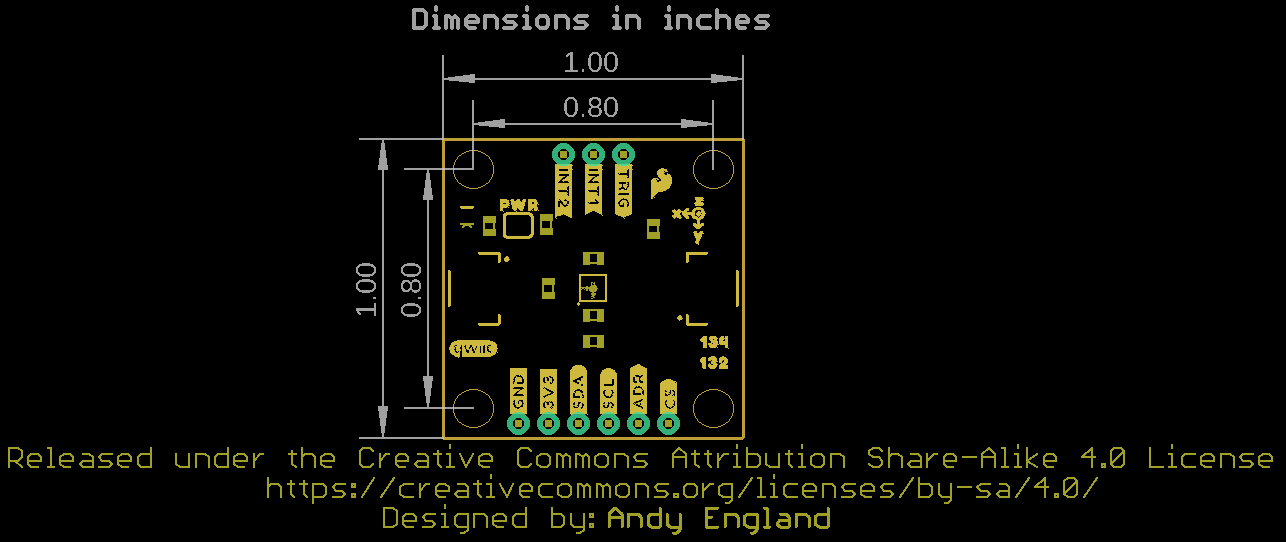
- Board Dimensions
- Hookup Guide
- Datasheet - KX134-1211
- Technical Reference Manual - KX134-1211
- AN092 Getting Started App Note
- Qwiic Info Page
- Arduino Library
- Python Package
- GitHub Hardware Repository
Videos
Jargon buster
Plain-language definitions for the technical terms used above.
- breakout
- A breakout board carries a small or fine-pitched component and brings its connections out to standard, breadboard- and header-friendly pins. Describing a part as a breakout means it can be wired into a project without soldering directly to the component's tiny contacts.
- FIFO
- FIFO stands for "first in, first out", a way of handling stored items so the oldest one is read out first, like a queue. In electronics a FIFO is usually a small buffer that temporarily holds data, such as sensor samples or serial bytes, so a processor can collect it in batches instead of reading continuously.
- ODR
- ODR means output data rate: how often the sensor produces a new measurement. A higher ODR can capture faster motion or vibration, but it usually uses more power and creates more data for the microcontroller to handle.
- PCB
- A printed circuit board (PCB) is a board, usually rigid, with etched copper tracks that connect electronic components together without loose wiring. Components are mounted on the board and signals route between them through the copper layout.
- PTH
- Plated through-hole means the pin holes are metal-lined so solder connects the pad on both sides of the board. It is useful for connectors and headers that need a strong mechanical and electrical connection.
- Qwiic
- Qwiic is a plug-in connector system for I2C devices that uses small 4-pin cables, so you can connect compatible sensors without soldering. It matters because your controller or adapter also needs Qwiic, or you will need a cable or breakout to wire it up.
- RMS
- RMS is a way of describing the effective level of an AC signal, such as an audio output voltage. It helps compare audio output levels more meaningfully than a peak voltage number.
- SPI
- A fast serial communication bus often used for displays, memory cards, and sensors. It matters because SPI devices need specific pins for clock and data, plus a separate chip-select line for each device.
Find this product in
Sensors & Input
Qwiic KX13X Schematic
Schematic · 62.1 KB · Click any page to view full size
KX134-1211 Datasheet
Datasheet · 1.1 MB · Click any page to view full size
KX134-1211 Technical Reference Manual
User Guide · 2.0 MB · Click any page to view full size
KX13X Getting Started Application Note
Quick Start · 459.6 KB · Click any page to view full size
Supplier page — sparkfun.com
Supplier Description · 625.5 KB · Click any page to view full size
Resources & Downloads
Guides, code examples, and more
Source Code
Open-source libraries, firmware & example projects for this product
The SparkFun Triple-Axis Accelerometer Breakouts are simple Qwiic breakout for the KX134x digital accelerometer from Kionix.
ba21595
7 months ago
· 21 commits
- .github fix issue with secrets 7 months ago
- docs fix issue with secrets 7 months ago
- Documentation Adds documentation and gitignore over 5 years ago
- Hardware Repanelizes design after fixing silk over 5 years ago
- Production Repanelizes design after fixing silk over 5 years ago
- .gitignore moved docs to gh pages and docusaurus - yay 7 months ago
- README.md Create README.md over 5 years ago
527618d
12 months ago
· 133 commits
- .github Fixes accidental indent on workflow over 2 years ago
- Documentation Places new documentation in documentation folder almost 4 years ago
- examples Minor changes to SPI example over 2 years ago
- src Adds preproccesor directives to make actions happy 12 months ago
- .gitignore Adds documentation and new gitignore over 5 years ago
- CONTRIBUTING.md Add contributing, issue template, and license docs 12 months ago
- ISSUE_TEMPLATE.md Add contributing, issue template, and license docs 12 months ago
- keywords.txt Add getRawAccelRegisterData and getRawAccelBufferData over 3 years ago
- library.properties v2.0.4 over 3 years ago
- LICENSE.md Add contributing, issue template, and license docs 12 months ago
- README.md Create README.md over 5 years ago
46fd4c4
over 1 year ago
· 46 commits
- .github Update build-deploy-ghpages.yml over 1 year ago
- docs Autogenerated. Convert PyPi packaging and add Readme Updates over 1 year ago
- examples Autogenerated: Fix example bullets/markdown links over 1 year ago
- .gitignore initial commit from template over 5 years ago
- .readthedocs.yml Initial commit from template, second attempt over 5 years ago
- DESCRIPTION.rst Autogenerated: Bump version number to 2.0.0 over 1 year ago
- DOCUMENTATION.md Initial commit from template, second attempt over 5 years ago
- LICENSE Initial commit from template, second attempt over 5 years ago
- package.json Autogenerated: Bump version number to 2.0.0 over 1 year ago
- pyproject.toml Autogenerated: Bump version number to 2.0.0 over 1 year ago
- qwiic_kx13x.py Fix indentation for kx132 method over 1 year ago
- README.md Autogenerated: Update supported boards. over 1 year ago
- requirements.txt Autogenerated: Add requirements.txt for circup packaging dependencies over 1 year ago