SparkFun
SparkFun Thing Plus - NINA-B306
The SparkFun NINA-B306 Thing Plus offers a unique combination development platform in the Thing Plus form factor featuring the NINA-B306 from u-blox™, the...
Get notified when back in stock
The SparkFun NINA-B306 Thing Plus offers a unique combination development platform in the Thing Plus form factor featuring the NINA-B306 from u-blox™, the ISM330DHCX 6DoF IMU from STMicroelectronics™ and the BME280 atmospheric sensor from Bosch Sensortec™.
The NINA-B306 is a combination Bluetooth® 5 compliant module with an Arm® Cortex®-M4 processor. The NINA-B306 features an integrated PCB antenna removing the need for any external antenna. It includes 1MB Flash and 250kB RAM.
The BME280 combined humidity and pressure sensor measures barometric pressure, humidity, and ambient temperature in a small package. The sensor measures pressure from 300 to 1100hPa and has a full temperature accuracy range from 0 to 65°C. The sensor communicates with the NINA-B306 over I2C.
The ISM330DHCX 6DoF IMU is a high-performance 3D digital accelerometer and 3D digital gyroscope tailored for Industry 4.0. The IMU has full-scale, user-selectable acceleration ranges of ±2/±4/±8/±16g and wide angular rate ranges of ±125/±250/±500/±1000/±2000/±4000dps. The ISM330DHCX has embedded features including Machine Learning Core, programmable FSM, FIFO, sensor hub, event decoding, and interrupts.
The NINA-B306 Thing Plus includes Qwiic and LiPo battery connectors, and a selection of GPIO, Analog, and communication pins (UART, SPI, and I2C) broken out to the PTH headers. The board also features the MCP73831 single-cell LiPo charger and the MAX17048 fuel gauge to charge and monitor a connected battery. Lastly, we've included a µSD card slot for external memory needs.
The SparkFun Qwiic Connect System is an ecosystem of I2C sensors, actuators, shields and cables that make prototyping faster and less prone to error. All Qwiic-enabled boards use a common 1mm pitch, 4-pin JST connector. This reduces the amount of required PCB space, and polarized connections mean you can’t hook it up wrong.
Features:
- NINA-B306
- Bluetooth 5 Compliant Low Energy module with integrated Arm Cortex-M4 processor
- Supported 2.4 GHz radio modes
- Bluetooth Low Energy
- IEEE 802.15.4
- Proprietary u-blox 2.4GHz modes
- Internal PCB antenna
- Max range: 1400m
- 1MB Flash
- 250kB RAM
- BME280 Environmental Sensor
- Temperature Range:
- Full Accuracy: 0 to 65°C
- Operational: -40 to +85°C
- Humidity Range: 0 to 100% RH
- Pressure Range: 300 to 1100hPa
- I2C address: 0x76
- Temperature Range:
- ISM330DHCX 6DoF IMU
- 3D Accelerometer
- Selectable full-scale ranges: ±2/±4/±8/±16g
- 3D Gyroscope
- Extended selectable full-scale ranges: ±125/±250/±500/±1000/±2000/±4000dps
- Operating temperature range: -40 to +105°C
- Embedded compensation for high stability over operating temperature range
- Embedded smart FIFO up to 9kB
- Programmable Finite State Machine to process data from accelerometer and gyroscope
- External sensor data processing not supported on this board
- Smart embedded functions and interrupts: tilt detection, free-fall, wakeup, 6D/4D orientation, click and double-click
- Embedded pedometer, step detector and counter
- Embedded temperature sensor
- I2C address: 0x6B
- 3D Accelerometer
- Thing Plus Form-Factor (Feather-compatible):
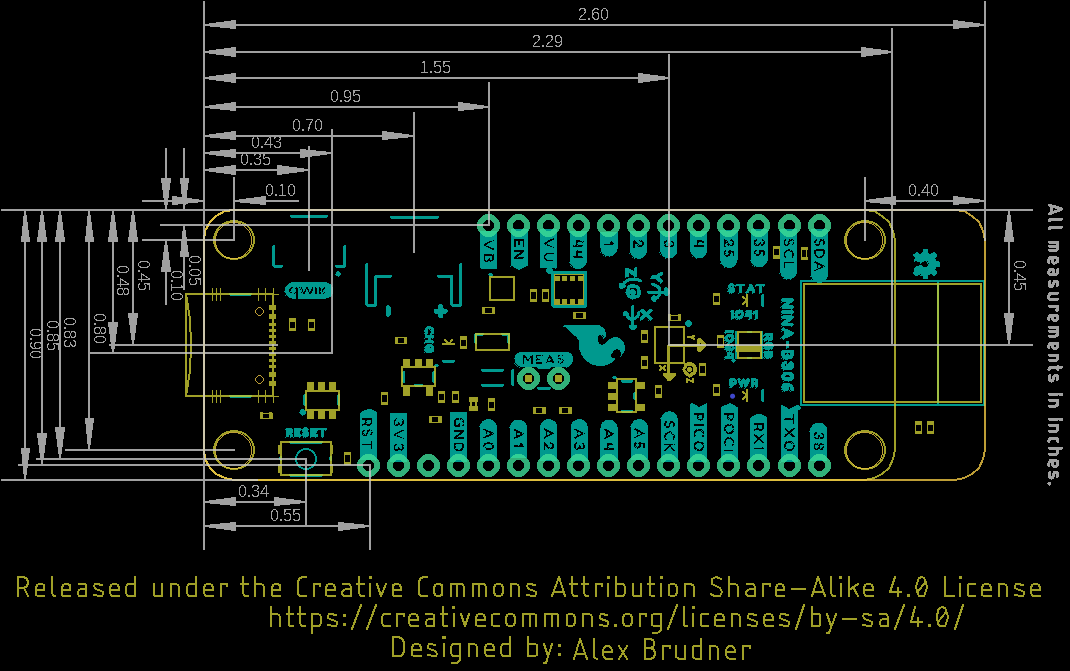
- Dimensions: 2.30in. x 0.9in.
- Two mounting holes:
- 4-40 screw compatible
- 21 GPIO PTH breakouts
- SPI, UART and I2C interfaces
- Six analog
- 8 digital I/O
- USB-C Connector
- 2-Pin JST LiPo Battery Connector for a LiPo battery (not included)
- 4-Pin JST Qwiic Connector
- MC73831 Single-Cell LiPo Charger
- 500mA charge rate
- MAX17048 Single-Cell LiPo Fuel Gauge
- µSD Card Slot
- LEDs:
-
PWR- Red Power LED -
CHG- Yellow battery charging status LED -
STAT- Blue status LED tied to IO41
-
Documents:
- Schematic
- Eagle Files
- Board Dimensions
- Hookup Guide
- Datasheets:
- Arduino Libraries:
- Thing+ Info Page
- Qwiic Info Page
- GitHub Hardware Repo
Videos
Jargon buster
Plain-language definitions for the technical terms used above.
- ARM Cortex-M4
- The ARM Cortex-M4 is a 32-bit processor core widely used inside microcontrollers, often with hardware support for signal-processing and control tasks. It provides enough processing power to run embedded programs that handle sensors, wireless communication, audio and similar workloads.
- Feather-compatible
- Feather-compatible means the board follows the Adafruit Feather size and pin layout used by many add-on boards and enclosures. It matters because it helps you choose accessories that will physically fit and connect to the same pins.
- FIFO
- FIFO stands for "first in, first out", a way of handling stored items so the oldest one is read out first, like a queue. In electronics a FIFO is usually a small buffer that temporarily holds data, such as sensor samples or serial bytes, so a processor can collect it in batches instead of reading continuously.
- GPIO
- General-purpose input/output pins are microcontroller pins you can set in software to read signals, switch devices on and off, or connect to peripherals. The number of GPIO pins matters because it limits how many buttons, LEDs, sensors, and other parts you can wire directly to the board.
- Gyroscope
- A gyroscope measures rotation, such as how fast a board is turning around its X, Y, and Z axes. This matters for projects like gesture controls, balancing robots, and motion tracking where tilt or rotation changes need to be detected.
- Headers
- Rows of connector contacts on a fixed pitch (commonly 2.54 mm) used to link a board to a breadboard, jumper wires, or another board. They come as male pin headers and female socket headers; when a module ships with pre-soldered headers it can be used straight away, whereas bare pads require soldering the pins yourself.
- IMU
- An IMU (Inertial Measurement Unit) combines motion sensors, typically an accelerometer and gyroscope and sometimes a magnetometer, to measure movement and orientation. It can sense motion, tilt, vibration, rotation, and changes in direction, which is useful for tasks such as navigation, stabilisation, gesture detection, and asset tracking.
- LED
- A light-emitting diode (LED) is a small electronic component that emits light when current flows through it in the correct direction. Because it only conducts one way, its polarity matters, and a through-hole LED must be soldered the correct way around to light up.
- LiPo
- A LiPo (lithium polymer) battery is a rechargeable lithium battery widely used in portable projects because it is light and compact. LiPo cells need correct charging circuitry and careful handling to stay safe, so equipment that supports LiPo generally includes charging or protection hardware suited to that battery type.
- MAX17048
- A battery fuel-gauge chip that estimates how much charge is left in a LiPo battery. It matters for portable projects because your software can monitor battery level instead of only measuring voltage.
- MCP73831
- A lithium battery charger chip used to safely charge a single-cell LiPo battery. It matters because it lets the board recharge a battery from USB or another input without needing a separate charger module.
- PCB
- A printed circuit board (PCB) is a board, usually rigid, with etched copper tracks that connect electronic components together without loose wiring. Components are mounted on the board and signals route between them through the copper layout.
- PCB antenna
- A PCB antenna is an antenna pattern built directly into the circuit board rather than a separate metal antenna. It matters because placement, nearby metal and enclosure design can affect wireless range.
- PTH
- Plated through-hole means the pin holes are metal-lined so solder connects the pad on both sides of the board. It is useful for connectors and headers that need a strong mechanical and electrical connection.
- Qwiic
- Qwiic is a plug-in connector system for I2C devices that uses small 4-pin cables, so you can connect compatible sensors without soldering. It matters because your controller or adapter also needs Qwiic, or you will need a cable or breakout to wire it up.
- RAM
- RAM (random-access memory) is fast, temporary memory a device uses for working data while it is running; in its common volatile form, its contents are lost when power is removed. Some devices offer a mode that applies settings to RAM only, which is handy for testing changes temporarily because they are not stored permanently and disappear at power-off.
- SPI
- A fast serial communication bus often used for displays, memory cards, and sensors. It matters because SPI devices need specific pins for clock and data, plus a separate chip-select line for each device.
- Thing Plus
- Thing Plus is SparkFun’s development-board form factor with a small rectangular layout and connections suited to wireless and battery-powered projects. It matters because boards and accessories in the same form factor are easier to mount, wire, and swap between projects.
- UART
- UART is a simple asynchronous serial interface that sends data over separate transmit and receive wires, usually labelled TX and RX, with both ends set to the same baud rate. It is a common way for microcontrollers and other serial devices to exchange data.
- USB-C
- USB-C is a small, reversible USB connector that can carry power, data and, on some devices, video over a single cable. The same connector can range from charging only to high-speed data, so the functions a given port actually supports vary.
Find this product in
Brands
Connectivity
Microcontrollers
SparkFun Thing Plus NINA-B306 Schematic
Schematic · 164.1 KB · Click any page to view full size
u-blox NINA-B306 Datasheet
Datasheet · 2.1 MB · Click any page to view full size
BME280 Sensor Datasheet
Datasheet · 1.5 MB · Click any page to view full size
ISM330DHCX IMU Datasheet
Datasheet · 2.5 MB · Click any page to view full size
MAX17048 Fuel Gauge Datasheet
Datasheet · 1.1 MB · Click any page to view full size
Supplier page — sparkfun.com
Supplier Description · 750.3 KB · Click any page to view full size
Resources & Downloads
Guides, code examples, and more
Source Code
Open-source libraries, firmware & example projects for this product
An Arduino library to control the BME280 humidity and pressure sensor.
870c17d
about 1 year ago
· 77 commits
- .github Create add_issue_to_project.yml about 3 years ago
- examples Change examples to 115200bps to match style guide almost 6 years ago
- src Number of changes along with an accidental format changes, rolls version about 1 year ago
- keywords.txt Comment changes to examples over 8 years ago
- library.properties Number of changes along with an accidental format changes, rolls version about 1 year ago
- LICENSE.md initial commit and beta release about 11 years ago
- README.md Update README.md almost 6 years ago
31c9ca3
about 2 years ago
· 118 commits
- .github Adds two new functions, accidentally formats files - would have done this separately about 2 years ago
- Documentation Adds documentation and many functions over 4 years ago
- examples Create example5_faster_I2C.ino almost 4 years ago
- src Adds two new functions, accidentally formats files - would have done this separately about 2 years ago
- keywords.txt Adds keywords over 4 years ago
- library.properties Correct setAccelSlopeFilter over 3 years ago
- License.md Create License.md over 4 years ago
- README.md Update README.md about 4 years ago
An Arduino library to support the MAX17043 / MAX17044 / MAX17048 / MAX17049 battery fuel gauge
6ea1765
about 3 years ago
· 35 commits
- examples Update Example4_MAX17048_KitchenSink.ino almost 6 years ago
- src v1.0.4: add setDevice and setWirePort about 4 years ago
- .gitattributes Initial commit almost 6 years ago
- keywords.txt v1.0.4: add setDevice and setWirePort about 4 years ago
- library.properties v1.0.4: add setDevice and setWirePort about 4 years ago
- LICENSE Initial commit almost 6 years ago
- README.md Update README.md about 3 years ago
4046be3
over 3 years ago
· 44 commits
- Documentation Added datasheets. almost 4 years ago
- Firmware Update example, update Readme over 3 years ago
- Hardware Moved files to proper spot. almost 4 years ago
- Production Moved files to proper spot. almost 4 years ago
- .gitattributes Initial commit about 4 years ago
- .gitignore Initial commit. about 4 years ago
- README.md Moved library to board repo so it's automatically included. Updated readme. over 3 years ago
Related Tutorials
Free step-by-step guides