SparkFun
SparkFun Qwiic Mini dToF Imager - TMF8820
The SparkFun Qwiic Mini dToF TMF8820 Imager is a direct time-of-flight (dToF) sensor that includes a single modular package with an associated Vertical Cavit...
Get notified when back in stock
The SparkFun Qwiic Mini dToF TMF8820 Imager is a direct time-of-flight (dToF) sensor that includes a single modular package with an associated Vertical Cavity Surface Emitting Laser (VCSEL) from AMS. The dToF device is based on Single Photon Avalanche Photodiode (SPAD), time-to-digital converter (TDC) and histogram technology to achieve a 5000mm detection range. Due to its lens on the SPAD, it supports 3x3 multizone output data and a very wide, dynamically adjustable field of view. A multi-lens-array (MLA) inside the package above the VCSEL widens up the FoI (field of illumination). All processing of the raw data is performed on-chip and the TMF8820 provides distance information together with confidence values on its I2C interface. The high performance on-chip optical filter blocks most of the ambient light, and enables distance measurements in dark and sunlight environments.
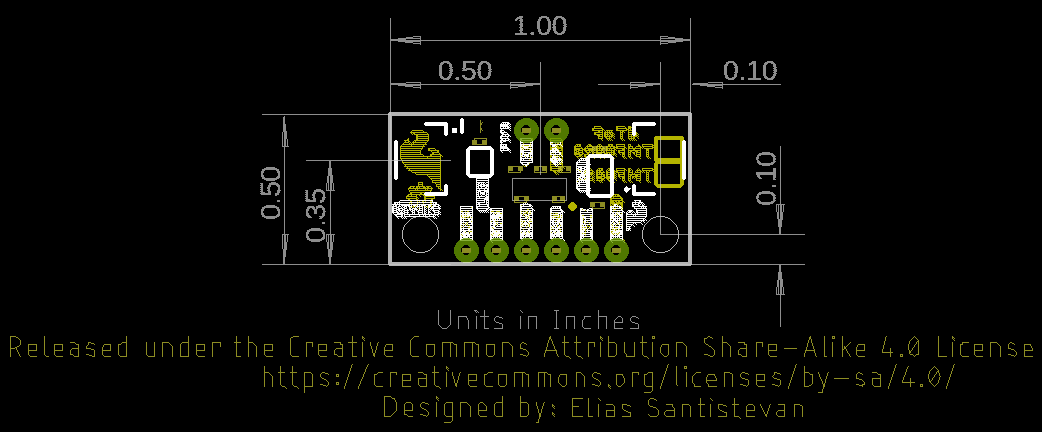
To make it even easier to get your readings, all communication is enacted exclusively via I2C, utilizing our handy Qwiic system so no soldering is required to connect it to the rest of your system. However, we still have broken out 0.1”-spaced pins in case you prefer to use a breadboard. The TMF8820 offers two configurable GPIO pins and one enable (EN) pin, which are broken out as PTH pads. The board also includes a power LED and I2C pull-up resistors, each configurable via jumpers. This Mini version has a footprint that is half the size (0.5in. x 1.0in.) of our standard Qwiic Mini dToF TMF8820 Imager board. Additionally, we moved the Qwiic connectors to the back of the board. These design changes favor mounting applications where the TMF8820 sensor faces outward from an enclosure or chassis, and keeps your Qwiic cables cleanly tucked away.
This sensor is great for projects such as distance measurement for camera autofocus - Laser Detect Autofocus - LDAF (mobile phone), presence detection (computing and communication), object detection and collision avoidance (robotics), and light curtain (industrial).
Note: CLASS 1 LASER PRODUCT CLASSIFIED IEC 60825-1 2014.
The SparkFun Qwiic Connect System is an ecosystem of I2C sensors, actuators, shields and cables that make prototyping faster and less prone to error. All Qwiic-enabled boards use a common 1mm pitch, 4-pin JST connector. This reduces the amount of required PCB space, and polarized connections mean you can’t hook it up wrong.
Features:
- Operating Voltage
- 2.7V to 3.6V
- (typically 3.3V via Qwiic cable)
- Current Consumption
- 8µA (standby)
- 57mA (active)
- AMS TMF8821 Multi-zone Time-of-Flight Sensor
- Direct ToF technology with high sensitivity SPAD detection
- 3x3 configurable multi-zone configuration with multi-object detection
- Fast Time-to-Digital Converter (TDC) architecture
- Sub-nanosecond light pulse
- On-chip histogram processing
- High performance on-chip sunlight rejection filter and algorithm
- Measurement Range: 10mm to 5000mm @ 30Hz
- Light Source: Class 1 940nm VCSEL
- Field of View: adjustable up to 63° diagonally
- Max Read Rate: up to 30Hz
- 2x Qwiic Connectors
- I2C Address: 0x41
- Operating Temperature Range
- -30°C to +70°C
- Breakout Pads
- 1x Ground
- 1x Power
- 1x I2C Port
- 1x Interrupt
- 2x GPIO
- 1x Enable
- Power LED (configurable via jumper)
- I2C pull-ups (configurable via jumper)
- Board Dimensions: 0.5" x 1.0" (1.27cm x 2.54cm)
Documents:
- Schematic
- Eagle Files
- Board Dimensions
- Hookup Guide
- TMF882X
- What Distance Sensor is Right for You?
- Qwiic Info Page
- Arduino Library
- GitHub Hardware Repo
Videos
Jargon buster
Plain-language definitions for the technical terms used above.
- ATmega328P
- An 8-bit microcontroller chip used on many Arduino Uno-compatible boards. Knowing the controller uses an ATmega328P helps you understand its memory, speed, pin compatibility, and the Arduino sketches it can run.
- breakout
- A breakout board carries a small or fine-pitched component and brings its connections out to standard, breadboard- and header-friendly pins. Describing a part as a breakout means it can be wired into a project without soldering directly to the component's tiny contacts.
- GPIO
- General-purpose input/output pins are microcontroller pins you can set in software to read signals, switch devices on and off, or connect to peripherals. The number of GPIO pins matters because it limits how many buttons, LEDs, sensors, and other parts you can wire directly to the board.
- LED
- A light-emitting diode (LED) is a small electronic component that emits light when current flows through it in the correct direction. Because it only conducts one way, its polarity matters, and a through-hole LED must be soldered the correct way around to light up.
- microcontroller
- A microcontroller is a small computer on a single chip that runs a stored program and controls connected inputs and outputs such as buttons, sensors, displays and communication interfaces. In a device built around one, it is the part that executes the code and coordinates the device's behaviour.
- PCB
- A printed circuit board (PCB) is a board, usually rigid, with etched copper tracks that connect electronic components together without loose wiring. Components are mounted on the board and signals route between them through the copper layout.
- photodiode
- A photodiode is a light-sensitive component that produces a small electrical signal, a current or voltage, when light falls on it. When a sensor uses several photodiodes, each can be tuned to a different part of the spectrum so the chip can measure several wavelength bands separately.
- PTH
- Plated through-hole means the pin holes are metal-lined so solder connects the pad on both sides of the board. It is useful for connectors and headers that need a strong mechanical and electrical connection.
- Qwiic
- Qwiic is a plug-in connector system for I2C devices that uses small 4-pin cables, so you can connect compatible sensors without soldering. It matters because your controller or adapter also needs Qwiic, or you will need a cable or breakout to wire it up.
Find this product in
Sensors & Input
SparkFun dToF TMF8820 Mini Schematic
Schematic · 152.5 KB · Click any page to view full size
TMF882X Sensor Datasheet
Datasheet · 2.9 MB · Click any page to view full size
TMF882X Driver User Guide
User Guide · 520.6 KB · Click any page to view full size
TMF8820/21 Host Driver Communication Application Note
Document · 843.8 KB · Click any page to view full size
Supplier page — sparkfun.com
Supplier Description · 607.3 KB · Click any page to view full size
TMF882X CB Test Certificate
Compliance · 195.5 KB · Click any page to view full size
TMF8820 Multizone Time-of-Flight Sensor Datasheet
Datasheet · 3.2 MB · Click any page to view full size
Resources & Downloads
Guides, code examples, and more
Source Code
Open-source libraries, firmware & example projects for this product
Arduino Library for SparkFun's Qwiic TMF882X breakout boards
f4be0ec
almost 2 years ago
· 155 commits
- .github Create add_issue_to_project.yml almost 3 years ago
- docs fix typo over 4 years ago
- examples fix doc link; formatting cleanup over 4 years ago
- src Update qwiic_tmf882x.cpp almost 3 years ago
- .gitignore Adds gitignore updates to names of leftover macros almost 5 years ago
- CONTRIBUTING.md rounding out repo over 4 years ago
- keywords.txt updated property file for this library; added keywords.txt file for this library over 4 years ago
- library.properties v1.0.2 - add include Arduino.h in qwiic_i2c.h over 3 years ago
- LICENSE.md filling out repo over 4 years ago
- mkdocs.yml Update mkdocs.yml almost 2 years ago
- README.md Update README.md about 4 years ago
740270a
almost 3 years ago
· 40 commits
- Documents Adds datasheets almost 5 years ago
- Hardware Move to Hardware folder over 4 years ago
- Production Update File Names over 4 years ago
- License.md Adds license almost 3 years ago
- README.md Update README.md over 4 years ago
Related Tutorials
Free step-by-step guides