SparkFun
SparkFun MicroMod Environmental Function Board
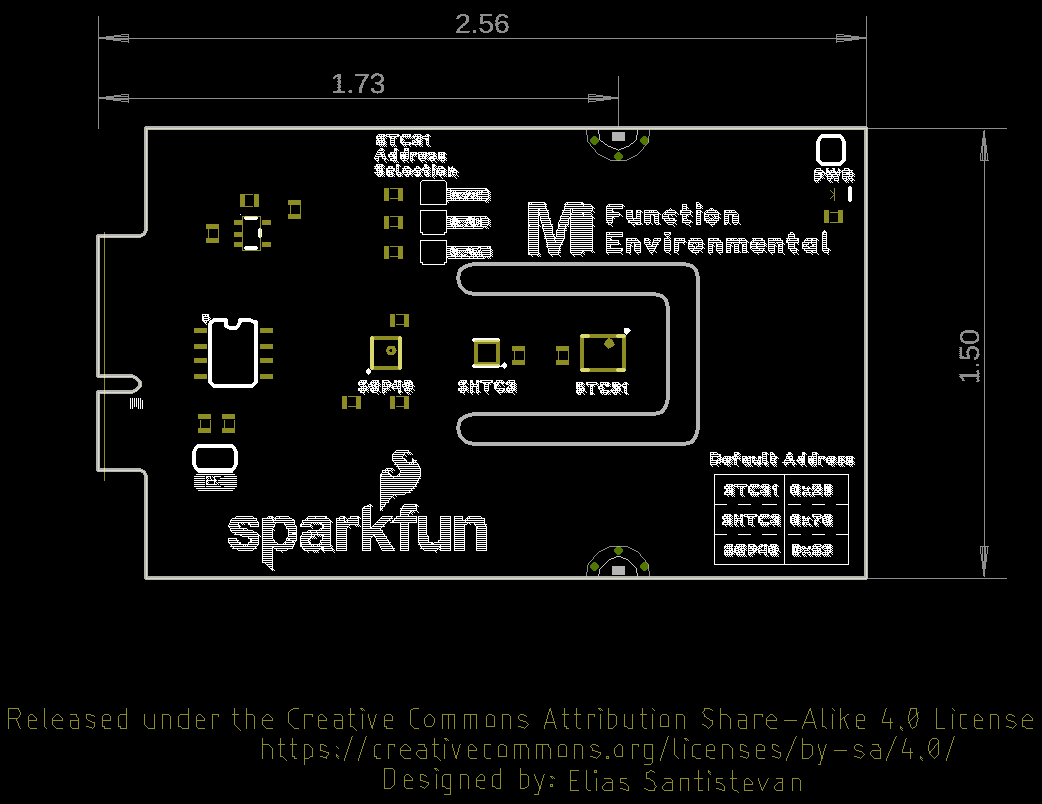
The SparkFun MicroMod Environmental Function Board adds additional sensing options to the MicroMod Processor Boards. This Function Board includes three senso...
Get notified when back in stock
- The SGP40 measures the quality of the air in your room or house. The SGP40 uses a metal oxide (MOx) sensor with a temperature controlled micro hotplate and provides a humidity-compensated volatile organic compound (VOC) based indoor air quality signal. Both the sensing element and VOC Algorithm feature an unmatched robustness against contaminating gases present in real world applications enabling a unique long term stability as well as low drift and device to device variation.
- The SHTC3 is a highly accurate digital humidity and temperature sensor. The SHTC3 uses a capacitive humidity sensor with a relative humidity measurement range of 0 to 100% RH and bandgap temperature sensor with a temperature measurement range of -40°C to 125°C. The SHTC3 builds on the success of their SHTC1 sensor with higher accuracy (±2% RH, ±0.2°C) than its predecessor, enabling greater flexibility.
- The STC31 measures CO2 concentrations based on thermal conductivity and has two CO2 measurement ranges: 0 to 25 vol%; and 0 to 100 vol%. The measurement repeatability is 0.2 vol%, with a stability of 0.025 vol% / °C. The measurement accuracy depends on the measurement range: 0.5 vol% + 3% measured value; 1 vol% + 3% measured value. Using measurements from the SHTC3, the STC31 is able to provide humidity-compensated measurements together with improved temperature compensation. The STC31 can compensate for atmospheric pressure too - which is handy if, like us, you’re up in the mountains!
- Input voltage range
- 2.5V to 6.0V
- Typ. 5V via Main Board's USB connector
- Typ. ~3.7V to 4.2V via Main Board's LiPo battery Connector
- 2.5V to 6.0V
- I/O voltage
- 3.3V
- AP2112 3.3V voltage regulator (rated 600mA)
- Power LED
- I2C pull-up resistors
-
Sensirion SGP40 Air Quality Sensor
- Uses I2C interface
- Address: 0x59 (default)
- Operating voltage range
- 1.7V to 3.6V (Typ. 3.3V)
- Operating temperature range
- -20°C to +55°C
- Typical current consumption
- 2.6mA during continuous operation (at 3.3V)
- 34µA when idle (heater off)
- Output signal
- Digital raw value (SRAW): 0 - 65535 ticks
- Digital processed value (VOC Index): 0 - 500 VOC index points
- Switch-on behavior
- Time until reliably detecting VOC events: <60s
- Time until specifications are met: <1h
- Recommended sampling interval
- VOC Index: 1s
- SRAW: 0.5s - 10s (Typ. 1s)
- Uses I2C interface
-
Sensirion SHTC3 Humidity and Temperature Sensor
- Uses I2C interface
- Address: 0x70 (default, non-configurable)
- Operating voltage range
- 1.62V - 3.6V (Typ. 3.3V)
- Operating temperature range
- -40°C to +125 °C
- Relative Humidity
- Measurement range: 0% to 100%
- Typical accuracy: ±2 %RH
- Resolution: 0.01 %RH
- Temperature
- Measurement range: -40°C to +125 °C
- Typical accuracy: ±0.2 °C
- Resolution: 0.01 °C
- Typical current consumption (varies based on mode)
- 4.9µA to 430µA (Normal Mode)
- 0.5µA to 270µA (Low Power Mode)
- Allows the STC31 to compensate for humidity and temperature
- Uses I2C interface
-
Sensirion STC31 CO2 Sensor
- Uses I2C interface
- Addresses: 0x29 (default), 0x2A, 0x2B, 0x2C
- Operating voltage range
- 2.7V to 5.5V (Typ. 3.3V)
- Operating temperature range
- -20 °C to +85 °C
- Calibrated for CO2 in N2 and CO2 in air
- Measurement ranges
- 0 to 25 vol% in N2
- 0 to 100 vol% in air
- Accuracy
- 0.5 vol% + 3% measured value in N2
- 1 vol% + 3% measured value in air
- Concentration and temperature resolution: 16-bit
- Repeatability: 0.2 vol%
- Temperature stability: 0.025 vol% / °C
- Start-up time: 14 ms
- Thermal conductivity sensor provides calibrated gas concentration and temperature output
- Uses I2C interface
- Jumpers
- PWR LED
- I2C pull-up resistors
- STC31 address selection
- Schematic
- Eagle Files
- Board Dimensions
- Hookup Guide
- SGP40
- SHTC3
- STC3X
- Arduino Libraries
- GitHub Hardware Repo
Jargon buster
Plain-language definitions for the technical terms used above.
- CMOSens
- CMOSens is Sensirion’s integrated sensor technology that combines sensing elements and electronics in one package. It matters because it affects how the sensor measures temperature and humidity and how it is supported by the manufacturer’s libraries and datasheets.
- I2C
- I2C is a two-wire communication bus used by many sensors and small modules. It matters because several I2C devices can share the same two wires, but each device needs a compatible address and your controller must support I2C.
- LED
- A light-emitting diode (LED) is a small electronic component that emits light when current flows through it in the correct direction. Because it only conducts one way, its polarity matters, and a through-hole LED must be soldered the correct way around to light up.
- LiPo
- A LiPo (lithium polymer) battery is a rechargeable lithium battery widely used in portable projects because it is light and compact. LiPo cells need correct charging circuitry and careful handling to stay safe, so equipment that supports LiPo generally includes charging or protection hardware suited to that battery type.
- M.2
- M.2 is a compact edge-connector standard for plugging small modules - such as SSDs, wireless cards or microcontroller modules - into a host board without soldering. The same slot shape can carry different interfaces (for example PCIe, SATA or USB), so keying and the supported module type need to be checked.
- microcontroller
- A microcontroller is a small computer on a single chip that runs a stored program and controls connected inputs and outputs such as buttons, sensors, displays and communication interfaces. In a device built around one, it is the part that executes the code and coordinates the device's behaviour.
- MicroMod
- MicroMod is a modular board system where a small processor board plugs into a separate carrier board (via an M.2 connector) that provides connectors, power, and peripherals. Within the MicroMod system, a board is either a processor board or a carrier board, and you need a matching pair of both before you can run project code.
- multiplexer
- A multiplexer (mux) is a chip or circuit that selects one of several input signals and routes it to a single shared output, with select lines choosing which input is connected; running the same idea in reverse, to send one input to a chosen output, gives a demultiplexer. Multiplexers let a single controller or line work with several signals or devices that would otherwise clash on a shared connection.
- Qwiic
- Qwiic is a plug-in connector system for I2C devices that uses small 4-pin cables, so you can connect compatible sensors without soldering. It matters because your controller or adapter also needs Qwiic, or you will need a cable or breakout to wire it up.
- Temperature compensation
- Temperature compensation is when a sensor or instrument adjusts its readings to reduce errors caused by changes in temperature. This matters because a sensor's raw output often drifts as conditions warm or cool, so compensation keeps readings more consistent and accurate over time.
- VOC
- Volatile organic compounds are gases released from things like paints, cleaners, smoke, and some plastics. A VOC reading helps indicate indoor air quality, but it is usually an index or estimate rather than a direct identification of each chemical.
Find this product in
Brands
MicroMod Environmental Function Board Schematic
Schematic · 152.9 KB · Click any page to view full size
SGP40 Gas Sensor Datasheet
Datasheet · 1.2 MB · Click any page to view full size
SHTC3 Humidity Sensor Datasheet
Datasheet · 638.7 KB · Click any page to view full size
STC31 CO₂ Sensor Datasheet
Datasheet · 897.1 KB · Click any page to view full size
SGP40 VOC Index Application Note
Document · 1.4 MB · Click any page to view full size
SGP40 Design-In Guide
Document · 304.4 KB · Click any page to view full size
SGP40 Quick Testing Guide
Quick Start · 507.9 KB · Click any page to view full size
STCxx Field Calibration Guide
Document · 328.5 KB · Click any page to view full size
STCxx Design-In Guide
Document · 313.3 KB · Click any page to view full size
Supplier page — sparkfun.com
Supplier Description · 760.9 KB · Click any page to view full size
Resources & Downloads
Guides, code examples, and more
Source Code
Open-source libraries, firmware & example projects for this product
This is an Arduino library for the SGP40 Air Quality Sensor
91cb551
almost 3 years ago
· 16 commits
- .github Create add_issue_to_project.yml almost 3 years ago
- examples v1.0.1 - change example sample rate to 1Hz over 5 years ago
- src Rename CRC variable to avoid conflict with CMSIS definition on STM32 platforms over 4 years ago
- ISSUE_TEMPLATE.md Initial commit almost 6 years ago
- keywords.txt Initial commit almost 6 years ago
- library.properties Update library.properties over 4 years ago
- LICENSE.md Initial commit almost 6 years ago
- README.md Update README.md almost 5 years ago
An Arduino library for the Sensirion STC3x (STC31) family of CO2 sensors
9d6b09d
almost 3 years ago
· 8 commits
- .github Create add_issue_to_project.yml almost 3 years ago
- documents Initial commit over 5 years ago
- examples Add SKU to the Examples about 5 years ago
- src Updates after testing on hardware about 5 years ago
- keywords.txt Initial commit over 5 years ago
- library.properties Updates after testing on hardware about 5 years ago
- LICENSE.md Initial commit over 5 years ago
- README.md Update README.md almost 5 years ago
An Arduino library to take Humidity and Temperature readings using the SHTC3 sensor from Sensirion
671ef7e
almost 3 years ago
· 29 commits
- .github Create add_issue_to_project.yml almost 3 years ago
- examples fixing typo in EX1 over 6 years ago
- src add uint8_t casts about 5 years ago
- .gitattributes Initial commit almost 8 years ago
- ISSUE_TEMPLATE.md Initial commit almost 8 years ago
- keywords.txt Updated documentation for initial release almost 8 years ago
- library.properties Update library.properties about 5 years ago
- LICENSE.md Create LICENSE.md almost 5 years ago
- README.md Add RAK1901 product reference to README almost 4 years ago
c6f51f2
almost 5 years ago
· 27 commits
- Firmware Update MicroMod_FB_Environmental_Sensor_CSV.ino almost 5 years ago
- Hardware Updates function board symbol to new one in the official SFE eagle library repo almost 5 years ago
- Production Moves production files to correct loaction about 5 years ago
- .gitignore Initial Commit about 5 years ago
- LICENSE.md Create LICENSE.md almost 5 years ago
- README.md Update README.md almost 5 years ago