SparkFun
SparkFun Micro Triple Axis Accelerometer Breakout - BMA400 (Qwiic)
·
The SparkFun Qwiic BMA400 Micro Triple Axis Accelerometer Breakout offers a 3-axis acceleration sensor perfect for ultra-low-power applications on an easy-to...
Get notified when back in stock
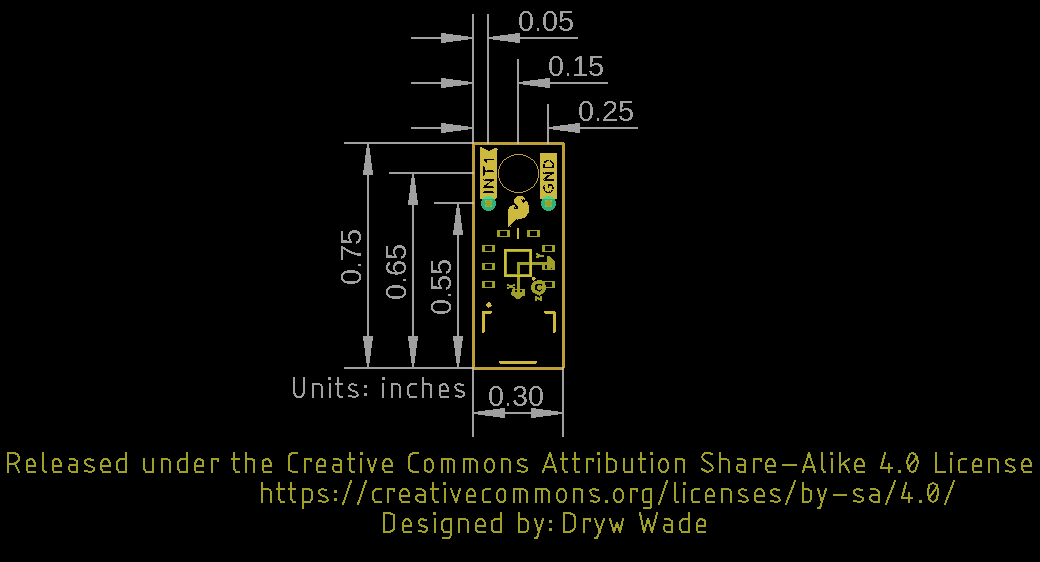
The SparkFun Qwiic BMA400 Micro Triple Axis Accelerometer Breakout offers a 3-axis acceleration sensor perfect for ultra-low-power applications on an easy-to-use Micro Qwiic format breakout board. Dubbed the first "real" ultra-low power acceleration sensor, the BMA400 is perfect when used in both wearable and smart home applications. Where this sensor shines, however, is its ability to distinguish between critical situations and false signals by avoiding false alarms. The Qwiic system allows for integration into your I2C system with no soldering required. While the Micro size does not allow for a traditional 0.1"-spaced PTH header for communication, the board does route an interrupt and ground pin to a through-hole connection.
The BMA400 from Bosch Sensortech© has a full scale acceleration range of ±2/±4/±8/±16g with exceptionally low current consumption of < 14.5µA while operating at its highest performance settings. The sensor also includes a complete feature set for on-chip interrupts including auto wakeup/low power, step counter, activity recognition, orientation detection and tap/double tap.
The SparkFun Qwiic Connect System is an ecosystem of I2C sensors, actuators, shields and cables that make prototyping faster and less prone to error. All Qwiic-enabled boards use a common 1mm pitch, 4-pin JST connector. This reduces the amount of required PCB space, and polarized connections mean you can’t hook it up wrong.
Qwiic Micro is our smallest I2C-supported board form-factor yet! At only 0.75in. by 0.30in. (or 24.65mm by 7.62mm for metric friends), Qwiic Micro is perfect for projects and applications that have space or weight concerns. With just a single Qwiic connector, Micro boards work great alongside the Qwiic Multiport or at the end of a Qwiic daisy chain.
Features:
- Qwiic Micro Sized Board (0.75in x 0.30in / 19.05mm x 7.62mm)
- Supply voltage range
- 1.72 - 3.6V
- Ultra-Low current consumption
- < 14.5µA at highest performance settings
- I2C interface (Qwiic-enabled)
- I2C addresses
- 0x14 (Default), 0x15
- Selectable acceleration ranges
- ±2/±4/±8/±16g
- On-chip interrupt features
- Auto-low power/auto wakeup
- Step counter
- Activity recognition (walking, running, standing still)
- Motion detection
- Orientation detection
- Tap/double tap
- Output data rate range
- 12.5 - 800Hz (Normal Mode)
- 25Hz (Low-Power Mode)
- 1x Horizontal Qwiic Connection Port
Documents:
Jargon buster
Plain-language definitions for the technical terms used above.
- breakout
- A breakout board carries a small or fine-pitched component and brings its connections out to standard, breadboard- and header-friendly pins. Describing a part as a breakout means it can be wired into a project without soldering directly to the component's tiny contacts.
- Daisy chain
- A wiring layout where devices are connected one after another in a line. It matters because long or awkward chains can make projects messy or less convenient, while a hub lets several devices branch out from one point.
- Motion detection
- The ability to sense that something has moved, either by comparing successive camera frames or by using a dedicated sensor such as a PIR (infrared) or radar module. When a product lists motion detection, movement can be used as a trigger so a system only acts or records when there is activity rather than running continuously.
- PCB
- A printed circuit board (PCB) is a board, usually rigid, with etched copper tracks that connect electronic components together without loose wiring. Components are mounted on the board and signals route between them through the copper layout.
- PTH
- Plated through-hole means the pin holes are metal-lined so solder connects the pad on both sides of the board. It is useful for connectors and headers that need a strong mechanical and electrical connection.
- Qwiic
- Qwiic is a plug-in connector system for I2C devices that uses small 4-pin cables, so you can connect compatible sensors without soldering. It matters because your controller or adapter also needs Qwiic, or you will need a cable or breakout to wire it up.
- through-hole
- A mounting style where the component leads pass through holes in a circuit board and are soldered on the other side. Through-hole parts are often easier to handle and solder by hand, which is useful for classroom and hobby projects.
Find this product in
Sensors & Input
SparkFun BMA400 Breakout Schematic
Schematic · 101.3 KB · Click any page to view full size
BMA400 Datasheet
Datasheet · 2.8 MB · Click any page to view full size
Supplier page — sparkfun.com
Supplier Description · 512.1 KB · Click any page to view full size
SparkFun Triple Axis Accelerometer Breakout BMA400 Qwiic
Document · 103.6 KB · Click any page to view full size
Resources & Downloads
Guides, code examples, and more
Source Code
Open-source libraries, firmware & example projects for this product
85e644b
almost 3 years ago
· 36 commits
- .github Create add_issue_to_project.yml almost 3 years ago
- examples Fix error handling example to work on Uno almost 4 years ago
- src Remove unused param of doxygen comment almost 4 years ago
- .gitignore Create .gitignore about 4 years ago
- keywords.txt Create keywords.txt almost 4 years ago
- library.properties Create library.properties about 4 years ago
- LICENSE.md Create LICENSE.md about 4 years ago
- README.md Update README.md almost 4 years ago
2751c15
over 3 years ago
· 21 commits
- Documents Add datasheet about 4 years ago
- Hardware Remove library file over 3 years ago
- Production Add v10 production files almost 4 years ago
- .gitignore Create .gitignore about 4 years ago
- LICENSE.md Create LICENSE.md about 4 years ago
- README.md Update README.md almost 4 years ago