SparkFun
SparkFun IoT RedBoard - ESP32 Development Board
The SparkFun IoT RedBoard is an ESP32 Development Board that includes everything but the kitchen sink! Espressif's ESP32 WROOM is a powerful WiFi and Blue...
Get notified when back in stock
- CPU and OnChip Memory
- ESP32-D0WD-V3 embedded, Xtensa dual-core 32-bit LX6 microprocessor, up to 240MHz
- 448KB ROM
- 520KB SRAM
- 16KB SRAM in RTC
- WiFi
- 802.11b/g/n
- Bit rate: 802.11n up to 150Mbps
- A-MPDU and A-MSDU aggregation
- 0.4µs guard interval support
- Center frequency range of operating channel: 2412 ~ 2484MHz
- Bluetooth®
- Bluetooth® V4.2 BR/EDR and Bluetooth® LE specification
- Peripherals
- microSD card, UART, SPI, SDIO, I2C, LED PWM, Motor PWM, I2S, IR, pulse counter, GPIO, capacitive touch sensor, ADC, DAC, TWAI® (compatible with ISO 11898-1, i.e. CAN Specification 2.0)
- Integrated Components on Module
- 40MHz crystal oscillator
- 4/8/16 MB SPI flash
- Qwiic connector
- Schematic
- Eagle Files
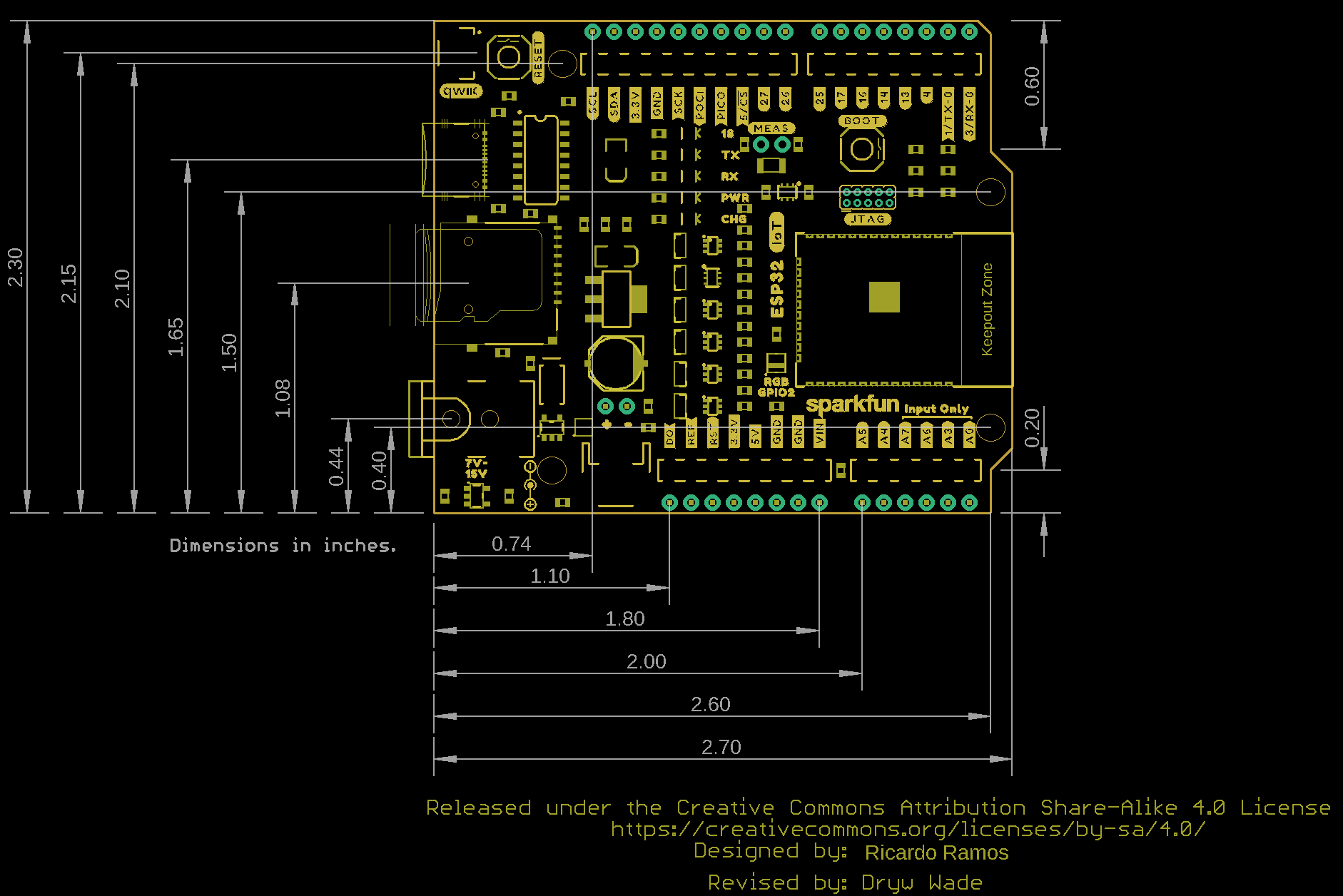
- Board Dimensions
- Hookup Guide
- How to Install CH340C Drivers
- Arduino IDE Download
- Qwiic Info Page
- Compare SparkFun RedBoards
- Arduino Buying Guide
- GitHub Hardware Repo
Jargon buster
Plain-language definitions for the technical terms used above.
- ADC
- An analogue-to-digital converter reads a changing voltage and turns it into a number the microcontroller can use. It matters when connecting analogue sensors such as light, sound, or variable-resistor sensors.
- DAC
- A digital-to-analogue converter turns numbers from the microcontroller into a real analogue voltage. It matters if you want to generate simple waveforms, audio-style signals, or variable control voltages rather than just on/off outputs.
- ESP32
- ESP32 is a family of low-cost microcontroller chips and modules from Espressif with built-in WiFi and Bluetooth. They support programmable firmware and over-the-air updates, and are commonly programmed with toolchains such as the Arduino core and ESP-IDF.
- GPIO
- General-purpose input/output pins are microcontroller pins you can set in software to read signals, switch devices on and off, or connect to peripherals. The number of GPIO pins matters because it limits how many buttons, LEDs, sensors, and other parts you can wire directly to the board.
- I2C
- I2C is a two-wire communication bus used by many sensors and small modules. It matters because several I2C devices can share the same two wires, but each device needs a compatible address and your controller must support I2C.
- I2S
- I2S is a digital audio interface used to send sound data between chips, such as from a microcontroller to an audio amplifier or DAC. It matters if your project needs cleaner digital audio output than a basic buzzer or PWM signal can provide.
- IoT
- Short for Internet of Things, meaning physical devices that connect to networks or the internet to send data or be controlled remotely. It matters if you want projects such as connected sensors, remote controls or classroom data-logging activities.
- LED
- A light-emitting diode (LED) is a small electronic component that emits light when current flows through it in the correct direction. Because it only conducts one way, its polarity matters, and a through-hole LED must be soldered the correct way around to light up.
- microSD card
- A microSD card is a small removable flash memory card used to store data such as audio, images, logs or program files. Its capacity and formatting (often FAT32 or exFAT) affect how much can be stored and whether the card needs preparing before use.
- OTA
- OTA means over-the-air updating, where a device's firmware is updated wirelessly rather than through a programming cable. This lets firmware be updated or maintained after a device is installed without a physical connection.
- PCB
- A printed circuit board (PCB) is a board, usually rigid, with etched copper tracks that connect electronic components together without loose wiring. Components are mounted on the board and signals route between them through the copper layout.
- PWM
- Pulse Width Modulation is a way for a digital pin to simulate variable output power by switching on and off very quickly. It matters for controlling things like LED brightness, motor speed, or servo-style signals from a microcontroller pin.
- Qwiic
- Qwiic is a plug-in connector system for I2C devices that uses small 4-pin cables, so you can connect compatible sensors without soldering. It matters because your controller or adapter also needs Qwiic, or you will need a cable or breakout to wire it up.
- RTC
- A Real-Time Clock keeps track of time even when the main processor is asleep or powered down, usually with a small backup battery. It matters for data logging and tracking projects that need accurate timestamps.
- SPI
- A fast serial communication bus often used for displays, memory cards, and sensors. It matters because SPI devices need specific pins for clock and data, plus a separate chip-select line for each device.
- SRAM
- Fast temporary memory used by a processor while a program is running. More SRAM helps with projects that handle larger data buffers, networking, displays, or more complex code.
- UART
- UART is a simple asynchronous serial interface that sends data over separate transmit and receive wires, usually labelled TX and RX, with both ends set to the same baud rate. It is a common way for microcontrollers and other serial devices to exchange data.
- USB-C
- USB-C is a small, reversible USB connector that can carry power, data and, on some devices, video over a single cable. The same connector can range from charging only to high-speed data, so the functions a given port actually supports vary.
Find this product in
Brands
Connectivity
SparkFun IoT RedBoard ESP32 Schematic
Schematic · 929.0 KB · Click any page to view full size
ESP32-WROOM-32E/32UE Datasheet
Datasheet · 1018.9 KB · Click any page to view full size
Supplier page — sparkfun.com
Supplier Description · 1.1 MB · Click any page to view full size
Resources & Downloads
Guides, code examples, and more
Source Code
Open-source libraries, firmware & example projects for this product
This repo houses all of the SFE Fritzing parts for use in diagrams in tutorials. If you create a new part in Fritzing that correlates to an SFE part, please add it here so others may use it and to avoid duplication.
71b17bb
about 2 years ago
· 339 commits
- kits Include SparkFun Inventor's Kit V4.1 almost 3 years ago
- parts Add Horizontal and Vertical Qwiic Connector and Cable to Breadboard Half (Top View) over 6 years ago
- products Update 13664_sfe_samd21_mini_breakout.fzpz about 2 years ago
- templates Renamed over 11 years ago
- License.md Create License.md over 7 years ago
- README.md Update README.md over 7 years ago
- SparkFun Plus.fzbz First Pass on SparkFun Plus bin file almost 7 years ago
- SparkFun_Plus.png Adding png for fzbz use almost 7 years ago
The SparkFun IoT RedBoard is an ESP32 Development Board that includes everything but the kitchen sink! Espressif's ESP32 WROOM is a powerful WiFi and Bluetooth® MCU module that targets a wide variety of applications.
72e78f9
over 3 years ago
· 63 commits
- documents Updating datasheets per espressif over 3 years ago
- hardware Fix PROD_ID of new regulator over 4 years ago
- production Fix PROD_ID of new regulator over 4 years ago
- .gitignore Added initial schematic version. almost 5 years ago
- License.md Create License.md almost 5 years ago
- README.md Update README.md over 3 years ago