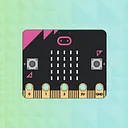
The Kitronik Motor Driver Board for the BBC micro:bit (V2) is an easy way to add proper motor control to a micro:bit robotics build. You slot a micro:bit into the integrated edge connector, then use the screw terminals to wire up two DC motors for forward/reverse/stop control—ideal for buggies, simple robots and classroom STEM projects where you want reliable wiring without breadboards.
It’s designed for the BBC micro:bit (V2) and also feeds a regulated 3V supply into the edge connector to power the inserted micro:bit (from your external battery pack). You also get four input connections: 2 analogue inputs plus external connections for Buttons A & B, making it straightforward to add bump switches, line sensors with analogue output, or other simple inputs. In this V2 board revision, the remaining micro:bit pins are additionally broken out to solder pads (or can be used with matching pin headers) for cleaner expansion than trying to clip onto the micro:bit directly.
Compared with using an L293D/L298N-style motor driver module, this board is more micro:bit-friendly: it has the correct edge connector, regulated power feed, and screw terminals laid out for education/robot builds—at the cost of being less general-purpose than a breadboard driver module for mixed-voltage or non‑micro:bit projects.
Key Features

Kitronik
Motor Driver Board for the BBC micro:bit - V2
This board provides a simple way to add motor driving capability to a BBC micro:bit. It allows two motors to be driven with full forward, reverse & sto...
Get notified when back in stock
This board provides a simple way to add motor driving capability to a BBC micro:bit. It allows two motors to be driven with full forward, reverse & stop control. It has terminal blocks to connect four input devices and a regulated 3V supply is fed in to the 80 way connector to power the inserted BBC micro:bit.
In this new version, the pins from the BBC micro:bit are now broken out to pads on the end of the Motor Driver Board. These pads can either be soldered onto directly, or they are the correct spacing for our PCB pin headers (see image below for a close up of the new pads).

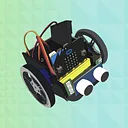
It is ideal for designs such as buggies (see below) and other robotics projects.

It includes an integrated Edge Connector slot for your BBC micro:bit to easily slot into. It also features external connections to the Buttons A and B inputs. This allows additional switches to be connected to the motor driver board and the state of these can then be read by the BBC micro:bit.
Get up to speed quickly. Example Microsoft TouchDevelop code and example connections in the datasheet (below).
Features:
- Drive 2 motors with full forward, reverse and stop control.
- Terminal blocks for easy connection of motors and inputs.
- 4 inputs (2 analogue inputs and 2 provide external connections to Buttons A and B as inputs).
- Includes Edge Connector for the BBC micro:bit to slot into.
- Provide regulated power to the BBC micro:bit.
- Access the other BBC micro:bit pins easily and conveniently.
- Ideal for designs such as buggies and other robotics projects.
Contents:
- 1 x Edge Connector Motor Driver Board for the BBC micro:bit - V2.
Dimensions:
- Length: 67mm.
- Width: 61mm.
- Height: 18mm.
Requires:
- 1 x BBC micro:bit.
- 4.5 - 6V Power Supply.
- 2 x DC Motors (that are compatible with the power supply used).
- 1 x Flat-headed Terminal Screwdriver.
Resources:
- Kitronik Custom Motor Driver MakeCode Editor Blocks (Use this URL to add them to the MakeCode Editor).
- Datasheet.

Jargon buster
Plain-language definitions for the technical terms used above.
- DC
- DC means direct current, where electricity flows in one constant direction, as supplied by batteries, USB ports and many plug-pack power supplies. When a product specifies DC, it runs from a DC supply rather than mains AC, so you need to provide the correct voltage and polarity.
- Headers
- Rows of connector contacts on a fixed pitch (commonly 2.54 mm) used to link a board to a breadboard, jumper wires, or another board. They come as male pin headers and female socket headers; when a module ships with pre-soldered headers it can be used straight away, whereas bare pads require soldering the pins yourself.
- motor driver
- An electronic circuit that lets a low-power controller switch and control a motor that needs more current than the controller pins can safely provide. Checking motor driver support matters because pumps and motors usually cannot be connected directly to a microcontroller output.
- PCB
- A printed circuit board (PCB) is a board, usually rigid, with etched copper tracks that connect electronic components together without loose wiring. Components are mounted on the board and signals route between them through the copper layout.
Find this product in
Digital Technologies
micro:bit
Robotics & Motion
STEM & Education
Related Tutorials
Free step-by-step guides