

DFRobot
Gravity: Digital Peristaltic Pump
Gravity: digital peristaltic pump is a new product developed by DFRobot. This is a new member of our water quality monitoring devices. It is an actu...
Get notified when back in stock
Gravity: digital peristaltic pump is a new product developed by DFRobot. This is a new member of our water quality monitoring devices. It is an actuator for the liquid system.
DFRobot peristaltic pump integrates a PPM motor driver on the pump, this is a Gravity interface (PH2.0-3P) motor driver. The control signal is compatible with standard servo motor, you can use Arduino, Raspberry Pi, micro:bit and other kinds of microcontrollers to control its direction and flow speed. The tube in the pump head is made up of BPT material, which is anti-acid and long life.
Peristaltic pumps are a kind of positive displacement pump used for delivering small amounts of fluid. The fluid is contained within a flexible tube fitted inside a circular pump casing. When the rotor rotates continuously, the fluid in the tube will be squeezed and deliver to the other side. In this way, the liquid flow rate can be easily accuracy controlled.
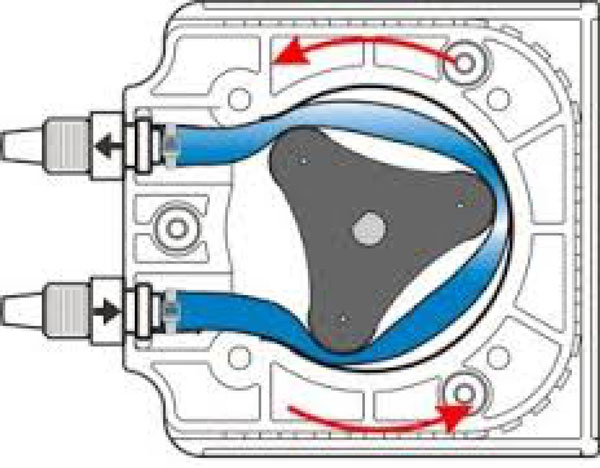
(Excerpt from internet)
As a kind of metering pump, peristaltic pump can be conveniently used for quantitative delivery. It has a wide range of application scenarios, such as science experiment, hydroponics, drip irrigation, tropical fish farming, shrimp cylinder environment control, etc. A large number of titration experiments can be automated with this peristaltic pump, such as potentiometric titration, indicator-based colorimetric titration, pH-based titration, and so on. It is great helpful to improve your working efficiency
At the other hand, peristaltic pumps also have a wide range of applications in food, medical and other industries. Making an automatic coffee machine will be a really good idea!
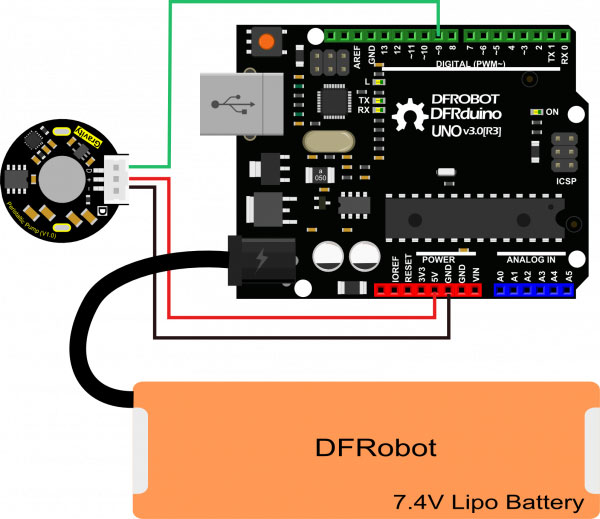
Arduino Peristaltic Pump
FEATURES
Peristaltic pump
- Low noise,
- Low cost,
- Simple structure,
- Easy to maintain,
- Three rotors with moderate pulsation,
- Non-toxic and pollution-free
Driver board
- Gravity 3Pin digital connector, plug and play
- Servo PPM control signal, driving easily and compatible with Arduino, Raspberry Pi, micro: bit and other controllers.
SPECIFICATION
Driver Board
- Input Voltage: 5V-6V
- Maximum Continuous Operating Current: 1.8A
- Peak Current: 2.5A
- Quiescent Current: <1mA (No PPM Signal Input)
- PPM Signal Resolution: 1us
- Positive Pulse Width of the PPM Signal: 500us-2500us
- Forward Pulse Width Range: 500us-1400us (500us: max forward speed)
- Stop Pulse Width Range: 1400us-1600us
- Inverted Pulse Width Range: 1600us-2500us (2500us: max inverted speed)
- PPM Frequency: 50Hz (Servo Control Signal)
- Connector: Gravity PH2.0-3P
- Size: 27.4 x 28.7 mm/1.08 x 1.13 inches
Peristaltic Pump
- Motor: DC Motor
- Rated Voltage: 6V
- Rated Power: 5W
- Tube Material: BPT
- Tube Specifications: inner diameter 2.5mm, outer diameter 4.5mm
- Pump Head Material: Engineering Plastics
- Pulsation: Three Rollers, Small Pulsation
- Flow: ≥45ml/min (almost 1ml/s)
- Working Conditions: ambient temperature 0 ~ 40 ℃, relative humidity <80%
DOCUMENTS
Jargon buster
Plain-language definitions for the technical terms used above.
- DC
- DC means direct current, where electricity flows in one constant direction, as supplied by batteries, USB ports and many plug-pack power supplies. When a product specifies DC, it runs from a DC supply rather than mains AC, so you need to provide the correct voltage and polarity.
- Gravity
- Gravity is DFRobot’s plug-in connector system for sensors, motors and modules, using standard cables to reduce loose jumper wiring. It matters because Gravity-compatible parts can connect directly to these ports, while non-Gravity parts may need adapters or manual wiring.
- microcontroller
- A microcontroller is a small computer on a single chip that runs a stored program and controls connected inputs and outputs such as buttons, sensors, displays and communication interfaces. In a device built around one, it is the part that executes the code and coordinates the device's behaviour.
- motor driver
- An electronic circuit that lets a low-power controller switch and control a motor that needs more current than the controller pins can safely provide. Checking motor driver support matters because pumps and motors usually cannot be connected directly to a microcontroller output.
- peristaltic pump
- A peristaltic pump moves liquid by squeezing flexible tubing in a rolling motion, so the liquid only ever touches the inside of the tube. This matters when dosing small, repeatable amounts of fluid or pumping liquids that must stay uncontaminated, because the pump's moving parts never contact the liquid.
- pH
- A measure of how acidic or alkaline a liquid is, on a scale from 0 to 14 where 7 is neutral, lower is acidic and higher is alkaline. When a probe or sensor quotes a pH range and accuracy, check they cover the readings your project needs.
- ppm
- ppm means parts per million, a common way to express very small gas concentrations in air. For CO₂ sensors, the ppm range tells you what levels the sensor can measure, such as normal indoor air through to poorly ventilated spaces.
- Pulse width range
- The span of control pulse lengths a servo understands, usually measured in microseconds. Matching this range in your code affects how far the servo moves and helps avoid commanding positions outside its intended travel.
- servo
- A servo is a motor with built-in position control, usually told to move to a specific angle by a control signal. It matters when you need repeatable movement, such as steering, arms, flaps, or linkages, rather than continuous spinning.
Find this product in
Brands
Supplier page — dfrobot.com
Supplier Description · 588.1 KB · Click any page to view full size
Resources & Downloads
Guides, code examples, and more
Source Code
Open-source libraries, firmware & example projects for this product
Gravity: digital peristaltic pump is a new product developed by DFRobot. This is a new member of our water quality monitoring devices. It is an actuator for the liquid system.
ec5dfd6
over 8 years ago
· 8 commits
- GravityPump.cpp add function Comments over 8 years ago
- GravityPump.h add function Comments over 8 years ago
- PumpTest.ino add the address of the button.h over 8 years ago
- README.md Update README.md over 8 years ago

