

Store

DFRobot

5.0 (1 review)

$16.72 |
In stock
5.0 (1 review)

DFRobot FireBeetle series is the low-power consumption micro-controller intentionally designed for Internet of Things (IoT) projects. FireBeetle Board - E...

Estimated Delivery
Arrives
Disclaimer
View Markdown
Secure checkout

DFRobot FireBeetle series is the low-power consumption micro-controller intentionally designed for Internet of Things (IoT) projects. FireBeetle Board - ESP32 integrates a Dual-Core ESP-WROOM-32 module, which supports MCU and Wi-Fi &Bluetooth dual-mode communication. The electric current is just 10µA in the deep-sleep mode. The main controller supports two power supply methods: USB and 3.7V external lithium battery. And both USB and external DC can charge the Lipo battery directly.

FireBeetle Board-ESP32 has made a special hardware design for Arduino IDE. You can make a download without switching booth-mode manually. It supports Arduino, IDF (linux), micropython etc. Moreover, FireBeetle made a pin mapping for Arduino IDE. It can be configured with Dx transport, compatible with UNO and reduce the entry barrier. The small size and high performance makes FireBeetle become idea solution for IOT low power consumption projects.
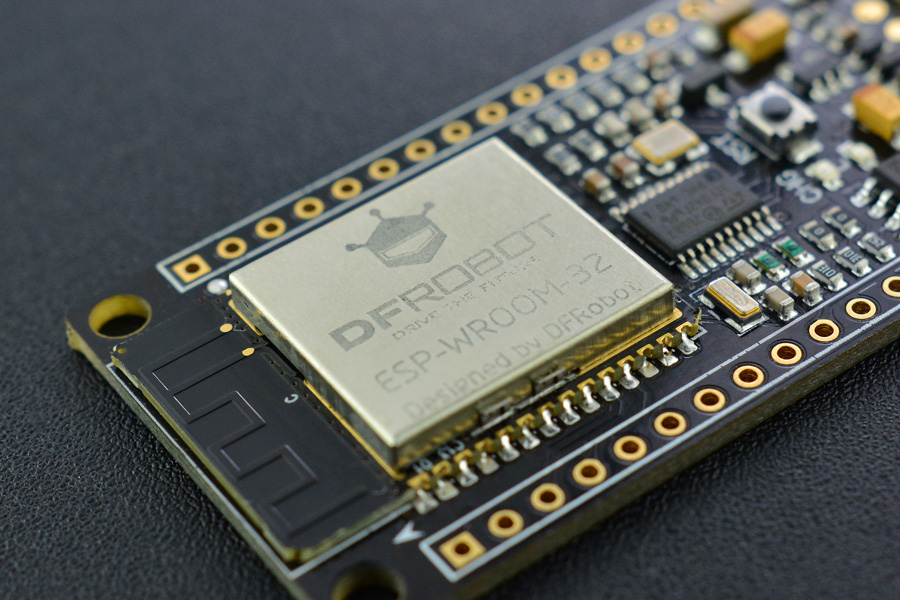
Please kindly note that developers are the most common users of FireBeetle Board-ESP32 and not all of the peripherals have examples for reference, and there are still some bugs being found and fixed. For Arduino IDE, all GPIO function, I2C/SPI communication has been working. But the other functions are still under development. We recommend this board for experienced engineer.


FEATURES

  • Compatible with products in the DFRobot FireBeetle serials
  • Low-power consumption(the electricity current under ultra-low power is 10µA)
  • Quick Response(the top frequency is 400KHz)
  • Cost-effective
  • Small size, convenient to install

  • SPECIFICATIONS

  • Working voltage: 3.3V
  • Input voltage: 3.3V~5V
  • Support electric current of low power consumption: 10 µA
  • Support maximum discharge current: 600mA
  • Support maximum charge current: 500mA
  • Support USB charging.
  • Processer: Tensilica LX6 dual core processer (One for high speed connection; one for independent programing).
  • Frequency: 240MHz
  • SRAM: 520KB
  • Flash: 16Mbit
  • Wi-Fi standard: FCC/CE/TELEC/KCC
  • Wi-Fi protocol: 802.11 b/g/n/d/e/I/k/r (802.11n, high speed can reach to 150 Mbps), converge A-MPDU and A-MSDU, supporting 0.4us protecting interval.
  • Frequency range: 2.4~2.5 GHz
  • Bluetooth protocol: Comply with BR/EDR/BLE standard of Bluetooth v4.2.
  • Bluetooth audio: the current under low power consumption of CVSD and SBC is 10µA
  • Working current: 80mA in average
  • Frequency range: 2.4~2.5GHz
  • Support one-key downloading.
  • Support micropython.
  • On-chip clock: 40MHz crystal and 32.768 KHz crystal.
  • Digital I/O: 10 (default setting of arduino)
  • Simulative input: 5(default setting of arduino)
  • SPI: 1 (default setting of arduino)
  • I2C: 1 (default setting of arduino)
  • I2S: 1 (default setting of arduino)
  • LED_BUILTIN: D9
  • Interface: FireBeetle series compatible
  • Working temperature: -40°C~+85°C
  • Dimension: 24 x 53(mm)/0.94 x 2.09(inches)
  • The dimension of mounting hole: inner diameter 3.1mm; outside diameter 6mm.

  • DOCUMENTS

  • Product Wiki
  • More

  • SHIPPING LIST

  • FireBeetle ESP32 IOT Microcontroller x1
  • 18 pin-2.54mm x4
  • 18 female header-2.54mm x4
  • Jargon buster

    Plain-language definitions for the technical terms used above.

    BLE
    BLE stands for Bluetooth Low Energy, a Bluetooth mode designed for lower power use and modern phone compatibility. It matters because BLE support can make the module easier to use with Apple devices and battery-powered projects, though it may behave differently from classic serial Bluetooth.
    ESP32
    ESP32 is a family of microcontroller modules with built-in wireless features such as Bluetooth and WiFi. Knowing this product uses an ESP32-based module helps explain how it provides wireless serial communication and firmware update features.
    GPIO
    General-purpose input/output pins are microcontroller pins you can set in software to read signals, switch devices on and off, or connect to peripherals. The number of GPIO pins matters because it limits how many buttons, LEDs, sensors, and other parts you can wire directly to the board.
    I2C
    I2C is a two-wire communication bus used by many sensors and small modules. It matters because several I2C devices can share the same two wires, but each device needs a compatible address and your controller must support I2C.
    I2S
    I2S is a digital audio interface used to send sound data between chips, such as from a microcontroller to an audio amplifier or DAC. It matters if your project needs cleaner digital audio output than a basic buzzer or PWM signal can provide.
    IDE
    Short for Integrated Development Environment, a program used to write, run and manage code. It matters because some learners prefer a traditional coding workspace instead of a guided notebook-style lesson.
    IoT
    Short for Internet of Things, meaning physical devices that connect to networks or the internet to send data or be controlled remotely. It matters if you want projects such as connected sensors, remote controls or classroom data-logging activities.
    LiPo
    A lithium polymer rechargeable battery commonly used in portable electronics projects. It matters because LiPo batteries need correct charging circuitry and care, and this board includes hardware intended for that battery type.
    microcontroller
    A microcontroller is a small computer on a chip that runs your program and controls connected inputs and outputs. For this product, it is the part that reads buttons and sensors, drives the display and speaker, and communicates over Bluetooth.
    MicroPython
    A version of the Python programming language made to run on microcontrollers. It matters because it lets beginners write readable code to control LEDs, sensors, motors and displays without needing to start with lower-level languages.
    SPI
    A fast serial communication bus often used for displays, memory cards, and sensors. It matters because SPI devices need specific pins for clock and data, plus a separate chip-select line for each device.
    SRAM
    Fast temporary memory used by a processor while a program is running. More SRAM helps with projects that handle larger data buffers, networking, displays, or more complex code.

    Supplier page — dfrobot.com

    Supplier Description · 777.4 KB · Click any page to view full size

    Download PDF
    Stella
    Stella Expert

    Ask me anything about this product

    Maddy, co-founder of Little Bird

    Need help? We're here for you!

    Hi, I'm Maddy. My team and I are ready to help with your order or any questions.

