

Adafruit
DHT20 - AHT20 Pin Module - I2C Temperature and Humidity Sensor
·
The DHT20 is a nice but inexpensive temperature and humidity sensor from the same folks that brought us the DHT22.This little sensor looks an awful lot&...
Get notified when back in stock
The DHT20 is a nice but inexpensive temperature and humidity sensor from the same folks that brought us the DHT22.
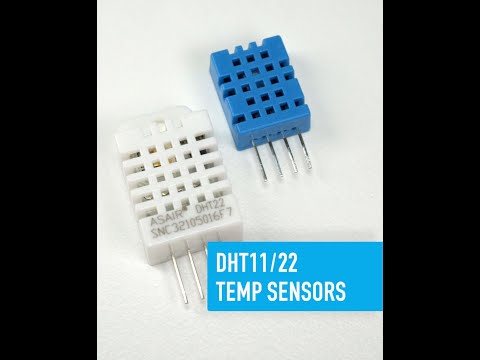
This little sensor looks an awful lot like the popular DHT11/DHT22 temperature and humidity sensors, but unlike classic DHT sensors, it has an I²C interface! That's right, you do not need to use a bit-bang timing-specific protocol to talk to the DHT20, it uses plain-old-I²C. And, you can power it with anything from 2.5V to 5.5V so it's good with 3V or 5V microcontrollers. Whew, that makes things a little easier, doesn't it?
Inside is the AHT20. You can take sensor readings as often as you like, and it uses standard I2C so its super easy to use with any Arduino or Linux/Raspberry Pi board.
This sensor has a typical accuracy of ±2% relative humidity, and ±0.3 °C at 20-80% RH and 20-60 °C. There is only one I2C address so it's not a good option when you need multiple humidity sensors.
That said, for maker and IoT projects? You can't beat the simplicity and price! And we've got ready-to-go working Arduino and CircuitPython code to use it. Check out our detailed guide for library code, datasheet, and more
Each order comes with one DHT20 pin module sensor with built-in pullups. You just provide any microcontroller that can run our Arduino or CircuitPython library.
Jargon buster
Plain-language definitions for the technical terms used above.
- CircuitPython
- A beginner-friendly version of Python designed to run directly on microcontroller boards. If a product supports CircuitPython, you can often program it by copying code files onto the board rather than setting up a more complex toolchain.
- I2C
- I2C is a two-wire communication bus used by many sensors and small modules. It matters because several I2C devices can share the same two wires, but each device needs a compatible address and your controller must support I2C.
- I2C address
- An I2C address is the number a device uses so a microcontroller can tell it apart from other devices on the same I2C bus. It matters because two devices with the same fixed address may conflict if used together.
- IoT
- Short for Internet of Things, meaning physical devices that connect to networks or the internet to send data or be controlled remotely. It matters if you want projects such as connected sensors, remote controls or classroom data-logging activities.
- microcontroller
- A microcontroller is a small computer on a single chip that runs a stored program and controls connected inputs and outputs such as buttons, sensors, displays and communication interfaces. In a device built around one, it is the part that executes the code and coordinates the device's behaviour.
Find this product in
adafruit aht20
Document · 4.8 MB · Click any page to view full size
Resources & Downloads
Guides, code examples, and more

