Store

Adafruit

5.0 (1 review)

$39.51 |
Only 1 left
5.0 (1 review)

A Feather board without ambition is a Feather board without FeatherWings! This is the DC Motor + Stepper FeatherWing which will let you use...

Estimated Delivery
Arrives
Disclaimer
View Markdown
Secure checkout

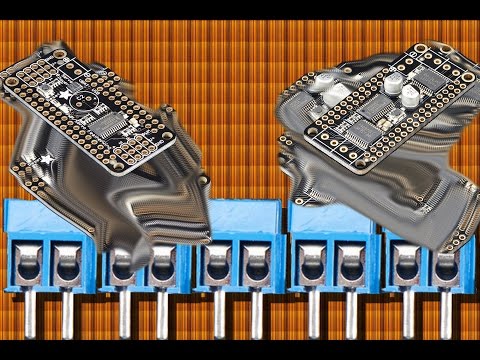
A Feather board without ambition is a Feather board without FeatherWings! This is the DC Motor + Stepper FeatherWing which will let you use 2 x bi-polar stepper motors or 4 x brushed DC motors (or 1 stepper and 2 DC motors). Using our Feather Stacking Headers or Feather Female Headers you can connect a FeatherWing on top or bottom of your Feather board and let the board take flight!

The original Adafruit Motorshield Kit is one of our most beloved kits, which is why we decided to squish it all together on a FeatherWing to make something even smaller, lighter, and more portable! Instead of using a latch and the Arduino's PWM pins, we have a fully-dedicated PWM driver chip onboard. This chip handles all the motor and speed controls over I2C.

Since the FeatherWing only uses the I2C (SDA & SCL pins), it works with any and all Feathers. You can stack it with any other FeatherWing or with itself (just make sure you have each wing with a unique I2C address) Check out our range of Feather boards here.

Motor FeatherWing Specs:

  • 4 full H-Bridges: the TB6612 chipset provides 1.2A per bridge with thermal shutdown protection, internal kickback protection diodes. Can run motors on 4.5VDC to 13.5VDC.
  • Up to 4 bi-directional DC motors with individual 12-bit speed selection (so, about 0.02% resolution)
  • Up to 2 stepper motors (unipolar or bipolar) with single coil, double coil, interleaved or micro-stepping.
  • Motors automatically disabled on power-up
  • Big 3.5mm terminal block connectors to easily hook up wires (18-26AWG) and power
  • Polarity protected 2-pin terminal block and jumper to connect external power, for separate logic/motor supplies
  • Completely stackable design: 5 address-select jumper pads means up to 32 stackable wings: that's 64 steppers or 128 DC motors! What on earth could you do with that many steppers? I have no idea but if you come up with something send us a photo because that would be a pretty glorious project.
  • Download the easy-to-use Arduino software library, check out the examples and you're ready to go!

Comes with an assembled & tested FeatherWing, terminal blocks & plain header. Some soldering is required to assemble the headers on. Stacking headers not included, but we sell them in the shop so if you want to stack shields, please pick them up at the same time. Feather and motors are not included but we have lots of motors in the shop. You can use any DC or stepper motors that run from 4.5-13.5VDC and draw under 1.2A per coil. You'll likely also need to provide some external power supply for your motors, since its not suggested you run motors from the Feather's lipoly battery.

We have a great tutorial in the Adafruit Learning System with a lot of documentation and example code in both Arduino and CircruitPython, so please check it out! Please note that unlike the original full sized shield, there's no servo connections (they wouldn't fit!) So if you need a bunch of servos, check out our 8-channel Servo Featherwing

//www.youtube.com/embed/B-brDrnMXqY?start=527

Jargon buster

Plain-language definitions for the technical terms used above.

FeatherWing
A FeatherWing is an add-on board made to plug into the Feather microcontroller board layout. Knowing a product is a FeatherWing helps you check whether it will physically and electrically fit your Feather-style mainboard.
Headers
Rows of metal pins used to plug a module into a breadboard or connect it with jumper wires. Pre-soldered headers make the module easier to use straight away without needing to solder the pins yourself.
I2C
I2C is a two-wire communication bus used by many sensors and small modules. It matters because several I2C devices can share the same two wires, but each device needs a compatible address and your controller must support I2C.
I2C address
An I2C address is the number a device uses so a microcontroller can tell it apart from other devices on the same I2C bus. It matters because two devices with the same fixed address may conflict if used together.
PWM
Pulse Width Modulation is a way for a digital pin to simulate variable output power by switching on and off very quickly. It matters for controlling things like LED brightness, motor speed, or servo-style signals from a microcontroller pin.
servo
A servo is a motor with built-in position control, usually told to move to a specific angle by a control signal. It matters when you need repeatable movement, such as steering, arms, flaps, or linkages, rather than continuous spinning.
Shield
An add-on board that plugs into a main controller board to give it extra features such as sensing, motor control or communication. Knowing a product supports shields helps you judge whether it can connect neatly into an existing maker-board setup.
Terminal block
A connector used to join wires together in a neat, removable, or serviceable way. For this product, it helps split one power input into several outputs without soldering.

Related Tutorials

Free guides on learn.littlebird.com.au

Stella
Stella Expert

Ask me anything about this product

Maddy, co-founder of Little Bird

Need help? We're here for you!

Hi, I'm Maddy. My team and I are ready to help with your order or any questions.