AI agents & screen readers: for a machine-readable, text-only catalogue,
start at /llms.txt.
Products are available as Markdown
(/products.md, /products/{handle}.md)
and JSON
(/products.json, /products/{handle}.json).
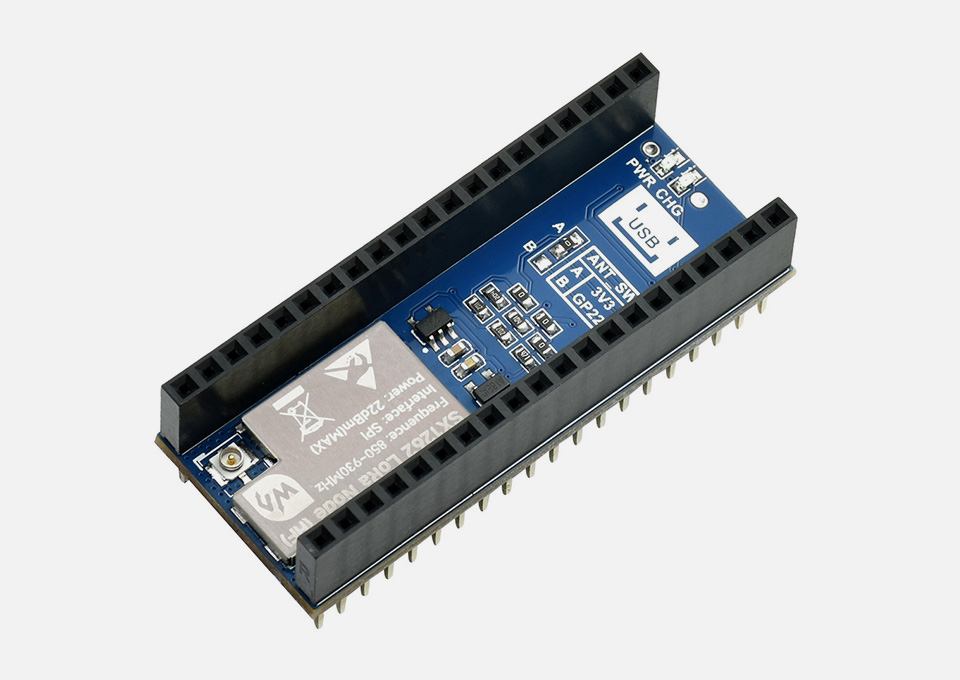
The Pico-LoRa-SX1262-XXXM is LoRa node expansion module designed for Raspberry Pi Pico based on SX1262 with better performance than the SX127X series. The LoRa modulation technology solves the balancing problem between transmission distance, interference immunity, and power consumption that traditional solutions aren't able to deal with.
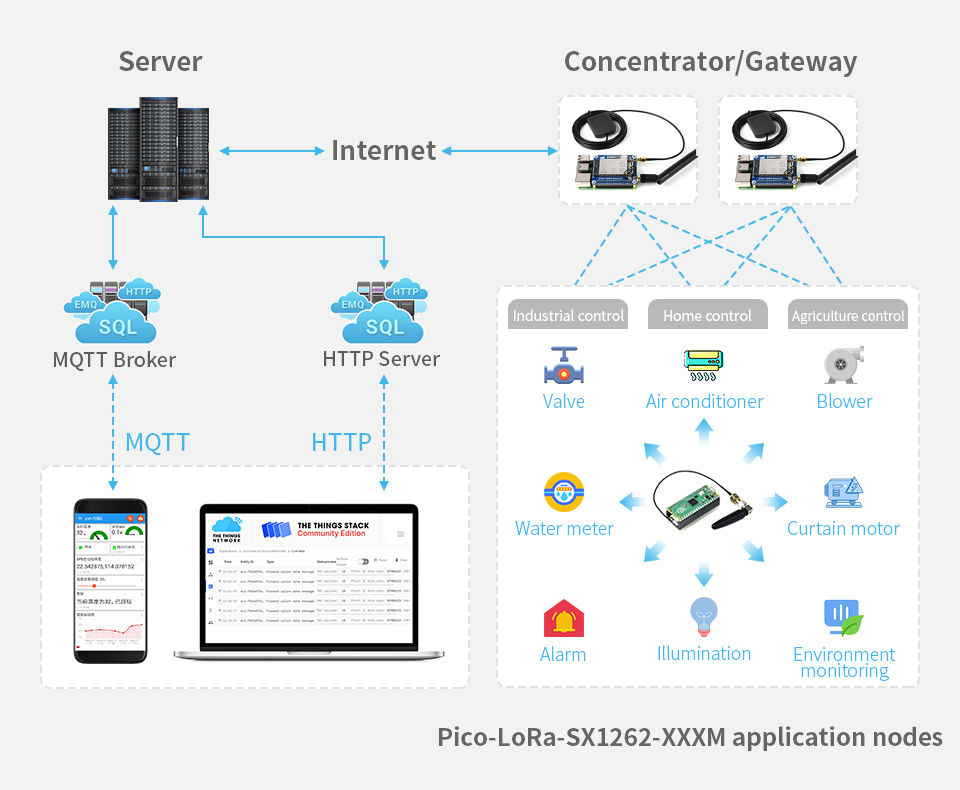
It supports LoRaWAN protocol, which allows it to connect the TTN, ChirpStack servers through a LoRa gateway to use LoRa Cloud service fast and easily.
Standard Raspberry Pi Pico header, supports Raspberry Pi Pico series boards
Supports LoRaWAN protocol, different frequency bands are available
Adopts active temperature compensation crystal oscillator, ensuring stable long-term operating in extreme high/low temperature conditions
Supports FSK, GFSK, LoRa modulations, outstanding block resistance and ultra long communication distance
High receiving sensitivity (up to -148dBm), programmable emitting power (up to 22dBm)
Supports preamble detection, with CRC, up to 256 bytes data packet engine
Comes with development resources and manual (example in C)
Specifications
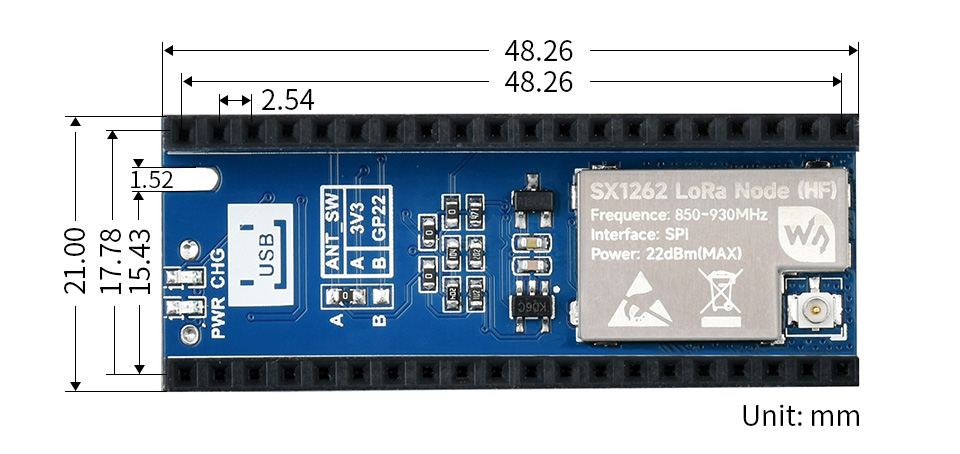
FREQUENCY BAND433M (410~525MHZ)868M (863~870MHZ)915M (902~930MHZ) RFID | SX1262 Emiting power | 22dBm Emiting current | 107mA@22dBm | 118mA@22dBm Receiving current | 5.3mA@125KHz Modulation | LoRa/(G)FSK Operating voltage | 3.3V Communication bus | SPI Operating temperature | -40 ~ 85℃ Dimensions | 21.00 × 52.00mm
Raspberry Pi Pico Header Compatibility
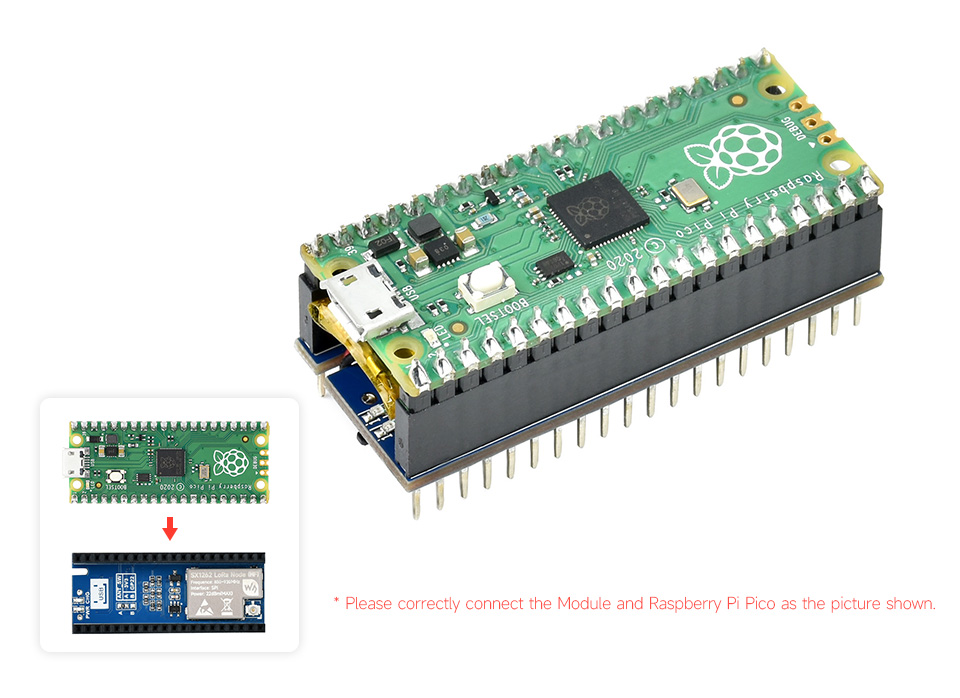
Onboard Female Pin Header For Direct Attaching To Raspberry Pi Pico
Raspberry Pi Pico is NOT included.
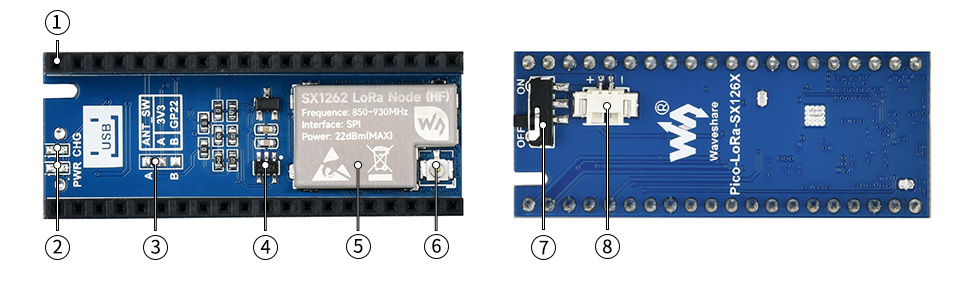
What's On Board
Raspberry Pi Pico header
Status indicators PWR: power indicator CHG: recharge indicator
RF switch control A: controlled by high level B: controlled by GPIO22
MCP73831 recharge IC
SX1262 module
IPEX 1 antenna connector
Power switch
PH1.25 battery header
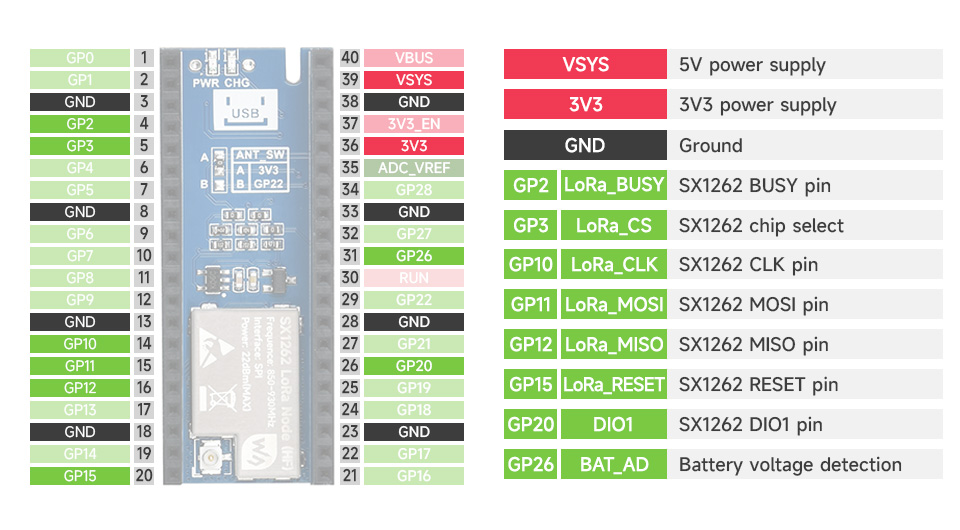
Pinout Definition
Application Examples
Industrial Control, Intelligent Home, And Data Acquisition...
Plain-language definitions for the technical terms used above.
LoRa
LoRa is a long-range, low-power wireless radio technology often used for telemetry, remote sensors and other links that send small amounts of data over long distances. It is distinct from Bluetooth and WiFi, so sharing a connector or pinout with LoRa hardware does not mean a device actually uses LoRa.
MCP73831
A lithium battery charger chip used to safely charge a single-cell LiPo battery. It matters because it lets the board recharge a battery from USB or another input without needing a separate charger module.
RF
RF means radio frequency, referring to signals used for wireless communication and other high-frequency electronics. A low-noise, stable power supply is important for RF circuits because power noise can affect signal quality and measurements.
SPI
A fast serial communication bus often used for displays, memory cards, and sensors. It matters because SPI devices need specific pins for clock and data, plus a separate chip-select line for each device.
Temperature compensation
Temperature compensation is when a sensor or instrument adjusts its readings to reduce errors caused by changes in temperature. This matters because a sensor's raw output often drifts as conditions warm or cool, so compensation keeps readings more consistent and accurate over time.
j / ↓Move selection downk / ↑Move selection upgJump to first itemGJump to last itemaAdd selected to cartoOpen in new browser tabuToggle unavailable productsBackspaceRemove 1 qty (cart tab)XClear entire cartcCheckout/Search productsEscBack / cancel / close:Command mode?Toggle this help1-3Switch tabs