SparkFun
SparkFun Spectral UV Sensor - AS7331 (Qwiic)
·
This SparkFun Qwiic Spectral UV Sensor features the AS7331 UV sensor from ams OSRAM©. It measures UV radiation on three channels: UVA (320-400nm), UVB (280-3...
Get notified when back in stock
This SparkFun Qwiic Spectral UV Sensor features the AS7331 UV sensor from ams OSRAM©. It measures UV radiation on three channels: UVA (320-400nm), UVB (280-320nm), and UVC (200-280nm) with high sensitivity and accuracy. The three channels on the AS7331 each have individual photodiodes with built-in interference filters. The sensor has four operating modes: Single Measurement (CMD), Continuous Measurement (CONT), SYNchronized Start (SYNS), and SYNchronized Start & End (SYND), with an automatic power-down sequence between measurements for low current consumption in all three modes.
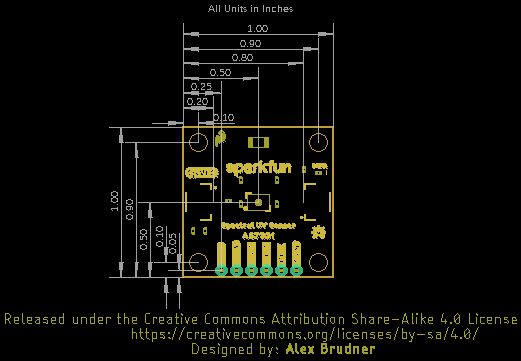
The AS7331 communicates over I2C, so naturally, this breakout routes the I2C bus pins (3.3V, GND, SDA, and SCL) to a pair of Qwiic connectors on each side of the board for solderless assembly but also routes them to a 0.1in.-spaced through-hole header on the bottom of the board for users who prefer a soldered connection. This header also includes the sensor's Interrupt and Sync pins. The AS7331 has four I2C addresses (default: 0x74) set by adjusting the A1 and A0 solder jumpers on the back of the board.
We've written an Arduino library to make it simple to quickly get started configuring the AS7331 and receiving UV radiation data from the sensor. Download it through the Arduino Library Manager tool by searching for 'SparkFun AS7331' or download it from the GitHub repository linked in the Documents tab.
The SparkFun Qwiic Connect System is an ecosystem of I2C sensors, actuators, shields and cables that make prototyping faster and less prone to error. All Qwiic-enabled boards use a common 1mm pitch, 4-pin JST connector. This reduces the amount of required PCB space, and polarized connections mean you can’t hook it up wrong.
Features:
- Operating Voltage: 2.7V-3.6V
- Current Consumption:
- Active Measurement: 1.42mA (Typ.)
- Standby Mode: 970µA
- Power Down Mode: 1µA
- Three UV Channels: UVA, UVB, & UVC
- Each with dedicated photodiode
- Four Operating Modes:
- Single Measurement
- Continuous Measurement
- Synchronized Start Measurement
- Synchronized Start/Stop Measurement
- High Dynamic Range: Up to 3.43E+10 (resolution multiplied by gain range)
- 2x Qwiic Connectors
- Four Adjustable I2C Addresses
- Set through A0 & A1 pins
- 0x74 (Default), 0x75, 0x76, & 0x77
Documents:
- Schematic
- Eagle Files
- Board Dimensions
- Hookup Guide
- Datasheet (AS7731)
- Qwiic Info Page
- SparkFun AS7331 Arduino Library
- GitHub Hardware Repo
Videos
Jargon buster
Plain-language definitions for the technical terms used above.
- AS7331
- The AS7331 is an ams OSRAM sensor chip that measures ultraviolet light across separate UVA, UVB and UVC bands. The part number tells you which libraries, datasheets and measurement capabilities apply, since software support and behaviour are tied to that specific chip.
- breakout
- A breakout board carries a small or fine-pitched component and brings its connections out to standard, breadboard- and header-friendly pins. Describing a part as a breakout means it can be wired into a project without soldering directly to the component's tiny contacts.
- dynamic range
- Dynamic range describes how wide a span of values a sensor can measure, from very low to very high. For a light sensor, a wide dynamic range means it can work in dim indoor settings as well as bright sunlight without changing hardware.
- GND
- GND is the ground or reference connection (0 V) for a circuit. When connecting two devices together, their grounds must be joined so both agree on what counts as a low or high signal.
- PCB
- A printed circuit board (PCB) is a board, usually rigid, with etched copper tracks that connect electronic components together without loose wiring. Components are mounted on the board and signals route between them through the copper layout.
- photodiode
- A photodiode is a light-sensitive component that produces a small electrical signal, a current or voltage, when light falls on it. When a sensor uses several photodiodes, each can be tuned to a different part of the spectrum so the chip can measure several wavelength bands separately.
- Qwiic
- Qwiic is a plug-in connector system for I2C devices that uses small 4-pin cables, so you can connect compatible sensors without soldering. It matters because your controller or adapter also needs Qwiic, or you will need a cable or breakout to wire it up.
- SCL
- The clock line used by the I2C bus to keep data transfers timed between a controller and connected devices. When wiring I2C, SCL must be connected to the SCL pin on every device sharing the bus.
- SDA
- The data line used by the I2C bus to carry information between a controller and connected devices. When wiring I2C, SDA must be connected to the SDA pin on every device sharing the bus.
- through-hole
- A mounting style where the component leads pass through holes in a circuit board and are soldered on the other side. Through-hole parts are often easier to handle and solder by hand, which is useful for classroom and hobby projects.
- UVA
- UVA is the longer-wavelength part of ultraviolet light, closest to visible violet light. Measuring it separately matters when you need to distinguish general UV exposure from the more energetic UVB and UVC bands.
- UVB
- UVB is a middle band of ultraviolet light that is more energetic than UVA and is important in sun exposure and plant-related UV monitoring. A sensor with a separate UVB channel lets you measure this band without it being mixed together with other UV light.
- UVC
- UVC is a short-wavelength, high-energy band of ultraviolet light often used in germicidal lamps and curing applications. A separate UVC reading matters if your project needs to monitor or verify UVC sources rather than just detect general UV light.
Find this product in
SparkFun Qwiic UV Sensor AS7331 Schematic
Schematic · 101.8 KB · Click any page to view full size
AS7331 Datasheet
Datasheet · 2.2 MB · Click any page to view full size
Supplier page — sparkfun.com
Supplier Description · 745.3 KB · Click any page to view full size
Resources & Downloads
Guides, code examples, and more
Source Code
Open-source libraries, firmware & example projects for this product
Arduino library for the SparkFun AS7331 Qwiic Spectral UV Sensor, which measures UV radiation on three channels, UVA, UVB, and UVC, with high sensitivity and accuracy.
3e22fb4
over 1 year ago
· 62 commits
- .github wrong toolkit name - grrr over 1 year ago
- docs make inherited members visible on arduino class over 1 year ago
- examples modifications to move to toolkit v1.0; updates to naming scheme and dir structure of independant section of code over 1 year ago
- src move to updated toolkit api; tweaks to call parameters for toolkit over 1 year ago
- .gitattributes Add library files. about 3 years ago
- .gitignore Add library files. about 3 years ago
- .gitmodules enable /setup initial doxygen for github pages files over 1 year ago
- keywords.txt Merge branch 'main' into work almost 3 years ago
- library.properties fix version over 1 year ago
- LICENSE Initial commit about 3 years ago
- README.md better doc link over 1 year ago
he SparkFun Spectral UV Sensor - AS7331 (Qwiic) measures UV radiation on three channels
b1354e6
4 months ago
· 25 commits
- .github fix mkdocs checkout 4 months ago
- docs Merge branch 'main' of https://github.com/sparkfun/SparkFun_Spectral_UV_Sensor_AS7331 almost 3 years ago
- Documentation Update datasheet to latest. about 3 years ago
- Hardware Pushing to v10 about 3 years ago
- overrides Deploy Fix 2 almost 3 years ago
- Production Remove unneeded folders and add production files. about 3 years ago
- .gitattributes Initial commit about 3 years ago
- .gitignore Initial commit about 3 years ago
- CONTRIBUTING.md Initial commit about 3 years ago
- ISSUE_TEMPLATE.md Initial commit about 3 years ago
- LICENSE.md Initial commit about 3 years ago
- mkdocs.yml Update mkdocs.yml 4 months ago
- README.md Deploy Fix 3 almost 3 years ago