SparkFun
SparkFun MicroMod mikroBUS Starter Kit
The SparkFun MicroMod mikroBUS™ Starter Kit is designed to give you just what you need to start using the MicroMod and Click ecosystems side-by-side. The cor...
Get notified when back in stock
- 1x SparkFun MicroMod mikroBUS™ Carrier Board
- 1x SparkFun MicroMod STM32 Processor
- 1x MIKROE Terminal Click
- 1x MIKROE Weather Click
- 1x SparkFun Serial Basic Breakout - CH340C and USB-C
- 1x USB 3.1 Cable A to C - 3 Foot
- 1x Jumper Wires Premium 6" M/F Pack of 10
- 1x MicroMod Screwdriver
- M.2 MicroMod (Processor Board) Connector
- USB-C Connector
- 3.3V 1A Voltage Regulator
- Qwiic Connectors (x2)
- mikroBUS Socket
- Boot/Reset Buttons
- Charge Circuit
- JTAG/SWD PTH Pins
- ARM® 32-bit Cortex®-M4 CPU with FPU
- Adaptive real-time accelerator (ART Accelerator™) allowing 0-wait state execution from Flash memory
- Frequency up to 168 MHz
- Memory protection unit
- 210 DMIPS/ 1.25 DMIPS/MHz (Dhrystone 2.1)
- DSP instructions
- 1 MB of Flash memory
- 192 Kbytes of SRAM including 64 Kbytes of CCM (core coupled memory) data RAM
- Flexible static memory controller supporting Compact Flash, SRAM, PSRAM, NOR and NAND memories
- Clock, reset and supply management
- 1.8 V to 3.6 V application supply and I/Os
- 32 kHz oscillator for RTC with calibration
- Internal 32 kHz RC with calibration
- Low-power operation
- Sleep, Stop and Standby modes
- Debug mode
- Serial wire debug (SWD) & JTAG interfaces
- Cortex-M4 Embedded Trace Macrocell™
- Advanced connectivity
- USB 2.0 full-speed device/host/OTG controller with on-chip PHY
- USB 2.0 high-speed/full-speed device/host/OTG controller with dedicated DMA, on-chip full-speed PHY and ULPI
- 10/100 Ethernet MAC with dedicated DMA: supports IEEE 1588v2 hardware, MII/RMII
- UART
- Two I2C Buses
- SPI Bus
- PDM Audio Processing
- Two Dedicated Analog Inputs, 15 total analog input capable inputs
- Schematic
- Eagle Files
- Board Dimensions
- Hookup Guide
- Getting Started with Necto Studio
- mikroBUS Standard
- Qwiic Info Page
- GitHub Hardware Repo
- Schematic
- Eagle Files
- Hookup Guide
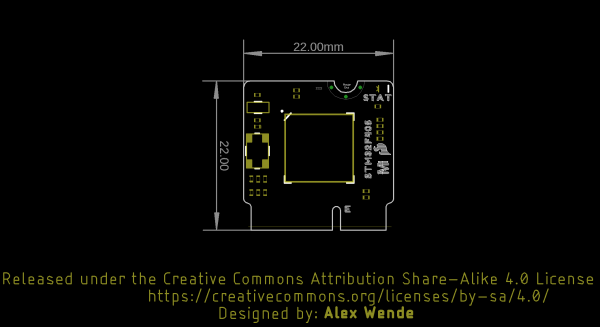
- Board Dimensions
- Datasheet (STM32F405xx)
- Graphical Datasheet
- GitHub Hardware Repo
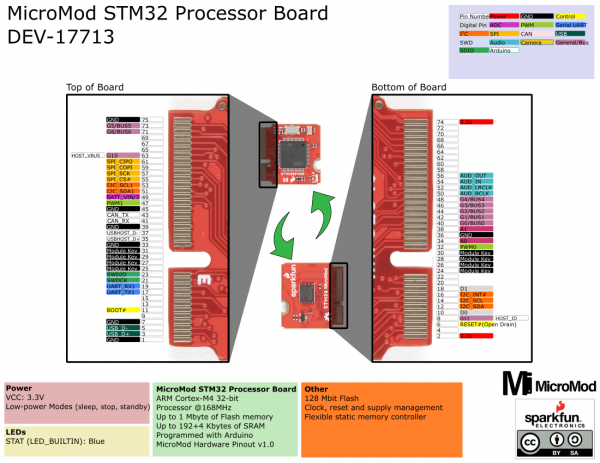
- SparkFun MicroMod Interface v1.0 - Pinout
- SparkFun MicroMod Interface v1.0 - Pin Descriptions
- Getting Started with MicroMod
- Designing with MicroMod
- MicroMod Info Page
- MicroMod Forums
- SparkFun Eagle Libraries contains example footprints for the M.2 connector and SMD standoff
- M.2 MicroMod Connector Datasheet
- MicroMod Reflowable Standoff Datasheet
- Schematic
- Eagle Files
- Hookup Guide
- Datasheet (CH340C)
- Drivers
- GitHub
Jargon buster
Plain-language definitions for the technical terms used above.
- breakout
- A breakout board carries a small or fine-pitched component and brings its connections out to standard, breadboard- and header-friendly pins. Describing a part as a breakout means it can be wired into a project without soldering directly to the component's tiny contacts.
- DSP
- Digital signal processing means using software or hardware to analyse or modify signals such as audio, vibration, or sensor readings. A board suited to DSP is useful when a project needs fast maths for filtering, synthesis, or real-time signal analysis.
- Flash memory
- Flash memory is non-volatile memory that retains stored data even when power is removed, and can be erased and rewritten in blocks. It lets data such as firmware, settings or saved records persist across power cycles.
- FPU
- A floating-point unit is hardware inside a processor that speeds up calculations with decimal numbers. This helps when projects use maths-heavy tasks such as motion sensing, filtering sensor readings, or audio processing.
- I2C
- I2C is a two-wire communication bus used by many sensors and small modules. It matters because several I2C devices can share the same two wires, but each device needs a compatible address and your controller must support I2C.
- JTAG
- JTAG is a hardware debugging and programming interface used to inspect and control chips at a low level. It matters for advanced development because it can help diagnose firmware problems that are hard to see through normal serial output.
- M.2
- M.2 is a compact edge-connector standard for plugging small modules - such as SSDs, wireless cards or microcontroller modules - into a host board without soldering. The same slot shape can carry different interfaces (for example PCIe, SATA or USB), so keying and the supported module type need to be checked.
- microcontroller
- A microcontroller is a small computer on a single chip that runs a stored program and controls connected inputs and outputs such as buttons, sensors, displays and communication interfaces. In a device built around one, it is the part that executes the code and coordinates the device's behaviour.
- MicroMod
- MicroMod is a modular board system where a small processor board plugs into a separate carrier board (via an M.2 connector) that provides connectors, power, and peripherals. Within the MicroMod system, a board is either a processor board or a carrier board, and you need a matching pair of both before you can run project code.
- PTH
- Plated through-hole means the pin holes are metal-lined so solder connects the pad on both sides of the board. It is useful for connectors and headers that need a strong mechanical and electrical connection.
- Qwiic
- Qwiic is a plug-in connector system for I2C devices that uses small 4-pin cables, so you can connect compatible sensors without soldering. It matters because your controller or adapter also needs Qwiic, or you will need a cable or breakout to wire it up.
- RAM
- RAM (random-access memory) is fast, temporary memory a device uses for working data while it is running; in its common volatile form, its contents are lost when power is removed. Some devices offer a mode that applies settings to RAM only, which is handy for testing changes temporarily because they are not stored permanently and disappear at power-off.
- RTC
- A Real-Time Clock keeps track of time even when the main processor is asleep or powered down, usually with a small backup battery. It matters for data logging and tracking projects that need accurate timestamps.
- SMD
- SMD means surface-mount device, a component style designed to be soldered directly onto the surface of a circuit board rather than through holes. SMD parts are compact and mounted flat on the board, which suits smaller and mass-produced designs.
- SPI
- A fast serial communication bus often used for displays, memory cards, and sensors. It matters because SPI devices need specific pins for clock and data, plus a separate chip-select line for each device.
- SRAM
- Fast temporary memory used by a processor while a program is running. More SRAM helps with projects that handle larger data buffers, networking, displays, or more complex code.
- STM32
- STM32 is a family of microcontroller chips commonly used in embedded electronics. Knowing a product uses an STM32 can help when looking at firmware updates, pin connections, or low-level serial control options.
- SWD
- Serial Wire Debug (SWD) is a two-wire programming and debugging interface used with many ARM Cortex-M microcontrollers. It provides low-level access to program, recover or debug the microcontroller.
- UART
- UART is a simple asynchronous serial interface that sends data over separate transmit and receive wires, usually labelled TX and RX, with both ends set to the same baud rate. It is a common way for microcontrollers and other serial devices to exchange data.
- USB 2.0
- USB 2.0 is a widely used wired standard for carrying both data and power between a device and a computer or other compatible host, with data rates up to 480 Mbps. It indicates the kind of port a device uses and that it should work with most modern and many older computers.
- USB-C
- USB-C is a small, reversible USB connector that can carry power, data and, on some devices, video over a single cable. The same connector can range from charging only to high-speed data, so the functions a given port actually supports vary.
Find this product in
Brands
STEM & Education
MicroMod mikroBUS Carrier Schematic
Schematic · 106.7 KB · Click any page to view full size
MicroMod mikroBUS Carrier Board Dimensions
Mechanical Drawings · 241.4 KB · Click any page to view full size
mikroBUS Standard Specification
Datasheet · 1.3 MB · Click any page to view full size
MicroMod STM32 Processor Schematic
Schematic · 531.4 KB · Click any page to view full size
STM32F405RG Datasheet
Datasheet · 5.4 MB · Click any page to view full size
SparkFun MicroMod Interface Pinout
Pinout · 27.5 KB · Click any page to view full size
SparkFun MicroMod Interface Pin Descriptions
Pinout · 58.2 KB · Click any page to view full size
MicroMod M.2 Connector Datasheet
Datasheet · 336.1 KB · Click any page to view full size
MicroMod Reflowable Standoff Datasheet
Datasheet · 1.2 MB · Click any page to view full size
Terminal Click Schematic
Schematic · 114.6 KB · Click any page to view full size
Weather Click Schematic
Schematic · 191.4 KB · Click any page to view full size
BME280 Datasheet
Datasheet · 1.5 MB · Click any page to view full size
Serial Basic CH340C Schematic
Schematic · 62.2 KB · Click any page to view full size
CH3402 Datasheet
Datasheet · 243.9 KB · Click any page to view full size
Supplier page — sparkfun.com
Supplier Description · 683.2 KB · Click any page to view full size
Resources & Downloads
Guides, code examples, and more
MicroMod mikroBUS Carrier Eagle Files
Schematic · ZIP · 332.0 KB
Eagle PCB design files for the MicroMod mikroBUS carrier board.
MicroMod STM32 Processor Eagle Files
Schematic · ZIP · 133.8 KB
Eagle PCB design files for the MicroMod STM32 processor board.
Serial Basic CH340C Eagle Files
Schematic · ZIP · 139.6 KB
Eagle PCB design files for the Serial Basic CH340C USB-C board.
Source Code
Open-source libraries, firmware & example projects for this product
bec0ae0
over 4 years ago
· 38 commits
- board_SF_MM_Carrier Updates to board.h file almost 5 years ago
- Hardware Update MM_MikroBUS_Carrier.brd over 4 years ago
- Test sketches Create UART.ino over 4 years ago
- .gitignore Initial commit about 5 years ago
- LICENSE.md Create LICENSE.md almost 5 years ago
- README.md Update README.md over 4 years ago
419f980
almost 4 years ago
· 26 commits
- Hardware Centered title, re-enabled layers. almost 4 years ago
- Production Update for v20 pushing to reds. about 4 years ago
- license.md Create license.md over 5 years ago
- README.md Update README.md almost 4 years ago
A simple USB to serial converter board utilizing the latest CH340C and USB C connector implementing USB 2.0..
64dd992
almost 3 years ago
· 10 commits
- Hardware Add Hardware Folder Path almost 8 years ago
- Production Updating libraries, tidied up schematic, deleted unneccessary files, adding readme outline almost 8 years ago
- .gitattributes Initial commit almost 8 years ago
- .gitignore Mispelled "plug" almost 8 years ago
- LICENSE.md Create LICENSE.md almost 8 years ago
- README.md Update README.md almost 3 years ago
This repository contains all MIKROE Click Board™ libraries and appropriate examples. Libraries are developed for each add-on board separately and cover a variety of features. The libraries can be easily included into any existing project.
8d168d1
4 months ago
· 480 commits
- .github Update feature_request.md about 2 years ago
- clicks Daily release: 2026-06-25 4 months ago
- CHANGELOG.md Daily release: 2026-06-25 4 months ago
- CODE_OF_CONDUCT.md Added following files: about 5 years ago
- CONTRIBUTING.md Update CONTRIBUTING.md almost 2 years ago
- LICENSE.md Added following files: about 5 years ago
- README.md Daily release: 2026-06-25 4 months ago
2354dae
about 2 years ago
· 3.2k commits
- images Adding images for wiki. almost 10 years ago
- .gitignore added in standard gitignore stuff over 10 years ago
- LilyPad-Wearables.lbr Updating library descriptions, moving Vout to PowerSymbol library almost 10 years ago
- readme.md Adding description of libraries to readme. over 8 years ago
- SparkFun-Aesthetics.lbr Add 5mm inverted Qwiic logo about 3 years ago
- SparkFun-Batteries.lbr Add 12mm SMD battery with both PWR pads over 3 years ago
- SparkFun-Boards.lbr Added notecard. Added vreg. almost 4 years ago
- SparkFun-Buzzard.lbr Add 3V3 and VIN TO labels over 6 years ago
- SparkFun-Capacitors.lbr Add devices from hardware libraries. over 2 years ago
- SparkFun-Clocks.lbr Add devices from hardware libraries. over 2 years ago
- SparkFun-Coils.lbr Add devices from hardware libraries. over 2 years ago
- SparkFun-Connectors.lbr Fix SD connector DET being active high over 2 years ago
- SparkFun-DiscreteSemi.lbr Fixes font on TVS Diode over 2 years ago
- SparkFun-Displays.lbr Update placement of pin1 indicator for Silsmart Alphanumeric display about 5 years ago
- SparkFun-Electromechanical.lbr Update PQ12--R footprint pad diameters about 5 years ago