SparkFun
SparkFun Distance Sensor - 1.3 Meter, VL53L4CD (Qwiic)
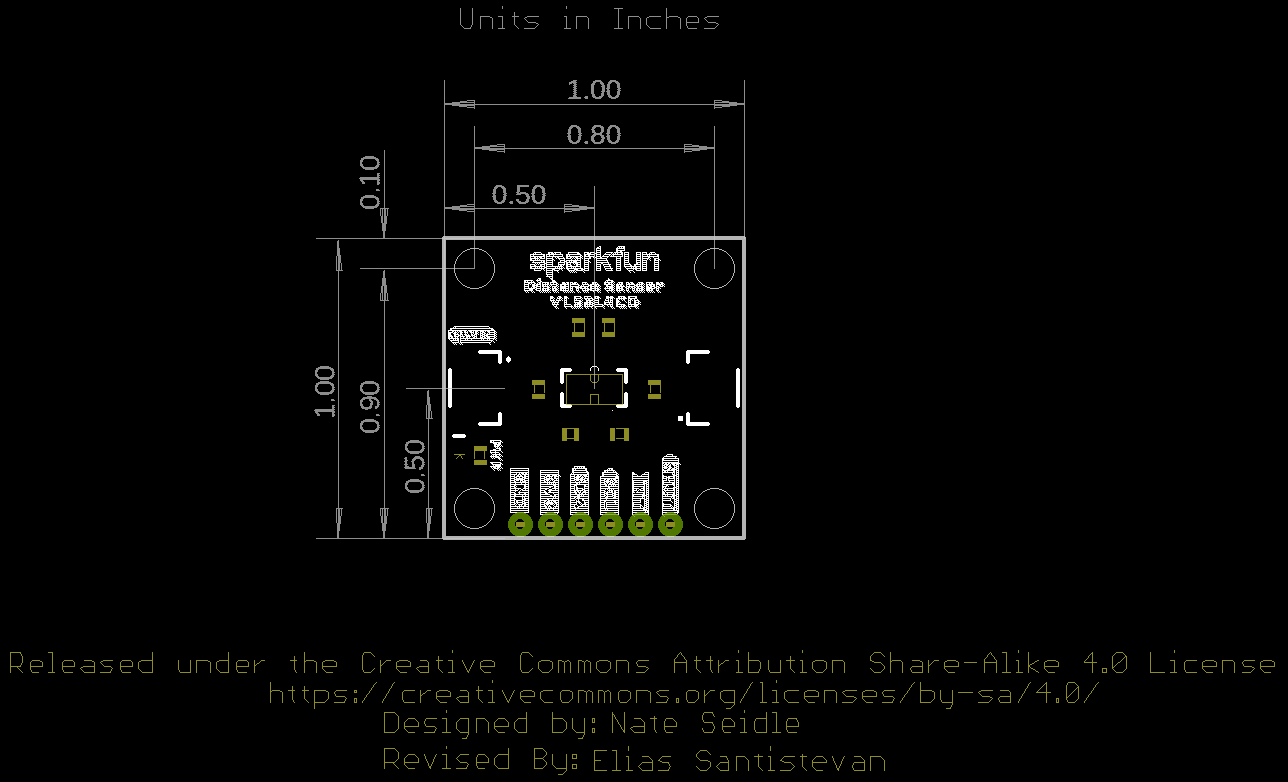
This SparkFun Distance Sensor Breakout utilizes the VL53L4CD next generation ToF (Time of Flight) sensor module to give you the highly accurate measurements ...
Get notified when back in stock
- Operating Voltage
- 2.6V to 3.5V
- (typically 3.3V via Qwiic cable)
- Average Current Consumption
- 22mA typically
- 24mA max
- 40mA peak current (including VSCEL)
- Measurement Range: 1mm to 1300mm
- Resolution: ±1mm
- Light Source: Class 1 940nm VCSEL
- Field of View: 18°
- Max Read Rate: 100Hz
- 2x Qwiic Connectors
- 7-bit unshifted I2C Address: 0x29
- Operating Temperature Range
- -30°C to +85°C
- Power LED
- Jumpers
- Pull-up Resistors
- LED
Jargon buster
Plain-language definitions for the technical terms used above.
- breakout
- A breakout board carries a small or fine-pitched component and brings its connections out to standard, breadboard- and header-friendly pins. Describing a part as a breakout means it can be wired into a project without soldering directly to the component's tiny contacts.
- I2C
- I2C is a two-wire communication bus used by many sensors and small modules. It matters because several I2C devices can share the same two wires, but each device needs a compatible address and your controller must support I2C.
- I2C address
- An I2C address is the number a device uses so a microcontroller can tell it apart from other devices on the same I2C bus. It matters because two devices with the same fixed address may conflict if used together.
- LED
- A light-emitting diode (LED) is a small electronic component that emits light when current flows through it in the correct direction. Because it only conducts one way, its polarity matters, and a through-hole LED must be soldered the correct way around to light up.
- multiplexer
- A multiplexer (mux) is a chip or circuit that selects one of several input signals and routes it to a single shared output, with select lines choosing which input is connected; running the same idea in reverse, to send one input to a chosen output, gives a demultiplexer. Multiplexers let a single controller or line work with several signals or devices that would otherwise clash on a shared connection.
- PCB
- A printed circuit board (PCB) is a board, usually rigid, with etched copper tracks that connect electronic components together without loose wiring. Components are mounted on the board and signals route between them through the copper layout.
- Qwiic
- Qwiic is a plug-in connector system for I2C devices that uses small 4-pin cables, so you can connect compatible sensors without soldering. It matters because your controller or adapter also needs Qwiic, or you will need a cable or breakout to wire it up.
Find this product in
Brands
Sensors & Input
SparkFun Qwiic Distance Sensor VL53L4CD Schematic
Schematic · 128.6 KB · Click any page to view full size
VL53L4CD Sensor Datasheet
Datasheet · 1.8 MB · Click any page to view full size
VL53L4CD Ultra Lite Driver User Manual
User Guide · 515.4 KB · Click any page to view full size
Supplier page — sparkfun.com
Supplier Description · 717.5 KB · Click any page to view full size
VL53L4CD CB Test Certificate
Approval · 278.3 KB · Click any page to view full size
Resources & Downloads
Guides, code examples, and more
Source Code
Open-source libraries, firmware & example projects for this product
A library for the laser based VL53L1X Time Of Flight distance sensor capable of detecting a target 4m away!
e88f55d
almost 3 years ago
· 90 commits
- .github Create add_issue_to_project.yml almost 3 years ago
- examples Moves all of STMicroelectronics source files to their own subfolder over 4 years ago
- src Add destructor. Correct begin overload almost 4 years ago
- keywords.txt fixing issues withtypes, updating examples to use begin almost 8 years ago
- library.properties Add begin(TwoWire &i2cPort) - requires VL53L1X::dev_i2c to be public almost 4 years ago
- LICENSE.md Moves all of STMicroelectronics source files to their own subfolder over 4 years ago
- README.md Moves all of STMicroelectronics source files to their own subfolder over 4 years ago
ce6e486
over 4 years ago
· 17 commits
- Hardware Updates Distance Sensor Part name almost 5 years ago
- Production Removes old production files almost 5 years ago
- .gitattributes Create .gitattributes over 4 years ago
- .gitignore Create .gitignore over 4 years ago
- LICENSE.md Create LICENSE.md over 4 years ago
- README.md Update README.md over 4 years ago
Python package for the qwiic VL53L1X distance sensor (4m)
58ae3ba
over 1 year ago
· 87 commits
- .github Update doxygen deploy branch to master over 1 year ago
- docs Autogenerated: Convert PyPi packaging and add Readme Updates over 1 year ago
- examples Add links for example readme over 1 year ago
- .readthedocs.yml Update .readthedocs.yml almost 3 years ago
- DESCRIPTION.rst Update DESCRIPTION.rst almost 7 years ago
- LICENSE Add README and LICENSE almost 7 years ago
- package.json Autogenerated: Bump version number to 2.0.0 over 1 year ago
- pyproject.toml Autogenerated: Bump version number to 2.0.0 over 1 year ago
- qwiic_vl53l1x.py Fix doxygen over 1 year ago
- README.md Autogenerated: Update supported boards. over 1 year ago
- requirements.txt Fix requirements.txt over 1 year ago
Related Tutorials
Free step-by-step guides