SparkFun
SparkFun AzureWave Thing Plus - AW-CU488
The SparkFun AzureWave Thing Plus is a Feather form-factor development board equipped with the AW-CU488. The module features the Realtek RTL8721DM integra...
Get notified when back in stock
The SparkFun AzureWave Thing Plus is a Feather form-factor development board equipped with the AW-CU488. The module features the Realtek RTL8721DM integrated single-chip low-power dual-band (2.4GHz and 5GHz) wireless LAN communication controller. It also consists of a dual processor core: Real-M300 CPU (ARMv8-M, Cortex-M33) and Real-M200 CPU (ARMv8-M, Cortex-M23). Connect the SparkFun AzureWave Thing Plus to the cloud to grab current weather conditions in your area, post sensor data to a server, control the lights in your next home automation project, or even calculate the Fast Fourier Transform (FFT) of an input audio signal!
Why the name? We lovingly call it the “Thing” because it's perfect for your Internet of Things project. The Thing does everything from turning on an LED to posting data with your chosen platform and can be programmed just like any microcontroller. You can even program the Thing through the Arduino IDE by installing the Realtek Arduino core.
The board includes a USB-C connector for programming and power. Two buttons for reset and boot are also populated on the board. For those that need to go remote with their application, the board includes a 2-pin JST connector and the MCP73831 single cell, LiPo charge IC (set to a default rate of 500mA). Voltage is regulated down for the AW-CU488 with the XC6222 3.3V/700mA voltage regulator. Three status LEDs are available for power, charging, and status. Due to the size of the module, the board is slightly longer than the standard Thing Plus footprint. With the added length, we were able to break out a few more PTHs on the edge of the board for a total of 30 GPIO pins (30 Interrupts, seven Analog, 11 PWM, two UARTs, two SPI, and a single I2C). The board also includes a built-in audio CODEC with two channel analog inputs and outputs at various sample rates (8/12/16/24/32/48/.../176.4 kHz). On the back of the board are five jumpers for the LiPo charge rate, LED, auto boot circuit, and USB shielding. Finally, one Qwiic connector is populated on the board to easily add Qwiic-enabled I2C devices to your projects!
Note: Additional items found in our photos are not included with the SparkFun AzureWave Thing Plus. You will need to purchase these components separately. Check the Hookup Accessories section below for options.
The SparkFun Qwiic Connect System is an ecosystem of I2C sensors, actuators, shields and cables that make prototyping faster and less prone to error. All Qwiic-enabled boards use a common 1mm pitch, 4-pin JST connector. This reduces the amount of required PCB space, and polarized connections mean you can’t hook it up wrong.
Features:
- AzureWave AW-CU488 Module
- up to 200MHz operating frequency
- 512KB SRAM and 4MB PSRAM
- 32Mbit SPI Flash
- Realtek RTL8721DM Dual Processor Core
- Real-M300 CPU (Armv8-M, Cortex-M33)
- Real-M200 CPU (Armv8-M, Cortex-M23)
- 2.4GHz/5GHz WiFi 802.11a/b/g/n 1T1R WLAN
- Built-in Antenna w/ Internal Shielding Antenna
- 2-Channel Audio CODEC (8/12/16/24/32/48/.../176.4 KHz)
- Thing Plus (or Feather) Form-Factor
- Breadboard-compatible 0.1" (2.54 mm) pitch headers
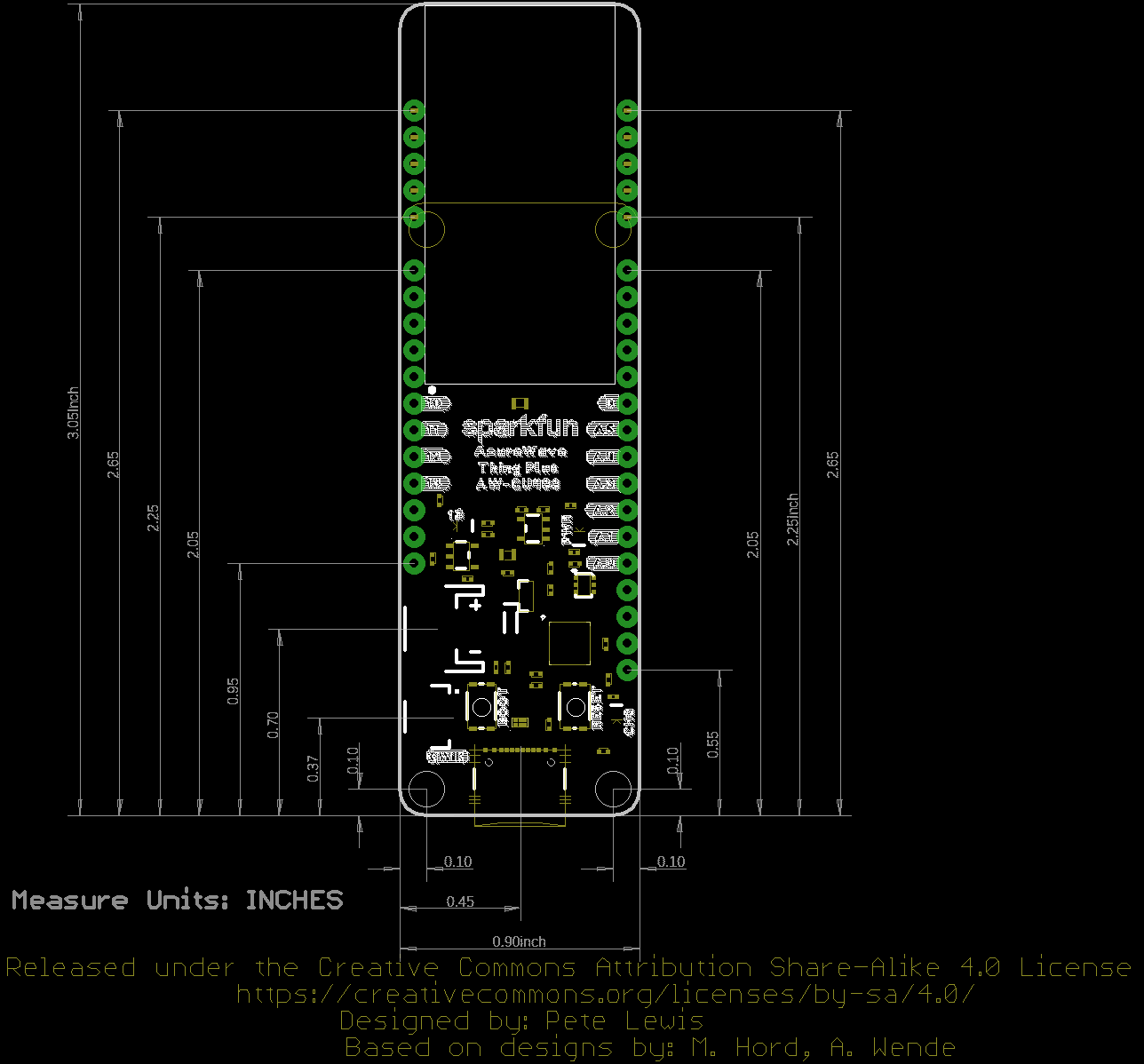
- Dimensions: 3.05" x 0.90" (77.47 mm x 22.86 mm)
- 30x Available GPIO
- Up to 30x INT
- Up to 7x 12-bit ADC
- Up to 11x PWM
- Up to 2x UARTs
- Up to 2x SPI
- Up to 1x I2C
- Two Mounting Holes
- 4-40 screw compatible
- 38x PTH Pins
- 1x USB Type C Connector
- 1x 2-pin JST Connector for a LiPo Battery (not included)
- 1x 4-pin Qwiic Connector
- CP210X USB-to-Serial Converter
- MCP73831 Single Cell, LiPo Charge IC
- Charge Rate Set to 500mA (default)
- Buttons
- Boot
- Reset
- LEDs
- Power
- Charge
- Status
- Jumpers
- Power LED
- LiPo Charge Rate (500mA/100mA)
- Auto Reset Circuit
- USB Shielding
Documents:
- Schematic
- Eagle Files
- Board Dimensions
- Hookup Guide
- Fritzing Part
- Graphical Datasheet
- Datasheets
- Qwiic Info Page
- Compare Thing Plus Boards
- Board Support Files
- GitHub Hardware Repo
Videos
Jargon buster
Plain-language definitions for the technical terms used above.
- ADC
- An analogue-to-digital converter reads a changing voltage and turns it into a number the microcontroller can use. It matters when connecting analogue sensors such as light, sound, or variable-resistor sensors.
- GPIO
- General-purpose input/output pins are microcontroller pins you can set in software to read signals, switch devices on and off, or connect to peripherals. The number of GPIO pins matters because it limits how many buttons, LEDs, sensors, and other parts you can wire directly to the board.
- Headers
- Rows of connector contacts on a fixed pitch (commonly 2.54 mm) used to link a board to a breadboard, jumper wires, or another board. They come as male pin headers and female socket headers; when a module ships with pre-soldered headers it can be used straight away, whereas bare pads require soldering the pins yourself.
- IDE
- Short for Integrated Development Environment, a program used to write, run and manage code. It matters because some learners prefer a traditional coding workspace instead of a guided notebook-style lesson.
- LED
- A light-emitting diode (LED) is a small electronic component that emits light when current flows through it in the correct direction. Because it only conducts one way, its polarity matters, and a through-hole LED must be soldered the correct way around to light up.
- LiPo
- A LiPo (lithium polymer) battery is a rechargeable lithium battery widely used in portable projects because it is light and compact. LiPo cells need correct charging circuitry and careful handling to stay safe, so equipment that supports LiPo generally includes charging or protection hardware suited to that battery type.
- MCP73831
- A lithium battery charger chip used to safely charge a single-cell LiPo battery. It matters because it lets the board recharge a battery from USB or another input without needing a separate charger module.
- microcontroller
- A microcontroller is a small computer on a single chip that runs a stored program and controls connected inputs and outputs such as buttons, sensors, displays and communication interfaces. In a device built around one, it is the part that executes the code and coordinates the device's behaviour.
- PCB
- A printed circuit board (PCB) is a board, usually rigid, with etched copper tracks that connect electronic components together without loose wiring. Components are mounted on the board and signals route between them through the copper layout.
- PTH
- Plated through-hole means the pin holes are metal-lined so solder connects the pad on both sides of the board. It is useful for connectors and headers that need a strong mechanical and electrical connection.
- PWM
- Pulse Width Modulation is a way for a digital pin to simulate variable output power by switching on and off very quickly. It matters for controlling things like LED brightness, motor speed, or servo-style signals from a microcontroller pin.
- Qwiic
- Qwiic is a plug-in connector system for I2C devices that uses small 4-pin cables, so you can connect compatible sensors without soldering. It matters because your controller or adapter also needs Qwiic, or you will need a cable or breakout to wire it up.
- SPI
- A fast serial communication bus often used for displays, memory cards, and sensors. It matters because SPI devices need specific pins for clock and data, plus a separate chip-select line for each device.
- SRAM
- Fast temporary memory used by a processor while a program is running. More SRAM helps with projects that handle larger data buffers, networking, displays, or more complex code.
- Thing Plus
- Thing Plus is SparkFun’s development-board form factor with a small rectangular layout and connections suited to wireless and battery-powered projects. It matters because boards and accessories in the same form factor are easier to mount, wire, and swap between projects.
- USB-C
- USB-C is a small, reversible USB connector that can carry power, data and, on some devices, video over a single cable. The same connector can range from charging only to high-speed data, so the functions a given port actually supports vary.
Find this product in
SparkFun AzureWave Thing Plus AW-CU488 Schematic
Schematic · 409.7 KB · Click any page to view full size
AW-CU488 Module Datasheet
Datasheet · 1.3 MB · Click any page to view full size
RTL8721DM Datasheet
Datasheet · 1.9 MB · Click any page to view full size
SparkFun AzureWave Thing Plus AW-CU488 Graphical Datasheet
Product Brief · 510.8 KB · Click any page to view full size
Supplier page — sparkfun.com
Supplier Description · 709.2 KB · Click any page to view full size
GraphicalDatasheet SparkFun AzureWave ThingPlus v10b
Datasheet · 511.3 KB · Click any page to view full size
Resources & Downloads
Guides, code examples, and more
Source Code
Open-source libraries, firmware & example projects for this product
AmebaD Arduino third-party package SDK
226d0b1
4 months ago
· 394 commits
- .github Changed TensorFlowLite to TFLite (#294) 4 months ago
- Ameba_misc Update .zip file and patches for tensorflow lite examples (#264) over 1 year ago
- Arduino_package Changed TensorFlowLite to TFLite (#294) 4 months ago
- Arduino_zip_libraries Update zip libaraies (#277) over 1 year ago
- .gitmodules Add DCT api examples almost 3 years ago
- CODE_OF_CONDUCT.md Create CODE_OF_CONDUCT.md over 2 years ago
- CONTRIBUTING.md Update CONTRIBUTING.md over 2 years ago
- LICENSE Create LICENSE over 2 years ago
- README.md Update README.md about 2 years ago
This repo houses all of the SFE Fritzing parts for use in diagrams in tutorials. If you create a new part in Fritzing that correlates to an SFE part, please add it here so others may use it and to avoid duplication.
71b17bb
about 2 years ago
· 339 commits
- kits Include SparkFun Inventor's Kit V4.1 almost 3 years ago
- parts Add Horizontal and Vertical Qwiic Connector and Cable to Breadboard Half (Top View) over 6 years ago
- products Update 13664_sfe_samd21_mini_breakout.fzpz about 2 years ago
- templates Renamed over 11 years ago
- License.md Create License.md over 7 years ago
- README.md Update README.md over 7 years ago
- SparkFun Plus.fzbz First Pass on SparkFun Plus bin file almost 7 years ago
- SparkFun_Plus.png Adding png for fzbz use almost 7 years ago
Dev board for the AzureWave AW-CU488 Microcontroller with 2.4G/5G Wifi and BLE
8c0d876
about 4 years ago
· 36 commits
- Documents Updated datasheet for AW-CU488 module about 4 years ago
- Hardware audio codec specific pin-names into sch symbol about 4 years ago
- .gitignore Module device created in temp library over 4 years ago
- LICENSE.md Module device created in temp library over 4 years ago
- README.md Update README.md about 4 years ago