Adafruit
SHARP Memory Display Breakout - 1.3 96x96 Silver Monochrome
The 96x96 resolution SHARP Memory LCD is no longer made, but we have a higher-resolution 168x144 display available in the shop at https://www.adafruit.com...
Get notified when back in stock
The 1.3" SHARP Memory LCD display is a cross between an eInk (e-paper) display and an LCD. It has the ultra-low power usage of eInk and the fast-refresh rates of an LCD. This model has a matt silver background, and pixels show up as little mirrors for a silver-reflective display, a really beautiful and unique look. It does not have a backlight, but it is daylight readable. For dark/night reading you may need to illuminate the LCD area with external LEDs.
The display is 3V powered and 3V logic, so we placed it on a fully assembled & tested breakout board with a 3V regulator and level shifting circuitry. The display slots into a ZIF socket on board and we use a piece of double-sided tape to adhere it onto one side. There are four mounting holes so you can easily attach it to a box.
The display is 'write only' which means that it only needs 3 pins to send data. However, the downside of a write-only display is that the entire 96x96 bits (1,152 bytes) must be buffered by the microcontroller driver. On an Arduino Uno/Leonardo that's half the RAM available and so it might not be possible to run this display with other RAM-heavy libraries like SD interfacing.
We don't have a detailed tutorial yet but its very easy to get started. Solder the included header to the display and connect Vin to 3-5V, GND to ground, and SCK, DI and CS to three Arduino pins. Then download and install our SHARP Memory Display library and the Adafruit GFX library. Run the example sharpmemtest sketch with the correct data pins to start drawing lines, circles, rectangles, text, etc!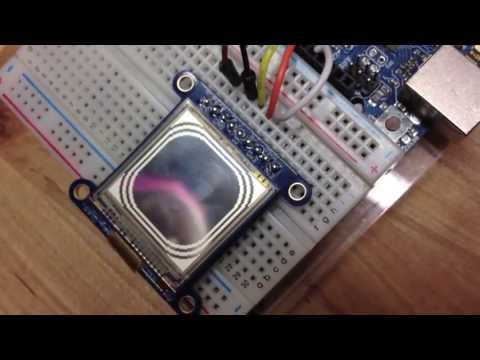
Jargon buster
Plain-language definitions for the technical terms used above.
- breakout
- A breakout board carries a small or fine-pitched component and brings its connections out to standard, breadboard- and header-friendly pins. Describing a part as a breakout means it can be wired into a project without soldering directly to the component's tiny contacts.
- CS
- CS stands for chip select, a control pin used by SPI devices to tell which connected device should listen. It matters when you connect more than one SPI module to the same microcontroller, because each device usually needs its own CS pin.
- GND
- GND is the ground or reference connection (0 V) for a circuit. When connecting two devices together, their grounds must be joined so both agree on what counts as a low or high signal.
- LCD
- LCD stands for liquid crystal display, a screen technology that uses a backlight and liquid crystals to show images or text. It matters because LCD modules usually need a display driver and enough controller pins or a bus interface to send image data.
- microcontroller
- A microcontroller is a small computer on a single chip that runs a stored program and controls connected inputs and outputs such as buttons, sensors, displays and communication interfaces. In a device built around one, it is the part that executes the code and coordinates the device's behaviour.
- RAM
- RAM (random-access memory) is fast, temporary memory a device uses for working data while it is running; in its common volatile form, its contents are lost when power is removed. Some devices offer a mode that applies settings to RAM only, which is handy for testing changes temporarily because they are not stored permanently and disappear at power-off.
Find this product in
Displays & Screens
Related Tutorials
Free guides on learn.littlebird.com.au