

Adafruit
Onion Omega2+ Starter Kit
·
Ever wanted your own Linux-based IoT computer? A small one, that can be battery powered? The Onion Omega2 is sort of in-between a microcontroller (like an...
Get notified when back in stock
Ever wanted your own Linux-based IoT computer? A small one, that can be battery powered? The Onion Omega2 is sort of in-between a microcontroller (like an Arduino/CircuitPython/MakeCode running chip) and a full-fledged microcomputer (like Raspbery Pi). What you get is a bite-sized development board that combines the power-efficiency of the Arduino and the flexibility of the Raspberry Pi!
So, for example, it runs Linux, but isn't going to replace your desktop computer. It's low power and has a static filesystem, but still requires some time to boot up. It's based on the MediaTek MT7688, a WiFi SoC that was initially designed for devices like WiFi routers or complex IoT devices. It comes with a variant of OpenWRT (nicknamed Onion OS) that is a slimmed down version of Linux. It's not going to run node.js but it is Linux. So, you get WiFi built in, and a full TCP/IP stack with SSL/TLS with all the scripting/programming language support that you expect.
Unlike a Raspberry Pi, you don't get a desktop or even a console on HDMI. Instead, you use a serial connection/ssh and the command line, or the simplified webpage interface to program it. So it's good if you have a bit of experience with those things!
Where it excels is as a physical computing platform, with hardware and WiFi. Wanna know how to blink an LED, or even multiple (!) LEDs? You can do that! You'll be able to read switches and use shift registers. Blinking text? No problem! A 7-Segment display and an LCD screen are included! The Starter Kit comes with all the fixins' to get comfortable with IoT and programming languages, including Python, C++, Node js, php, Bash, Ruby, Perl, Lua, G, and more!
This starter kit has everything you need to dip your toes into Onion Omega2+ play and development. Once you have your project or product well-developed you can then purchase individual Omega2's and add-on boards from Onion.
This Onion Omega2+ Starter Kit includes:
- Omega2+ development board – comes with built-in Wi-Fi and onboard storage. 128 MB RAM and 32 MB Flash memory and microSD card for additional storage
- Expansion Dock
- Wall Charger
- USB Micro-B Cable
- Breadboard
- 20 x M-M Jumper Wire
- 20 x M-F Jumper Wire
- 20 x LEDs
- 5 x 100nF Capacitor
- 5 x 100Ω Resistor
- 20 x 200Ω Resistor
- 5 x 470Ω Resistor
- 5 x 1kΩ Resistor
- 5 x 5.1 kΩ Resistor
- 5 x 51 kΩ Resistor
- 12 x Push Button
- 5 x Slide Switch
- Digital Temperature Sensor
- 7-Segment Display
- 16x2 LCD Screen
- Shift Register
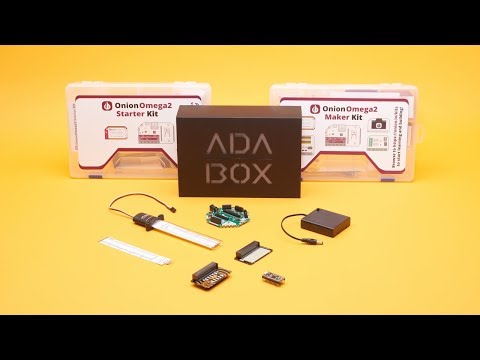
We also stock the Maker kit which comes with more stuff like an OLED, relay and servo/PWM board
Jargon buster
Plain-language definitions for the technical terms used above.
- CircuitPython
- A beginner-friendly version of Python designed to run directly on microcontroller boards. If a product supports CircuitPython, you can often program it by copying code files onto the board rather than setting up a more complex toolchain.
- Flash memory
- Flash memory is non-volatile memory that retains stored data even when power is removed, and can be erased and rewritten in blocks. It lets data such as firmware, settings or saved records persist across power cycles.
- HDMI
- HDMI is a common digital video and audio connection used by computers, media players, and many displays. If a display kit has HDMI input, it is usually much easier to test with a single-board computer because it can act like a normal monitor.
- IoT
- Short for Internet of Things, meaning physical devices that connect to networks or the internet to send data or be controlled remotely. It matters if you want projects such as connected sensors, remote controls or classroom data-logging activities.
- LCD
- LCD stands for liquid crystal display, a screen technology that uses a backlight and liquid crystals to show images or text. It matters because LCD modules usually need a display driver and enough controller pins or a bus interface to send image data.
- LED
- A light-emitting diode (LED) is a small electronic component that emits light when current flows through it in the correct direction. Because it only conducts one way, its polarity matters, and a through-hole LED must be soldered the correct way around to light up.
- microcontroller
- A microcontroller is a small computer on a single chip that runs a stored program and controls connected inputs and outputs such as buttons, sensors, displays and communication interfaces. In a device built around one, it is the part that executes the code and coordinates the device's behaviour.
- microSD card
- A microSD card is a small removable flash memory card used to store data such as audio, images, logs or program files. Its capacity and formatting (often FAT32 or exFAT) affect how much can be stored and whether the card needs preparing before use.
- RAM
- RAM (random-access memory) is fast, temporary memory a device uses for working data while it is running; in its common volatile form, its contents are lost when power is removed. Some devices offer a mode that applies settings to RAM only, which is handy for testing changes temporarily because they are not stored permanently and disappear at power-off.
Find this product in
Brands
Connectivity
STEM & Education

