SparkFun
MyoWare 2.0 Wireless Shield
·
The MyoWare® 2.0 Wireless Shield is designed to take in readings from the MyoWare 2.0 Muscle Sensor and wirelessly transmit sensor data with the ESP32-WROOM!...
Get notified when back in stock
The MyoWare® 2.0 Wireless Shield is designed to take in readings from the MyoWare 2.0 Muscle Sensor and wirelessly transmit sensor data with the ESP32-WROOM! This shield also includes a built-in LiPo battery to remotely power the muscle sensor and the ESP32 module. The Wireless Shield is equipped with snap connectors and low-profile pogo pins on the board, so you can easily stack it on the top side of the MyoWare 2.0 Muscle Sensor. Simply select a Power Source and flip the power switch to the ON position to give the sensor all the power it needs to work its myoelectric magic.
TThe board's USB type C and CH340 USB-to-serial converter enable programming via serial using the Arduino IDE. As you might expect, a reset button resets the ESP32. Various protection circuits are built into the board: ESD protection diodes for the USB data lines, a resettable PTC fuse for VUSB, and ideal diodes for protection on the VUSB and VBATT nets.
Each board comes with a 40mAh single-cell lithium polymer (LiPo) battery connected to it. The battery can be recharged through the USB Type C connector, and its dedicated LiPo charging circuit is set to a charge rate of about 40mA. Operating your MyoWare 2.0 Muscle Sensor on battery power and transmitting data wirelessly allows for complete isolation from the power grid.
Power is regulated down to 3.3V. Users can select their power source as well as turn on/off the board with included switches. A button to manually place the ESP32 in bootloader mode is populated as well. This button can also be used as a general purpose button as well. The board is equipped with two horizontal Qwiic connectors and 2.2kΩ pull-up resistors if you decide to include additional Qwiic-enabled devices. Standard 0.1"-spaced plated through holes (PTHs) break out a few of the ESP32 module's pins on the edge of the board for users.
This board also includes status LEDs for power (PWR), charge status (CHG), user LED (13), and envelope (ENV). There are additional jumpers for power (PWR), USB shield (SHLD), reference (REF), raw EMG (RAW), envelope (ENV), and I2C pull-up resistors (I2C). Use it as a teaching tool to reduce the number of wires in your system or add some myoelectric flair to your Halloween costume!
Note: This item may take longer to process due to battery installed in the equipment and therefore does not qualify for same-day shipping policy. Additionally, these batteries can not be shipped via Ground or Economy methods to Alaska or Hawaii. Sorry for any inconvenience this may cause.
The MyoWare® 2.0 ecosystem consists of shields that easily interface with the MyoWare® 2.0 Muscle Sensor, which is a low-cost, Arduino-compatible, all-in-one electromyography (EMG) sensor from Advancer Technologies. The innovative connector system allows users to easily snap shields together with a compact low profile and connect to a microcontroller's analog input to measure raw, filtered, and rectified electrical activity of a target muscle. This eliminates the need to solder connections between boards.
This product is a collaboration with Brian Kaminski from Advancer Technologies. A portion of each sales goes back to them for product support and continued development.
Features:
- Input Voltage
- 5V via USB Type C Connector
- Output Voltage (e.g. "VIN")
- 3.3V via voltage regulator (RT9080)
- 3.3V via Qwiic Connector
- ESD Protection Diodes for USB Data Lines
- Ideal Diodes for Protection on the VBATT and VUSB Nets
- Resettable PTC Fuse (Rated 6V/500mA)
- Switches
- Power Source
- Power ON/OFF
- Built-in LiPo Battery
- Rated Capacity: 40mAh
- Nominal Voltage: 3.7V
- Max Charge Current: 1C (40mA)
- MCP73831 Single Cell LiPo Charge IC
- Charge Rate Set to ~40mA
- 3.3V Voltage Regulator
- MyoWare® 2.0 Muscle Sensor Form Factor
- 3x Female Snap Pins (Power and EMG Envelope Output)
- Espressif ESP32-WROOM Module
- CH340 USB-to-Serial Converter
- 2x Qwiic Connectors
- 2.2kΩ Pull-Up Resistors
- Button
- Reset
- General Purpose/Bootloader
- LEDs
- PWR - Power Indicator
- CHG - Charge Status
- 13 - User
- ENV- Envelope
- Jumpers
- PWR - Power LED
- SHLD - USB Shield
- REF - Reference Pin
- RAW - Raw EMG Output
- ENV - Envelope Detector Output
- I2C - I2C Pull-Up Resistors
- Board Dimensions
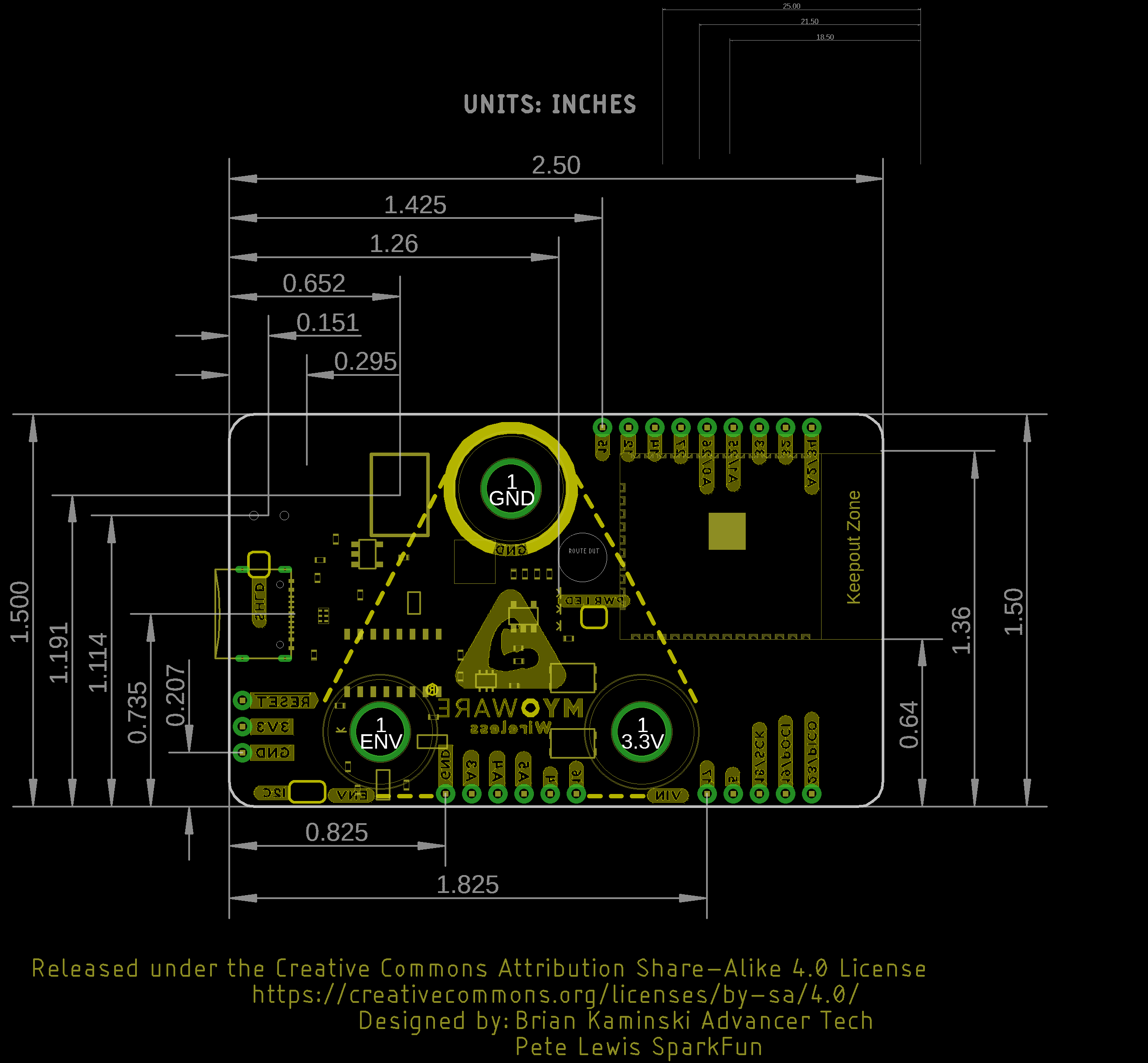
- 63.5mm x 38.000mm (2.50in. x 1.50in.)
Documents:
- Board Dimensions
- Hookup Guide
-
Advancer Technologies: MyoWare® 2.0
- Quickstart Guide (4.37MB)
- Advanced Guide (9.00MB)
- Patents [1]
- MCP73831 Datasheet
- Polymer Lithium Ion Battery (40mAh)
- MyoWare Arduino Library
- MyoWare 2.0 Ecosystem Page
[1] Note: This product is patent protected. To prevent counterfeit boards, the Eagle design files and GitHub hardware repository are not shared for boards in the MyoWare 2.0 ecosystem.
Videos
Jargon buster
Plain-language definitions for the technical terms used above.
- Bootloader
- Small starter software on a microcontroller that lets new code be uploaded before the main program runs. Knowing how to enter bootloader mode matters when you need to program the board or recover it after a faulty sketch.
- ESD protection
- ESD protection helps protect electronics from damage caused by static electricity discharges. It is useful on development boards because cables, sensors and modules are often plugged and unplugged during prototyping.
- ESP32
- ESP32 is a family of low-cost microcontroller chips and modules from Espressif with built-in WiFi and Bluetooth. They support programmable firmware and over-the-air updates, and are commonly programmed with toolchains such as the Arduino core and ESP-IDF.
- I2C
- I2C is a two-wire communication bus used by many sensors and small modules. It matters because several I2C devices can share the same two wires, but each device needs a compatible address and your controller must support I2C.
- IDE
- Short for Integrated Development Environment, a program used to write, run and manage code. It matters because some learners prefer a traditional coding workspace instead of a guided notebook-style lesson.
- LED
- A light-emitting diode (LED) is a small electronic component that emits light when current flows through it in the correct direction. Because it only conducts one way, its polarity matters, and a through-hole LED must be soldered the correct way around to light up.
- LiPo
- A LiPo (lithium polymer) battery is a rechargeable lithium battery widely used in portable projects because it is light and compact. LiPo cells need correct charging circuitry and careful handling to stay safe, so equipment that supports LiPo generally includes charging or protection hardware suited to that battery type.
- MCP73831
- A lithium battery charger chip used to safely charge a single-cell LiPo battery. It matters because it lets the board recharge a battery from USB or another input without needing a separate charger module.
- microcontroller
- A microcontroller is a small computer on a single chip that runs a stored program and controls connected inputs and outputs such as buttons, sensors, displays and communication interfaces. In a device built around one, it is the part that executes the code and coordinates the device's behaviour.
- PTC fuse
- A resettable fuse that increases its resistance when too much current flows, helping protect the board from short circuits or overloads. It matters because it can recover after a fault instead of needing replacement like a traditional fuse.
- Qwiic
- Qwiic is a plug-in connector system for I2C devices that uses small 4-pin cables, so you can connect compatible sensors without soldering. It matters because your controller or adapter also needs Qwiic, or you will need a cable or breakout to wire it up.
- Shield
- An add-on board that plugs into a main controller board to give it extra features such as sensing, motor control or communication. Knowing a product supports shields helps you judge whether it can connect neatly into an existing maker-board setup.
Find this product in
Brands
Sensors & Input
MyoWare 2.0 Wireless Shield Quickstart Guide
Quick Start · 4.4 MB · Click any page to view full size
MCP73831 LiPo Charger Datasheet
Datasheet · 823.1 KB · Click any page to view full size
MyoWare 2.0 Wireless Shield Advanced Guide
User Guide · 9.0 MB · Click any page to view full size
LiPo Battery Cell Datasheet
Datasheet · 621.4 KB · Click any page to view full size
LiPo Battery MSDS
Compliance · 751.5 KB · Click any page to view full size
Supplier page — sparkfun.com
Supplier Description · 917.0 KB · Click any page to view full size
Source Code
Open-source libraries, firmware & example projects for this product
Arduino library for the MyoWare Muscle Sensor and Ecosystem
2c2bcb9
over 2 years ago
· 2 commits
- examples Release commit (v1.0.0) over 2 years ago
- src Release commit (v1.0.0) over 2 years ago
- ISSUE_TEMPLATE.md Release commit (v1.0.0) over 2 years ago
- library.properties Release commit (v1.0.0) over 2 years ago
- LICENSE.md Release commit (v1.0.0) over 2 years ago
- README.md Release commit (v1.0.0) over 2 years ago