

Adafruit
Monochrome 2.7 128x64 OLED Graphic Display Module Kit
·
If you've been diggin' our monochome OLEDs but need something bigger, this display will delight you. These displays are 2.7" diagonal, and very readable due ...
Get notified when back in stock
If you've been diggin' our monochome OLEDs but need something bigger, this display will delight you. These displays are 2.7" diagonal, and very readable due to the high contrast of an OLED display. This display is made of 128x64 individual white OLED pixels, each one is turned on or off by the controller chip. Because the display makes its own light, no backlight is required. This reduces the power required to run the OLED and is why the display has such high contrast; we really like this graphic display for its crispness!
The driver chip, SSD1325 can communicate in two ways: 8-bit or SPI. Personally we think SPI is the way to go, only 4 or 5 wires are required. The OLED itself requires a 3.3V power supply and 3.3V logic levels for communication. We include a breadboard-friendly level shifter that can convert 3V or 5V down to 3V, so it can be used with 5V-logic devices like Arduino.
The power requirements depend a little on how much of the display is lit but on average the display uses about 50-150mA from the 3.3V supply. Built into the OLED driver is a simple boost converter that turns 3.3V into a high voltage drive for the OLEDs. The boost converter which may make a squeaking/buzzing noise, which you can minimize by adding hot-glue or foam tape around the inductor but may not be completely removable.
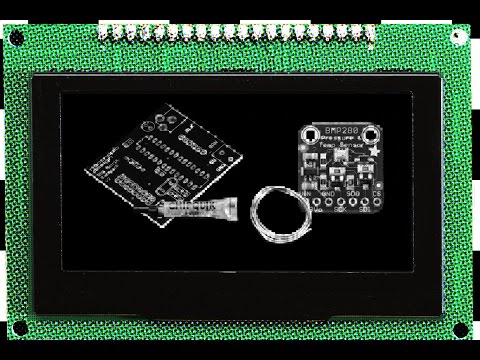
Each order comes with one assembled OLED module with a nice bezel and 4 mounting holes. The display is 3V logic & power so we include a 74HC4050 (or compatible) level shifter. We also toss in a 220uF capacitor, as we noticed an Arduino may need a little more capacitance on the 3.3V power supply for this big display! This display does not come with header attached but we do toss in a stick of header you can solder on. Also, the display may come in 8-bit mode. You can change modes from 8-bit to SPI with a little soldering, check out the tutorial for how to do so.
Getting started is easy! We have a detailed tutorial and example code in the form of an Arduino library for text and graphics. You'll need a microcontroller with more than 1K of RAM since the display must be buffered. The library can print text, bitmaps, pixels, rectangles, circles and lines. It uses 1K of RAM since it needs to buffer the entire display but its very fast! The code is simple to adapt to any other microcontroller.
Jargon buster
Plain-language definitions for the technical terms used above.
- boost converter
- A boost converter is a switching power circuit that raises a lower input voltage to a higher output voltage. It is used when a device needs more voltage than its power source provides, for example running a 5 V sensor from a 3.3 V supply.
- capacitance
- Capacitance is the amount of electrical charge a capacitor can store, usually measured in farads such as uF. Choosing the right capacitance value matters because it affects how well a circuit filters power, handles timing, or stores short bursts of energy.
- microcontroller
- A microcontroller is a small computer on a single chip that runs a stored program and controls connected inputs and outputs such as buttons, sensors, displays and communication interfaces. In a device built around one, it is the part that executes the code and coordinates the device's behaviour.
- OLED
- OLED stands for organic light-emitting diode, a display type where each pixel produces its own light. It matters because OLED screens are thin, high-contrast and easy to read for small status displays, but they can be more sensitive to image burn-in than some other display types.
- RAM
- RAM (random-access memory) is fast, temporary memory a device uses for working data while it is running; in its common volatile form, its contents are lost when power is removed. Some devices offer a mode that applies settings to RAM only, which is handy for testing changes temporarily because they are not stored permanently and disappear at power-off.
- SPI
- A fast serial communication bus often used for displays, memory cards, and sensors. It matters because SPI devices need specific pins for clock and data, plus a separate chip-select line for each device.
Find this product in
Brands
Displays & Screens
2 7 monochrome 128x64 oled display module
Document · 2.9 MB · Click any page to view full size
2 7 monochrome 128x64 oled display module
Document · 2.9 MB · Click any page to view full size
Resources & Downloads
Guides, code examples, and more

