DFRobot
micro: Maqueen Lite with Housing (Blue) - micro:bit Educational Programming Robot Platform
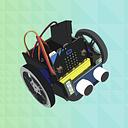
The micro:Maqueen Lite is a compact STEAM education robot built around the Maqueen 4.2 core, designed for children aged 8 and up. This version comes pre-asse...
Get notified when back in stock
The micro:Maqueen Lite is a compact STEAM education robot built around the Maqueen 4.2 core, designed for children aged 8 and up. This version comes pre-assembled with a blue housing — motors, wheels, support wheel, housing, and battery holder are all installed and ready to go. Just insert a micro:bit board and batteries to start programming.
Compatible with both micro:bit V1 and V2, the Maqueen Lite supports MakeCode and Mind+ graphical programming. It includes a rich set of sensors and outputs for exploring line tracking, obstacle avoidance, light effects, and more.
Key Features
- Pre-Assembled – Housing, motors, wheels, and battery holder installed, ready to use
- micro:bit V1 & V2 Compatible – Works with both versions
- Ultrasonic Sensor Included – HR-SR04 for obstacle detection and ranging
- IR Line-Tracking – 2 infrared sensors for following tracks (map included)
- 4× RGB Ambient Lights – 16 million colours for visual feedback
- 2× LED Car Lights – Front-facing headlights
- IR Receiver – NEC-encoded remote control support
- Buzzer – Audio output for sound effects
- Expansion Ports – 2× servo (S1, S2), 3× Gravity (P0, P1, P2), 1× I2C
Specifications
- Supply Voltage: 3.5–5 V DC (3× AAA batteries, not included)
- Motors: 2× N20 metal gear motors (1:150 ratio, 133 RPM max)
- Motor Drive: PWM
- Ultrasonic Interface: SR04 (5 V)
- I2C: 3.3 V
- Housing Material: Eco-friendly ABS (blue)
- Wheel Material: ABS with eco-friendly rubber tyres
- Programming: MakeCode, Mind+
- Dimensions: 81 × 85 × 44 mm (micro:bit not included)
- Weight: ~136 g (75.5 g robot + 60 g housing, batteries and micro:bit not included)
Ideal For
- STEM and coding education for ages 8+
- Classroom robotics and programming lessons
- Learning line tracking, obstacle avoidance, and sensor integration
Package Contents
- 1× Maqueen Lite vehicle body (pre-assembled with blue housing)
- 1× HR-SR04 Ultrasonic Sensor
- 1× Line-tracking map
Resources
Jargon buster
Plain-language definitions for the technical terms used above.
- DC
- DC means direct current, where electricity flows in one constant direction, as supplied by batteries, USB ports and many plug-pack power supplies. When a product specifies DC, it runs from a DC supply rather than mains AC, so you need to provide the correct voltage and polarity.
- Gravity
- Gravity is DFRobot’s plug-in connector system for sensors, motors and modules, using standard cables to reduce loose jumper wiring. It matters because Gravity-compatible parts can connect directly to these ports, while non-Gravity parts may need adapters or manual wiring.
- I2C
- I2C is a two-wire communication bus used by many sensors and small modules. It matters because several I2C devices can share the same two wires, but each device needs a compatible address and your controller must support I2C.
- LED
- A light-emitting diode (LED) is a small electronic component that emits light when current flows through it in the correct direction. Because it only conducts one way, its polarity matters, and a through-hole LED must be soldered the correct way around to light up.
- PWM
- Pulse Width Modulation is a way for a digital pin to simulate variable output power by switching on and off very quickly. It matters for controlling things like LED brightness, motor speed, or servo-style signals from a microcontroller pin.
- RGB
- Short for red, green and blue, the three primary colours of light that are mixed in varying amounts to make a wide range of colours. In electronics RGB can refer to an LED or pixel that blends these three colours, or to a colour signal or interface that carries separate red, green and blue channels.
- servo
- A servo is a motor with built-in position control, usually told to move to a specific angle by a control signal. It matters when you need repeatable movement, such as steering, arms, flaps, or linkages, rather than continuous spinning.
Find this product in
micro:bit
Robotics & Coding
Robotics & Motion
STEM & Education
Related Tutorials
Free step-by-step guides