SparkFun
micro:bit v2 Board
The BBC micro:bit v2.21 is your gateway to hands-on learning, creativity, and innovation with digital technology. This pocket-sized powerhouse packs impressi...
Get notified when back in stock
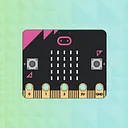
The BBC micro:bit v2.21 is your gateway to hands-on learning, creativity, and innovation with digital technology. This pocket-sized powerhouse packs impressive features into a board that’s half the size of a credit card. Whether you’re crafting robots, designing musical instruments, or inventing something entirely new, the micro:bit is ready to bring your ideas to life.
Key Features:
-
Front Side Highlights:
- A 5x5 LED matrix that doubles as a light sensor and mini display for messages, numbers, or fun animations.
- Two programmable tactile buttons for interaction and control.
- A touch-sensitive logo that functions as a third button—perfect for games, playlists, and more.
- Built-in microphone with an indicator LED to detect and respond to sound.
-
Back Side Powerhouse:
- A 64 MHz ARM Cortex-M4 microcontroller with FPU, 512KB Flash, and 128KB RAM for robust performance.
- Onboard accelerometer and compass for motion and directional sensing.
- MEMS microphone, speaker, and Bluetooth Low Energy (BLE 5.0) for connectivity and interaction.
- Gold-tabbed edge pins and ring connectors for quick and easy prototyping with alligator clips or additional components.
- Flexible power options with a microUSB port and a two-pin JST connector.
Next-Level Coding and Connectivity:
Pair the micro:bit with the official mobile app for seamless Bluetooth coding—no USB cable needed! Write, test, and deploy your creations anywhere. This board is designed to grow with your projects, supporting everything from beginner-friendly experiments to advanced designs.
Important: This product includes the micro:bit v2.21 board only. To power your board, we recommend adding a micro:bit AAA battery holder or a micro USB cable.
From interactive gadgets to ambitious projects, the BBC micro:bit v2.21 is a versatile tool that makes coding accessible and fun. Let your creativity flow!
Jargon buster
Plain-language definitions for the technical terms used above.
- ARM Cortex-M4
- The ARM Cortex-M4 is a 32-bit processor core widely used inside microcontrollers, often with hardware support for signal-processing and control tasks. It provides enough processing power to run embedded programs that handle sensors, wireless communication, audio and similar workloads.
- BLE
- BLE stands for Bluetooth Low Energy, a Bluetooth mode designed for low power use and broad compatibility with modern phones and computers. It connects well to battery-powered and mobile devices, including Apple hardware, though it behaves differently from Bluetooth Classic and its serial-style profiles.
- edge pins
- Edge pins are exposed electrical contacts along the edge of a board that let you connect to power, signals, and accessories. They matter because they make it easier to attach clips, expansion boards, or external components without soldering.
- FPU
- A floating-point unit is hardware inside a processor that speeds up calculations with decimal numbers. This helps when projects use maths-heavy tasks such as motion sensing, filtering sensor readings, or audio processing.
- LED
- A light-emitting diode (LED) is a small electronic component that emits light when current flows through it in the correct direction. Because it only conducts one way, its polarity matters, and a through-hole LED must be soldered the correct way around to light up.
- MEMS microphone
- A tiny microphone made using micro-electromechanical systems, the same style of miniature manufacturing used in many phone sensors. It lets the board detect sound without needing an external microphone, which is useful for noise-reactive projects and simple audio input.
- microcontroller
- A microcontroller is a small computer on a single chip that runs a stored program and controls connected inputs and outputs such as buttons, sensors, displays and communication interfaces. In a device built around one, it is the part that executes the code and coordinates the device's behaviour.
- RAM
- RAM (random-access memory) is fast, temporary memory a device uses for working data while it is running; in its common volatile form, its contents are lost when power is removed. Some devices offer a mode that applies settings to RAM only, which is handy for testing changes temporarily because they are not stored permanently and disappear at power-off.
Find this product in
Brands
STEM & Education
Supplier page — sparkfun.com
Supplier Description · 906.8 KB · Click any page to view full size
Related Tutorials
Free step-by-step guides