Keyestudio
Micro bit DRV8833 Motor Driver Expansion Board
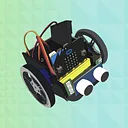
The micro:bit DRV8833 Motor Driver Expansion Board adds dual DC motor control to the BBC micro:bit. Built around the DRV8833CPWP motor driver IC, it can outp...
Get notified when back in stock
The micro:bit DRV8833 Motor Driver Expansion Board adds dual DC motor control to the BBC micro:bit. Built around the DRV8833CPWP motor driver IC, it can output up to 700 mA per channel with four control modes: clockwise rotation, anticlockwise rotation, brake, and stop.
The board includes on-board 3.3 V and 5 V voltage regulators, a serial communication interface for connecting Bluetooth modules, and 3-pin sensor interfaces for expanding your project. Motor pins A1, A2, B2, and B1 connect to micro:bit pins P13, P12, P15, and P16 respectively.
Key Features
- DRV8833CPWP Motor Driver – Dual H-bridge driver with up to 700 mA output per channel
- Four Motor Control Modes – Clockwise, anticlockwise, brake, and stop
- PWM Support – Frequencies up to 100 kHz for smooth motor control
- On-Board Voltage Regulators – 3.3 V and 5 V regulated outputs
- Serial Communication Interface – For connecting Bluetooth modules
- 3-Pin Sensor Interfaces – Easily connect additional sensors and peripherals
Specifications
- Motor Driver IC – DRV8833CPWP
- Max Output Current – 700 mA per channel
- PWM Frequency – Up to 100 kHz
- Regulated Outputs – 3.3 V and 5 V
- Motor Pin Mapping – A1→P13, A2→P12, B2→P15, B1→P16
- Compatibility – BBC micro:bit (V1 and V2)
Ideal For
- Micro:bit-powered robotics projects
- Educational motor control experiments
- Motorised vehicles and line-following robots
- STEM and coding workshops
Package Contents
- 1× DRV8833 Motor Driver Expansion Board for micro:bit
Jargon buster
Plain-language definitions for the technical terms used above.
- DC
- DC means direct current, where electricity flows in one constant direction, as supplied by batteries, USB ports and many plug-pack power supplies. When a product specifies DC, it runs from a DC supply rather than mains AC, so you need to provide the correct voltage and polarity.
- motor driver
- An electronic circuit that lets a low-power controller switch and control a motor that needs more current than the controller pins can safely provide. Checking motor driver support matters because pumps and motors usually cannot be connected directly to a microcontroller output.
- PWM
- Pulse Width Modulation is a way for a digital pin to simulate variable output power by switching on and off very quickly. It matters for controlling things like LED brightness, motor speed, or servo-style signals from a microcontroller pin.
Find this product in
micro:bit
Related Tutorials
Free step-by-step guides