

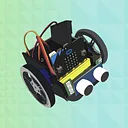
The Line Following Buggy is a micro:bit-powered robotics kit that lets students build a 2‑wheel buggy that can automatically follow a track using the included :MOVE line following board. Compared to older versions, the line sensor board comes pre-assembled (no component soldering), making the build faster and more suitable for younger makers—only the motor wires need soldering. Sensitivity is adjustable via onboard trim pots, and it can be set to follow either a dark line on a light surface or a light line on a dark surface (aim for around 5mm ground clearance for best results).
Compatibility-wise, it’s designed for the BBC micro:bit (v1 or v2) and includes a Kitronik Motor Driver Board V2 to drive the two geared motors. It does not include the micro:bit itself, and you’ll need 4×AA batteries plus basic tools to finish assembly. Beyond line following, the same hardware can be repurposed as a general robot buggy—e.g. controlled over Bluetooth or Radio using micro:bit code (Kitronik’s app is a common approach), making it useful for classroom challenges like obstacle courses, PID/sensor tuning experiments, and intro autonomous navigation.
If you’re choosing between options: this kit is ideal when you want a structured, buildable robot platform with a dedicated line sensor and motor driver included. Alternatives like simpler micro:bit car chassis kits may be easier mechanically but often require adding your own sensor/driver hardware to achieve reliable line following; this one is purpose-built for that activity and includes example code and datasheets to get started.
Key Features

You might also like

Kitronik
Line Following Buggy for the BBC micro:bit
The Line Following Buggy with :MOVE line following board for the BBC microbit is the newest version of our very popular line following buggy. It offers a ...
Get notified when back in stock
The Line Following Buggy with :MOVE line following board for the BBC microbit is the newest version of our very popular line following buggy. It offers a significant upgrade in the form of our new :MOVE line following board. Not only does it provide far superior line following it also makes the kit much easier to assemble, making it a suitable activity for younger children.
The line following board is supplied pre-assembled, so no soldering of components is required. The only soldering required for assembly is to attach the wires to the two motors.
The board design is such that the buggy can either follow a dark line on a light background or a light line on a dark background. For best results, ensure there is approx. 5mm clearance between the bottom of the board and the driving surface.
Also, the sensitivity of the line following can be adjusted via the two onboard pots, one for each detector. The same pots are also used to change the type of line that will be followed; to detect darker, turn the pot clockwise and to detect lighter, turn the pot anti-clockwise.
In addition, although the buggy has been designed to follow lines, due to the flexibility of both the microbit and the Kitronik Motor Driver board it can also be used as a remote-controlled robot buggy. Kitronik has an App for that!
Features:
- Simple to build buggy.
- BBC micro:bit controlled.
- The kit features a new and improved line following board.
- It can be configured to either follow a dark line on a light back ground or a light line on a dark background.
- The line following sensitivity can be adjusted with a screwdriver.
- Example line following code is provided.
- Also, the buggy can easily be re-purposed for remote control over Bluetooth or Radio.
Contents:
- 2 x Right Angle Hobby Geared Motor.
- 2 x Wheel for Hobby Motor.
- 1 x Motor Driver Board V2 for the BBC micro:bit.
- 1 x Steel Ball Caster 16mm Metal Ball.
- 1 x 4xAA Battery Box with Switch.
- 1 x MOVE Line Following Board.
- 1 x Perspex Buggy Chassis.
- 1 x Perspex :MOVE board mount.
- 1 x 1mm x 12mm x 25mm Foam Pad.
- 4 x Plastic Spacer 20mm.
- 12 x Pan Head M3 6mm Machine Screw.
- 4 x Pan Head M3 10mm Machine Screw.
- 10 x M3 Hex Full Width Nut.
- 4 x Plastic Hex M3 Standoff, M-F.
- 2 x Pan Head M3 30mm Machine Screw.
- 10 x Jumper Wires 20cm M/F.
- 1 x 15cm Multi-strand Cable, Black.
- 1 x 15cm Multi-strand Cable, White.
- 1 x 15cm Multi-strand Cable, Green.
- 1 x 15cm Multi-strand Cable, Blue.
Requires:
- 4 x AA Batteries.
- A small flat head screwdriver.
- Wire strippers.
- A soldering iron and some solder.
- A pair of pliers.
- A Phillips screwdriver.
- A computer with a spare USB port and Internet access.
- 1 x BBC micro:bit.
- A USB to micro USB cable.
Resources:
Jargon buster
Plain-language definitions for the technical terms used above.
- motor driver
- An electronic circuit that lets a low-power controller switch and control a motor that needs more current than the controller pins can safely provide. Checking motor driver support matters because pumps and motors usually cannot be connected directly to a microcontroller output.
Find this product in
Robotics & Motion
STEM & Education
Related Tutorials
Free step-by-step guides
Featured in buying guides
Comparison guides this product appears in

