

Adafruit
Breadboard-friendly RGB Smart NeoPixel - Pack of 4
·
This is the easiest way possible to add small, bright RGB pixels to your project. We took the same technology from our Flora NeoPixels and made them bread...
Get notified when back in stock
This is the easiest way possible to add small, bright RGB pixels to your project. We took the same technology from our Flora NeoPixels and made them breadboard friendly, with two rows of 3 x 0.1" spaced header on each side for easy soldering, chaining and breadboarding. These ultra-bright LEDs have a constant-current driver cooked right into the LED package! The pixels are chainable - so you only need 1 pin/wire to control as many LEDs as you like.
These pixels have full 24-bit color ability with PWM taken care of by the controller chip. Since the LED is so bright, you need less current/power to get the effects you want. The driver is constant current so its OK if your battery power changes or fluctuates a little.
Each pixel draws as much as 60mA (all three RGB LEDs on for full brightness white). An Arduino can drive up to 500 pixels at 30 FPS (it will run out of RAM after that). Using ribbon cable you can string these up to 6" apart (after that, you might get power droops and data corruption)
Each order comes with 4 individually controllable pixels. In the photos above we show the pixels with headers soldered on, but the pixels do not come with any headers. You can pick up some in the shop if you need
Our detailed NeoPixel Uberguide has everything you need to use NeoPixels in any shape and size. Including ready-to-go library & example code for the Arduino UNO/Duemilanove/Diecimila, Flora/Micro/Leonardo, Trinket/Gemma, Arduino Due & Arduino Mega/ADK (all versions)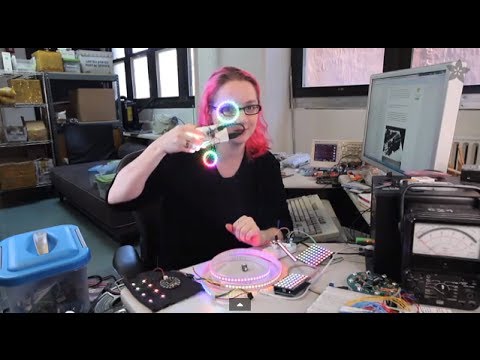
Jargon buster
Plain-language definitions for the technical terms used above.
- constant-current driver
- A constant-current driver supplies a set current to its load even as the load voltage changes. It is commonly used to keep LED brightness consistent and protect LEDs from being overdriven, whether for indicator LEDs, high-power lighting, or display backlights.
- fps
- fps means frames per second, or how many video images are captured or displayed each second. A higher fps generally gives smoother motion, which helps when the camera or the scene being viewed is moving.
- Headers
- Rows of connector contacts on a fixed pitch (commonly 2.54 mm) used to link a board to a breadboard, jumper wires, or another board. They come as male pin headers and female socket headers; when a module ships with pre-soldered headers it can be used straight away, whereas bare pads require soldering the pins yourself.
- LED
- A light-emitting diode (LED) is a small electronic component that emits light when current flows through it in the correct direction. Because it only conducts one way, its polarity matters, and a through-hole LED must be soldered the correct way around to light up.
- PWM
- Pulse Width Modulation is a way for a digital pin to simulate variable output power by switching on and off very quickly. It matters for controlling things like LED brightness, motor speed, or servo-style signals from a microcontroller pin.
- RAM
- RAM (random-access memory) is fast, temporary memory a device uses for working data while it is running; in its common volatile form, its contents are lost when power is removed. Some devices offer a mode that applies settings to RAM only, which is handy for testing changes temporarily because they are not stored permanently and disappear at power-off.
- RGB
- Short for red, green and blue, the three primary colours of light that are mixed in varying amounts to make a wide range of colours. In electronics RGB can refer to an LED or pixel that blends these three colours, or to a colour signal or interface that carries separate red, green and blue channels.
Find this product in
Brands
Components

