Adafruit
Terminal Block Breakout Module for Raspberry Pi Pico
·
A screw-terminal breakout module for the Raspberry Pi Pico, designed for industrial, robotics, and prototyping applications where secure, tool-free wiring is...
Get notified when back in stock
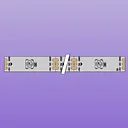
A screw-terminal breakout module for the Raspberry Pi Pico, designed for industrial, robotics, and prototyping applications where secure, tool-free wiring is essential. Every GPIO pin is broken out to labelled terminal blocks, making it easy to connect sensors, displays, motors, and other peripherals without soldering.
The breakout PCB sits inside a plastic enclosure with screw-mount tabs at each end for permanent installation. Simply plug your header-equipped Pico into the socket headers, loosen the terminal screws, and slide in your stranded or solid-core wire.
Key Features
- Full Pin Breakout – All Pico GPIO pins accessible via screw terminal blocks
- Labelled Terminals – Each block is clearly marked for easy wiring
- Mountable Enclosure – Plastic case with screw-mount tabs for surface installation
- Debug Header – 3-pin header for SWD debugging access
- Tool-Free Wiring – Accepts stranded or solid-core wire, no soldering required
Ideal For
- Industrial and robotics wiring with multiple sensors
- Permanent installations requiring surface mounting
- Prototyping without breadboards or soldering
- Education and workshop environments
Package Contents
- 1× Terminal block breakout module with enclosure
- 2× M3 × 10 mm wood screws
- 2× 20-pin 2.54 mm pitch headers
- 1× 3-pin 2.54 mm pitch debug header
Jargon buster
Plain-language definitions for the technical terms used above.
- breakout
- A breakout board carries a small or fine-pitched component and brings its connections out to standard, breadboard- and header-friendly pins. Describing a part as a breakout means it can be wired into a project without soldering directly to the component's tiny contacts.
- GPIO
- General-purpose input/output pins are microcontroller pins you can set in software to read signals, switch devices on and off, or connect to peripherals. The number of GPIO pins matters because it limits how many buttons, LEDs, sensors, and other parts you can wire directly to the board.
- Headers
- Rows of connector contacts on a fixed pitch (commonly 2.54 mm) used to link a board to a breadboard, jumper wires, or another board. They come as male pin headers and female socket headers; when a module ships with pre-soldered headers it can be used straight away, whereas bare pads require soldering the pins yourself.
- PCB
- A printed circuit board (PCB) is a board, usually rigid, with etched copper tracks that connect electronic components together without loose wiring. Components are mounted on the board and signals route between them through the copper layout.
- screw terminal
- A connector that clamps bare wire using a small screw, making it easier to attach and remove wires without soldering. Screw terminals are useful for power wiring or thicker wires that are not suited to small plug-in connectors.
- SWD
- Serial Wire Debug (SWD) is a two-wire programming and debugging interface used with many ARM Cortex-M microcontrollers. It provides low-level access to program, recover or debug the microcontroller.
- Terminal block
- A terminal block is a connector that joins wires together in a neat, removable, or serviceable way, usually clamping each wire under a screw or spring instead of soldering. It makes it easier to connect, change, or service wiring without permanent joints.
Find this product in
Brands
Related Tutorials
Free step-by-step guides