SparkFun
SparkFun Thing Plus - STM32
With a 32-bit ARM® Cortex®-M4 RISC core, the SparkFun STM32 Thing Plus brings power and precision to your projects. The STM32 Thing Plus provides you with a...
Get notified when back in stock
With a 32-bit ARM® Cortex®-M4 RISC core, the SparkFun STM32 Thing Plus brings power and precision to your projects. The STM32 Thing Plus provides you with an economical and easy to use development platform if you're needing more power with a minimal working space. This Thing comes flashed with the DFU bootloader, and to make the Thing Plus even easier to use, we've moved a few pins around to make the board Feather compatible. In addition, it utilizes our handy Qwiic Connect System which means no soldering or shields are required to connect it to the rest of your system!
As we previously stated; the STM32F405 Processor is based on the high-performance ARM® Cortex®-M4 32-bit RISC core and can operate at a frequency of up to 168 MHz. The Cortex-M4 core features a floating point unit (FPU) single precision which supports all ARM single precision data-processing instructions and data types. It also implements a full set of DSP instructions and a memory protection unit (MPU) which enhances application security. This Processor Board utilizes the DFU bootloader for uploading code, and incorporates an extensive range of enhanced I/Os and peripherals. In addition to the USB interface and Qwiic connection, the STM32 Thing Plus provides a 3.3V regulator and LiPo charger as well as 16MB of Flash and microSD slot for expandable memory.
The SparkFun Qwiic Connect System is an ecosystem of I2C sensors, actuators, shields and cables that make prototyping faster and less prone to error. All Qwiic-enabled boards use a common 1mm pitch, 4-pin JST connector. This reduces the amount of required PCB space, and polarized connections mean you can’t hook it up wrong.
Features:
STM32 General Features:
- ARM® 32-bit Cortex®-M4 CPU with FPU
- Adaptive real-time accelerator (ART Accelerator™) allowing 0-wait state execution from Flash memory
- Frequency up to 168 MHz
- Memory protection unit
- 210 DMIPS/ 1.25 DMIPS/MHz (Dhrystone 2.1)
- DSP instructions
- 1 Mbyte of Flash memory
- 192 Kbytes of SRAM including 64 Kbytes of CCM (core coupled memory) data RAM
- Flexible static memory controller supporting Compact Flash, SRAM, PSRAM, NOR and NAND memories
- Clock, reset and supply management
- 1.8 V to 3.6 V application supply and I/Os
- 32 kHz oscillator for RTC with calibration
- Internal 32 kHz RC with calibration
- Low-power operation
- Sleep, Stop and Standby modes
- VBAT supply for RTC, 20×32 bit backup registers + optional 4 KB backup SRAM
- Debug mode
- Serial wire debug (SWD) & JTAG interfaces
- Cortex-M4 Embedded Trace Macrocell™
- Advanced connectivity
- USB 2.0 full-speed device/host/OTG controller with on-chip PHY
- USB 2.0 high-speed/full-speed device/host/OTG controller with dedicated DMA, on-chip full-speed PHY and ULPI
- 10/100 Ethernet MAC with dedicated DMA: supports IEEE 1588v2 hardware, MII/RMII
Specific Peripherals available on STM32 Thing Plus:
- UART bus
- I2C Bus
- SPI bus
- Up to 15 Analog Inputs, Two Analog Outputs
- 20 Digital I/O Pins, 14 PWM Capable
- SDIO for microSD card support
- JTAG Serial Wire Debug Support
- Power Select
- LiPo Charging Circuit
- 3.3V Regulator
- 128 Mbit SPI Flash
Documents:
- Schematic
- Eagle Files
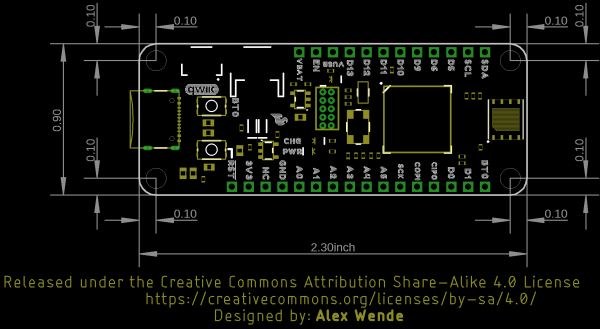
- Board Dimensions
- Hookup Guide
- Datasheet (STM32F405xx)
- Qwiic Info Page
- GitHub Hardware Repo
- Compare Thing Plus Boards
Videos
Jargon buster
Plain-language definitions for the technical terms used above.
- 3.3V regulator
- A 3.3V regulator is a power circuit that provides a steady 3.3 volts for parts that need that supply voltage. On a breakout board, it can let the sensor run safely even when the connected microcontroller or power source uses a higher voltage.
- Bootloader
- Small starter software on a microcontroller that lets new code be uploaded before the main program runs. Knowing how to enter bootloader mode matters when you need to program the board or recover it after a faulty sketch.
- DFU
- Device Firmware Update is a mode that lets you load new firmware onto a board over USB. It matters when recovering a board or installing firmware without using a separate programmer.
- DSP
- Digital signal processing means using software or hardware to analyse or modify signals such as audio, vibration, or sensor readings. A board suited to DSP is useful when a project needs fast maths for filtering, synthesis, or real-time signal analysis.
- Flash memory
- Flash memory is non-volatile memory that retains stored data even when power is removed, and can be erased and rewritten in blocks. It lets data such as firmware, settings or saved records persist across power cycles.
- FPU
- A floating-point unit is hardware inside a processor that speeds up calculations with decimal numbers. This helps when projects use maths-heavy tasks such as motion sensing, filtering sensor readings, or audio processing.
- JTAG
- JTAG is a hardware debugging and programming interface used to inspect and control chips at a low level. It matters for advanced development because it can help diagnose firmware problems that are hard to see through normal serial output.
- LiPo
- A LiPo (lithium polymer) battery is a rechargeable lithium battery widely used in portable projects because it is light and compact. LiPo cells need correct charging circuitry and careful handling to stay safe, so equipment that supports LiPo generally includes charging or protection hardware suited to that battery type.
- microSD card
- A microSD card is a small removable flash memory card used to store data such as audio, images, logs or program files. Its capacity and formatting (often FAT32 or exFAT) affect how much can be stored and whether the card needs preparing before use.
- MPU
- MPU can refer to a few different things in electronics: a microprocessor unit (a processor powerful enough to run a full operating system such as Linux, with external memory and storage), a motion-processing unit like the MPU-6050 or MPU-9250 inertial sensor modules, or a memory protection unit built into some microcontrollers. The intended meaning depends on the surrounding context.
- PCB
- A printed circuit board (PCB) is a board, usually rigid, with etched copper tracks that connect electronic components together without loose wiring. Components are mounted on the board and signals route between them through the copper layout.
- PWM
- Pulse Width Modulation is a way for a digital pin to simulate variable output power by switching on and off very quickly. It matters for controlling things like LED brightness, motor speed, or servo-style signals from a microcontroller pin.
- Qwiic
- Qwiic is a plug-in connector system for I2C devices that uses small 4-pin cables, so you can connect compatible sensors without soldering. It matters because your controller or adapter also needs Qwiic, or you will need a cable or breakout to wire it up.
- RAM
- RAM (random-access memory) is fast, temporary memory a device uses for working data while it is running; in its common volatile form, its contents are lost when power is removed. Some devices offer a mode that applies settings to RAM only, which is handy for testing changes temporarily because they are not stored permanently and disappear at power-off.
- RTC
- A Real-Time Clock keeps track of time even when the main processor is asleep or powered down, usually with a small backup battery. It matters for data logging and tracking projects that need accurate timestamps.
- SPI
- A fast serial communication bus often used for displays, memory cards, and sensors. It matters because SPI devices need specific pins for clock and data, plus a separate chip-select line for each device.
- SRAM
- Fast temporary memory used by a processor while a program is running. More SRAM helps with projects that handle larger data buffers, networking, displays, or more complex code.
- STM32
- STM32 is a family of microcontroller chips commonly used in embedded electronics. Knowing a product uses an STM32 can help when looking at firmware updates, pin connections, or low-level serial control options.
- SWD
- Serial Wire Debug (SWD) is a two-wire programming and debugging interface used with many ARM Cortex-M microcontrollers. It provides low-level access to program, recover or debug the microcontroller.
- Thing Plus
- Thing Plus is SparkFun’s development-board form factor with a small rectangular layout and connections suited to wireless and battery-powered projects. It matters because boards and accessories in the same form factor are easier to mount, wire, and swap between projects.
- UART
- UART is a simple asynchronous serial interface that sends data over separate transmit and receive wires, usually labelled TX and RX, with both ends set to the same baud rate. It is a common way for microcontrollers and other serial devices to exchange data.
- USB 2.0
- USB 2.0 is a widely used wired standard for carrying both data and power between a device and a computer or other compatible host, with data rates up to 480 Mbps. It indicates the kind of port a device uses and that it should work with most modern and many older computers.
- VBAT
- VBAT is a backup battery power pin used to keep a small part of a circuit, such as a real-time clock, running when the main power is off. It matters if your project needs to remember the time while the board is shut down.
Find this product in
Brands
Microcontrollers
SparkFun Thing Plus STM32 Schematic
Schematic · 129.2 KB · Click any page to view full size
STM32F405xx Datasheet
Datasheet · 5.4 MB · Click any page to view full size
Supplier page — sparkfun.com
Supplier Description · 781.9 KB · Click any page to view full size
Resources & Downloads
Guides, code examples, and more
Source Code
Open-source libraries, firmware & example projects for this product
07b3b43
over 5 years ago
· 15 commits
- Hardware Updated USB Load Resistors over 5 years ago
- Production Updated Panel over 5 years ago
- license.md Create license.md over 5 years ago
- README.md Update README.md over 5 years ago
Related Tutorials
Free step-by-step guides