SparkFun
SparkFun Thing Plus - ESP32-S3
·
The SparkFun ESP32-S3 Thing Plus adds a powerful and versatile IoT development platform to the Thing Plus product line. It features the ESP32 WROOM-S3 MINI w...
Get notified when back in stock
The SparkFun ESP32-S3 Thing Plus adds a powerful and versatile IoT development platform to the Thing Plus product line. It features the ESP32 WROOM-S3 MINI wireless module from espressif™. The ESP32 WROOM-S3 is built around an Xtensa® 32-bit LX7 processor with massive processing power that operates up to 240 MHz. It supports 2.4 GHz WiFi and Bluetooth® 5 (LE) with a built-in PCB antenna. This version of the ESP32-S3 has 4MB Flash memory and 2MB of dynamic/PSRAM, and the board also has a microSD card slot for those who need more storage space.
The module has many peripherals, including UART, I2C, SPI, LCD control, SDIO host, TWAI® controller (compatible with ISO 11898-1, i.e., CAN Specification 2), and more. The module allows for customizing which GPIO pins these peripherals operate on though some are limited to specific pins. The ESP32-S3 can run two USB ports simultaneously and can even act as a USB host host device.
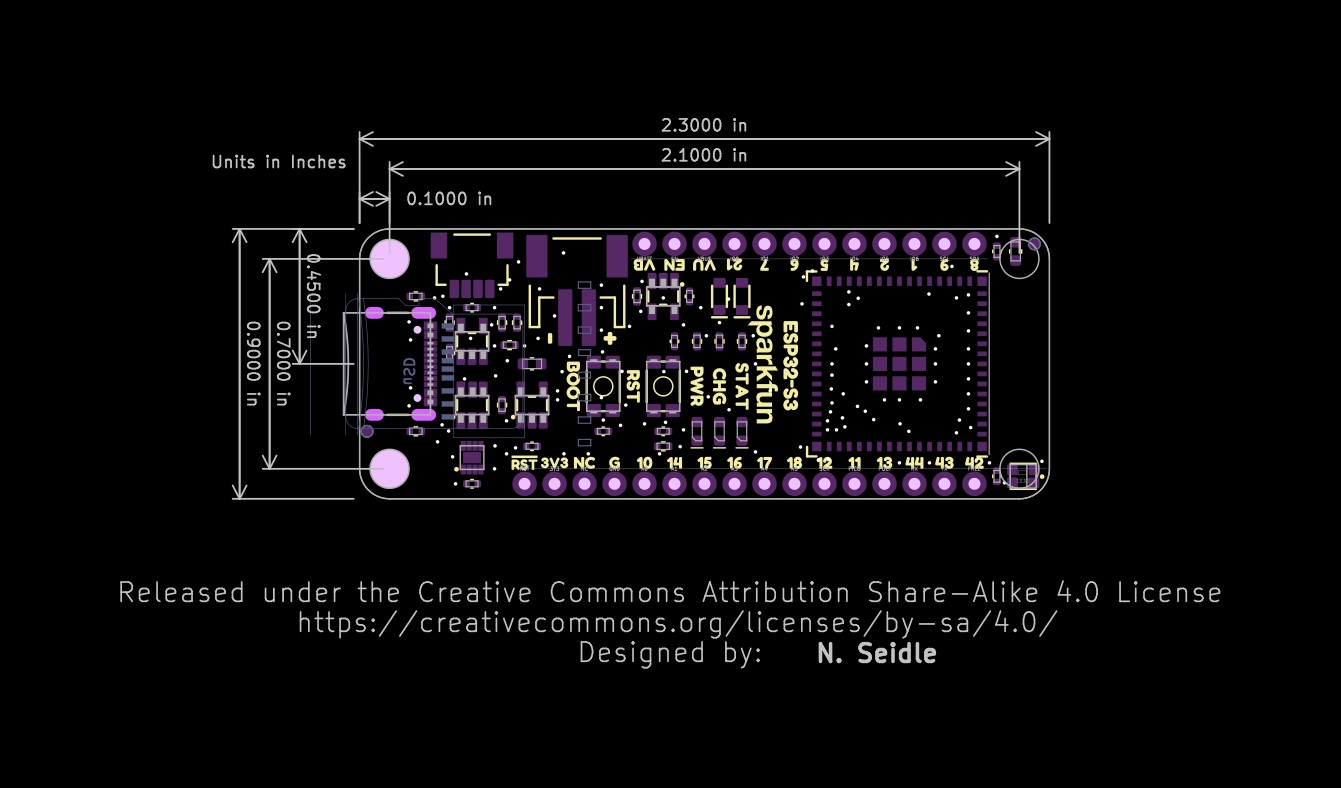
The Thing Plus footprint breaks out 21 of the ESP32-S3's GPIO pins along with the ESP32's Reset and Enable signals to a pair of 0.1in.-spaced plated through hole (PTH) headers. The available GPIO pins include twelve unassigned GPIO with six analog-capable pins as well as GPIO assigned to UART, I2C, and SPI interfaces. Refer to the pin labels on the board or the schematic for complete details on the pin functions.
The board also has a USB-C connector for primary power and programming, a 2-pin JST connector for a LiPo battery (not included), a microSD card slot for expanded storage, and a Qwiic connector to integrate it into SparkFun's Qwiic ecosystem. It also includes a charging circuit and fuel gauge for charging and monitoring an attached LiPo battery.
The SparkFun Qwiic Connect System is an ecosystem of I2C sensors, actuators, shields and cables that make prototyping faster and less prone to error. All Qwiic-enabled boards use a common 1mm pitch, 4-pin JST connector. This reduces the amount of required PCB space, and polarized connections mean you can’t hook it up wrong.
Features:
- ESP32-S3 Mini Module
- Dual-Core Xtensa® 32-bit LX7 Processor
- 45 Programmable GPIO (21 pins broken out on Thing Plus, 17 analog input capable)
- Up to 3 UART Channels
- 1 Full-Speed USB OTG
- 1 USB Serial/JTAG Controller
- Up to 4 SPI
- Up to 2 I2C
- Up to 2 I2S
- 1 LCD Interface
- Up to 8 LED PWM Controller Channels
- 1 TWAI® Controller (Compatible with ISO 11898-1 CAN Spec. 2.0)
- 4 MB Flash
- 2 MB PSRAM
- 2.4 GHz WiFi 6
- Bluetooth® 5 LE
- PCB Antenna
- Thing Plus Form-Factor:
- Dimensions: 2.55" x 0.9"
- Two Mounting Holes
- 28 PTH pins
- USB-C Connector
- 2-pin JST Connector for LiPo Battery (not included)
- 4-pin Qwiic Connector
- µSD Card Slot
- MCP73831 Battery Charger
- Charge Rate: 213mA@3.3V
- MAX17048 Fuel Gauge
- I2C Address: 0x36
- LEDs:
-
PWR- Red Power LED -
CHG- Yellow Battery Charging Indicator -
STAT- Blue LED
-
- Buttons:
BOOTRESET
Documents:
Jargon buster
Plain-language definitions for the technical terms used above.
- ESP32
- ESP32 is a family of low-cost microcontroller chips and modules from Espressif with built-in WiFi and Bluetooth. They support programmable firmware and over-the-air updates, and are commonly programmed with toolchains such as the Arduino core and ESP-IDF.
- Flash memory
- Flash memory is non-volatile memory that retains stored data even when power is removed, and can be erased and rewritten in blocks. It lets data such as firmware, settings or saved records persist across power cycles.
- GPIO
- General-purpose input/output pins are microcontroller pins you can set in software to read signals, switch devices on and off, or connect to peripherals. The number of GPIO pins matters because it limits how many buttons, LEDs, sensors, and other parts you can wire directly to the board.
- Headers
- Rows of connector contacts on a fixed pitch (commonly 2.54 mm) used to link a board to a breadboard, jumper wires, or another board. They come as male pin headers and female socket headers; when a module ships with pre-soldered headers it can be used straight away, whereas bare pads require soldering the pins yourself.
- I2C
- I2C is a two-wire communication bus used by many sensors and small modules. It matters because several I2C devices can share the same two wires, but each device needs a compatible address and your controller must support I2C.
- IoT
- Short for Internet of Things, meaning physical devices that connect to networks or the internet to send data or be controlled remotely. It matters if you want projects such as connected sensors, remote controls or classroom data-logging activities.
- JTAG
- JTAG is a hardware debugging and programming interface used to inspect and control chips at a low level. It matters for advanced development because it can help diagnose firmware problems that are hard to see through normal serial output.
- LCD
- LCD stands for liquid crystal display, a screen technology that uses a backlight and liquid crystals to show images or text. It matters because LCD modules usually need a display driver and enough controller pins or a bus interface to send image data.
- LED
- A light-emitting diode (LED) is a small electronic component that emits light when current flows through it in the correct direction. Because it only conducts one way, its polarity matters, and a through-hole LED must be soldered the correct way around to light up.
- LiPo
- A LiPo (lithium polymer) battery is a rechargeable lithium battery widely used in portable projects because it is light and compact. LiPo cells need correct charging circuitry and careful handling to stay safe, so equipment that supports LiPo generally includes charging or protection hardware suited to that battery type.
- MAX17048
- A battery fuel-gauge chip that estimates how much charge is left in a LiPo battery. It matters for portable projects because your software can monitor battery level instead of only measuring voltage.
- MCP73831
- A lithium battery charger chip used to safely charge a single-cell LiPo battery. It matters because it lets the board recharge a battery from USB or another input without needing a separate charger module.
- microSD card
- A microSD card is a small removable flash memory card used to store data such as audio, images, logs or program files. Its capacity and formatting (often FAT32 or exFAT) affect how much can be stored and whether the card needs preparing before use.
- PCB
- A printed circuit board (PCB) is a board, usually rigid, with etched copper tracks that connect electronic components together without loose wiring. Components are mounted on the board and signals route between them through the copper layout.
- PCB antenna
- A PCB antenna is an antenna pattern built directly into the circuit board rather than a separate metal antenna. It matters because placement, nearby metal and enclosure design can affect wireless range.
- PTH
- Plated through-hole means the pin holes are metal-lined so solder connects the pad on both sides of the board. It is useful for connectors and headers that need a strong mechanical and electrical connection.
- PWM
- Pulse Width Modulation is a way for a digital pin to simulate variable output power by switching on and off very quickly. It matters for controlling things like LED brightness, motor speed, or servo-style signals from a microcontroller pin.
- Qwiic
- Qwiic is a plug-in connector system for I2C devices that uses small 4-pin cables, so you can connect compatible sensors without soldering. It matters because your controller or adapter also needs Qwiic, or you will need a cable or breakout to wire it up.
- SPI
- A fast serial communication bus often used for displays, memory cards, and sensors. It matters because SPI devices need specific pins for clock and data, plus a separate chip-select line for each device.
- Thing Plus
- Thing Plus is SparkFun’s development-board form factor with a small rectangular layout and connections suited to wireless and battery-powered projects. It matters because boards and accessories in the same form factor are easier to mount, wire, and swap between projects.
- UART
- UART is a simple asynchronous serial interface that sends data over separate transmit and receive wires, usually labelled TX and RX, with both ends set to the same baud rate. It is a common way for microcontrollers and other serial devices to exchange data.
- USB host
- A USB host is the side of a USB connection that controls attached devices, like a computer talking to a keyboard or flash drive. This matters because most microcontroller boards are normally USB devices, so adding USB host support lets them use common USB peripherals.
- USB-C
- USB-C is a small, reversible USB connector that can carry power, data and, on some devices, video over a single cable. The same connector can range from charging only to high-speed data, so the functions a given port actually supports vary.
Find this product in
Brands
Connectivity
Microcontrollers
SparkFun Thing Plus ESP32-S3 Schematic
Schematic · 645.6 KB · Click any page to view full size
ESP32-S3 MINI-1 Datasheet
Datasheet · 1.0 MB · Click any page to view full size
Supplier page — sparkfun.com
Supplier Description · 1.2 MB · Click any page to view full size
Resources & Downloads
Guides, code examples, and more
Source Code
Open-source libraries, firmware & example projects for this product
A SparkFun Thing Plus development board for the ESP32-S3.
c9fc69f
almost 2 years ago
· 23 commits
- .github Docs build update over 2 years ago
- docs Update software_setup over 2 years ago
- Documents Initial commit almost 3 years ago
- Firmware Update comments on example sketches over 2 years ago
- Hardware Update with current models and symbols almost 2 years ago
- overrides Docs build update over 2 years ago
- .gitattributes Initial commit almost 3 years ago
- .gitignore Update .gitignore over 2 years ago
- LICENSE.md Initial commit almost 3 years ago
- mkdocs.yml Update mkdocs.yml almost 2 years ago
- README.md Update README.md over 2 years ago