SparkFun
SparkFun Thing Plus Dual-Port Logging Shield
We carry several data logging products which have microSD sockets on them: OpenLog Artemis and the Qwiic OpenLog to name but two. They're great for logging d...
Get notified when back in stock
We carry several data logging products which have microSD sockets on them: OpenLog Artemis and the Qwiic OpenLog to name but two. They're great for logging data to a microSD card, but when it comes to reading the logged data quickly you usually have to pop out the microSD card and plug it into your computer. But what if you're developing an embedded system and you don't want to or aren't able to eject the microSD card. Enter the SparkFun Thing Plus Dual-Port Logging Shield!
The SparkFun Dual-Port Logging Shield is a Thing Plus/Feather-compatible board which allows you to access your microSD card over both SPI and USB-C. It is designed to be mounted on or under one of our Thing Plus boards. You can log data to and read data from your microSD card over SPI as usual, using your favorite Arduino SD library. But you can also connect it to your computer via USB-C and read and write files at up to 35 MBytes/second! The write speed is card-dependent but, in our tests, we've routinely seen write speeds around 20MB/s.
The SparkFun Dual-Port Logging Shield has an ATtiny841 microcontroller on it to act as an arbiter: If you power up your Thing Plus, the ATtiny841 will automatically put the Dual-Port Logging Shield into SPI mode, so your Arduino code can access the microSD card as normal If you power the Shield from your computer by connecting it via USB-C, the ATtiny841 will put the Shield into SDIO "thumb drive" mode. Your computer can then read and write data really quickly! Finally, if you have both your Thing Plus powered up - and have your computer connected - then you can switch between the two modes by giving the ATtiny841 some very simple commands over I2C!
You can configure the ATtiny to automatically default to SPI mode or SDIO "thumb drive" mode if both power sources are powered up simultaneously. It's your choice!
Note: The USB2241, which provides the USB interface, supports FAT32, exFAT and NTFS on cards up to and including 32GB. Cards larger than 32GB are not supported.
Features:
- Thing Plus / Feather-compatible footprint and breakout pins
- ATtiny841 microcontroller
- The ATtiny841 acts as an arbiter and can put the shield into either SPI or SDIO ("thumb drive") mode
- USB2241 Ultra Fast USB 2.0 Media Controller
- Supports cards up to 32GB
- Supports FAT32, exFAT and NTFS
- Read and write speed: up to 35 MBytes/second (card-dependent)
- The board includes solder pads for an optional 24C04 I2C EEPROM
- Push-push microSD socket
- Simple I2C command set to switch modes and set the default mode
- Can be powered by:
- Thing Plus / Feather 3.3V
- USB-C 5V
- Or both!
- Full power control
- Sleep current (PWR LED disabled): 300 µA
- Power source voltage sensing
- Activity LED (for SDIO "thumb drive" mode)
- Power LED (configurable)
Documents:
- Schematic
- Eagle Files
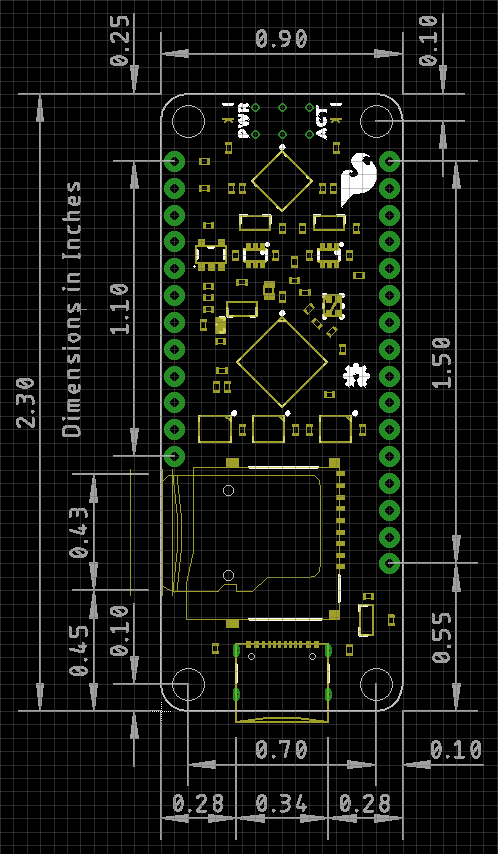
- Board Dimensions
- Hookup Guide
- Datasheet (USB224x)
- Thing+ Info Page
- Arduino Library
- GitHub Hardware Repo
Videos
Jargon buster
Plain-language definitions for the technical terms used above.
- breakout
- A breakout board carries a small or fine-pitched component and brings its connections out to standard, breadboard- and header-friendly pins. Describing a part as a breakout means it can be wired into a project without soldering directly to the component's tiny contacts.
- EEPROM
- A type of non-volatile memory that keeps stored data even when power is turned off. In a sensor module, it can be used to store settings or calibration data so they do not need to be re-entered every time.
- Feather-compatible
- Feather-compatible means the board follows the Adafruit Feather size and pin layout used by many add-on boards and enclosures. It matters because it helps you choose accessories that will physically fit and connect to the same pins.
- LED
- A light-emitting diode (LED) is a small electronic component that emits light when current flows through it in the correct direction. Because it only conducts one way, its polarity matters, and a through-hole LED must be soldered the correct way around to light up.
- microcontroller
- A microcontroller is a small computer on a single chip that runs a stored program and controls connected inputs and outputs such as buttons, sensors, displays and communication interfaces. In a device built around one, it is the part that executes the code and coordinates the device's behaviour.
- microSD card
- A microSD card is a small removable flash memory card used to store data such as audio, images, logs or program files. Its capacity and formatting (often FAT32 or exFAT) affect how much can be stored and whether the card needs preparing before use.
- Shield
- An add-on board that plugs into a main controller board to give it extra features such as sensing, motor control or communication. Knowing a product supports shields helps you judge whether it can connect neatly into an existing maker-board setup.
- SPI
- A fast serial communication bus often used for displays, memory cards, and sensors. It matters because SPI devices need specific pins for clock and data, plus a separate chip-select line for each device.
- Thing Plus
- Thing Plus is SparkFun’s development-board form factor with a small rectangular layout and connections suited to wireless and battery-powered projects. It matters because boards and accessories in the same form factor are easier to mount, wire, and swap between projects.
- USB 2.0
- USB 2.0 is a widely used wired standard for carrying both data and power between a device and a computer or other compatible host, with data rates up to 480 Mbps. It indicates the kind of port a device uses and that it should work with most modern and many older computers.
- USB-C
- USB-C is a small, reversible USB connector that can carry power, data and, on some devices, video over a single cable. The same connector can range from charging only to high-speed data, so the functions a given port actually supports vary.
Find this product in
Brands
SparkFun Thing Plus Dual-Port Logging Shield Schematic
Schematic · 253.7 KB · Click any page to view full size
USB224x Datasheet
Datasheet · 718.1 KB · Click any page to view full size
Supplier page — sparkfun.com
Supplier Description · 588.7 KB · Click any page to view full size
Resources & Downloads
Guides, code examples, and more
Source Code
Open-source libraries, firmware & example projects for this product
An Arduino Library to support the Thing Plus Dual-Port Logging Shield
2731eb4
over 4 years ago
· 10 commits
- .github Initial commit over 4 years ago
- docs Correct comments over 4 years ago
- examples Create Example6_SetDefaultMode.ino over 4 years ago
- src Correct comments over 4 years ago
- Doxyfile Initial commit over 4 years ago
- keywords.txt Initial commit over 4 years ago
- library.properties Initial commit over 4 years ago
- LICENSE.md Initial commit over 4 years ago
- README.md Update README.md over 4 years ago
A Thing Plus Shield providing access to a microSD card via both SPI and USB
6fb3ef9
over 4 years ago
· 26 commits
- Documents Final Eagle files for Proto over 4 years ago
- Firmware Firmware v1.1 over 4 years ago
- Hardware PCB v1.1 over 4 years ago
- img Final Eagle files for Proto over 4 years ago
- License.md Create License.md almost 5 years ago
- ReadMe.md Update ReadMe.md over 4 years ago
Related Tutorials
Free step-by-step guides