SparkFun
SparkFun QwiicBus - EndPoint
The SparkFun QwiicBus EndPoint is the fastest and easiest way to extend the range of your I2C communication bus. The breakout uses NXP’s PCA9615 IC, which co...
Get notified when back in stock
The SparkFun QwiicBus EndPoint is the fastest and easiest way to extend the range of your I2C communication bus. The breakout uses NXP’s PCA9615 IC, which converts the two default I2C signals into four differential signals, two for SCL and two for SDA. The differential signals are sent over an Ethernet cable, which attaches to the breakout through the on-board RJ-45 connectors. The differential signaling allows the I2C signals to reach distances of up to 100ft. while still maintaining their signal integrity! To make it even easier to get your readings, all communication is enacted exclusively via I2C, utilizing our handy Qwiic system so no soldering is required to connect it to the rest of your system. However, we still have broken out 0.1"-spaced pins in case you prefer to use a breadboard.
The simplicity of the QwiicBus EndPoint is one of its biggest appeals. Other I2C communication methods require packetizing I2C communication into another protocol, be it RS-485 or 1-Wire. However, the PCA9615 keeps the I2C protocol by utilizing a differential transceiver.
This updated version of the Differential I2C Breakout adds two 0.1" spaced pins connected to the unused pair of wires on the RJ-45 connectors so users can easily take advantage of the unused pair for whatever they would like.
Whether you need to extend the range of an I2C sensor on an autonomous vehicle plagued with noise from motors or want to create a vast sensor network in your home or office, the QwiicBus EndPoint is a great solution to extend distance and reduce noise susceptibility.
The SparkFun Qwiic Connect System is an ecosystem of I2C sensors, actuators, shields and cables that make prototyping faster and less prone to error. All Qwiic-enabled boards use a common 1mm pitch, 4-pin JST connector. This reduces the amount of required PCB space, and polarized connections mean you can’t hook it up wrong.
Features:
- Uses the PCA9615 buffer IC
- I2C Supply voltage range: 2.3-5.5V
- Differential Supply voltage range: 3-5.5V
- Multiple power configurations depending on application needs
- Extends I2C bus up to 100 feet
- 2x Qwiic Connectors
Documents:
- Schematic
- Eagle Files
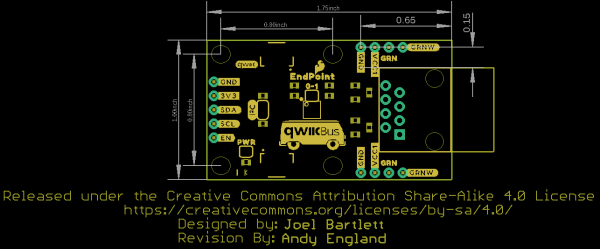
- Dimensional Drawing
- Hookup Guide
- Datasheet (PCA9615)
- Qwiic Info Page
- Hardware GitHub Repository
Videos
Jargon buster
Plain-language definitions for the technical terms used above.
- 1-Wire
- 1-Wire is a communication method where devices share a single data line, often with each device having its own address. It matters because several temperature modules can be connected to one microcontroller pin instead of needing a separate pin for each probe.
- breakout
- A breakout board carries a small or fine-pitched component and brings its connections out to standard, breadboard- and header-friendly pins. Describing a part as a breakout means it can be wired into a project without soldering directly to the component's tiny contacts.
- PCB
- A printed circuit board (PCB) is a board, usually rigid, with etched copper tracks that connect electronic components together without loose wiring. Components are mounted on the board and signals route between them through the copper layout.
- Qwiic
- Qwiic is a plug-in connector system for I2C devices that uses small 4-pin cables, so you can connect compatible sensors without soldering. It matters because your controller or adapter also needs Qwiic, or you will need a cable or breakout to wire it up.
- SCL
- The clock line used by the I2C bus to keep data transfers timed between a controller and connected devices. When wiring I2C, SCL must be connected to the SCL pin on every device sharing the bus.
- SDA
- The data line used by the I2C bus to carry information between a controller and connected devices. When wiring I2C, SDA must be connected to the SDA pin on every device sharing the bus.
Find this product in
SparkFun QwiicBus EndPoint Schematic
Schematic · 126.7 KB · Click any page to view full size
PCA9615 Datasheet
Datasheet · 899.7 KB · Click any page to view full size
Supplier page — sparkfun.com
Supplier Description · 557.1 KB · Click any page to view full size
Resources & Downloads
Guides, code examples, and more
Source Code
Open-source libraries, firmware & example projects for this product
Extend your I2C communication along long ethernet cables!
4e79187
over 5 years ago
· 5 commits
- Documentation pulling in files from v11 branch of differential I2C breakout over 5 years ago
- Hardware pulling in files from v11 branch of differential I2C breakout over 5 years ago
- Production pulling in files from v11 branch of differential I2C breakout over 5 years ago
- .gitignore Create .gitignore over 5 years ago
- LICENSE.md pulling in files from v11 branch of differential I2C breakout over 5 years ago
- README.md Update README over 5 years ago