SparkFun
SparkFun Qwiic Buzzer
·
The SparkFun Qwiic Buzzer adds simple beeps and buzzes to your projects via I2C. Make some noises to alert you when something interesting (or urgent) happens...
Get notified when back in stock
The SparkFun Qwiic Buzzer adds simple beeps and buzzes to your projects via I2C. Make some noises to alert you when something interesting (or urgent) happens. Simply connect a Qwiic cable and load up some pre-written code to an Arduino to start making noises!
The board includes an ATtiny84 with custom firmware to control the piezoelectric buzzer over I2C. Utilizing our handy Qwiic system, no soldering is required to connect it to the rest of your system. However, we still broke out 0.1"-spaced PTH pads if you prefer to use a breadboard to access the board's I2C, power, trigger, and reset pins on the board's edge. A 2.2kΩ pull-up resistor is included on the data and clock lines.
A set of transistors control the buzzer's volume. At full volume, it allows the full current of about ~95mA, which makes it really loud. A flyback diode is included to discharge any energy remaining when the buzzer is turned off. For those who want to control the loudness of the buzzer, a footprint is available to solder a custom PTH resistor to one of the transistors. Just make sure to cut the jumper labeled "JP1." Two LEDs are also included on the board for power and status.
We've written an Arduino Library to control the volume, frequency, duration, and I2C address. There are even examples of how to play a quick melody and sweet sound effects! You can download the library through the Arduino library manager by searching 'SparkFun Qwiic Buzzer,' or you can get the GitHub repo as a .zip to install the library from there manually. For those who want a simple buzz without an Arduino, you can also make noise by simply grounding the trigger pin! We've even ported the library as a Python package!
This board is great for adding a simple audible sound to your projects. Pair the board with the Qwiic RTC to make an alarm clock, play a tune with the Qwiic RFID, or add a sound effect to your robot. So what are you waiting for?!? Start making some noise in your projects with the SparkFun Qwiic Buzzer!
The SparkFun Qwiic Connect System is an ecosystem of I2C sensors, actuators, shields and cables that make prototyping faster and less prone to error. All Qwiic-enabled boards use a common 1mm pitch, 4-pin JST connector. This reduces the amount of required PCB space, and polarized connections mean you can’t hook it up wrong.
Features:
- Recommended Input Voltage: 3.3V
- ATtiny84 Pre-programmed with Custom Firmware
- 2x Qwiic Connectors
- I2C Controlled Buzzer
- Default I2C Address: 0x34 (Default)
- Built-in I2C 2.2kΩ Pull-Up Resistors
- LED
- Power (PWR)
- Status (STAT)
- Jumpers
- I2C Pull-Up Resistors
- STAT
- PWR
- JP1
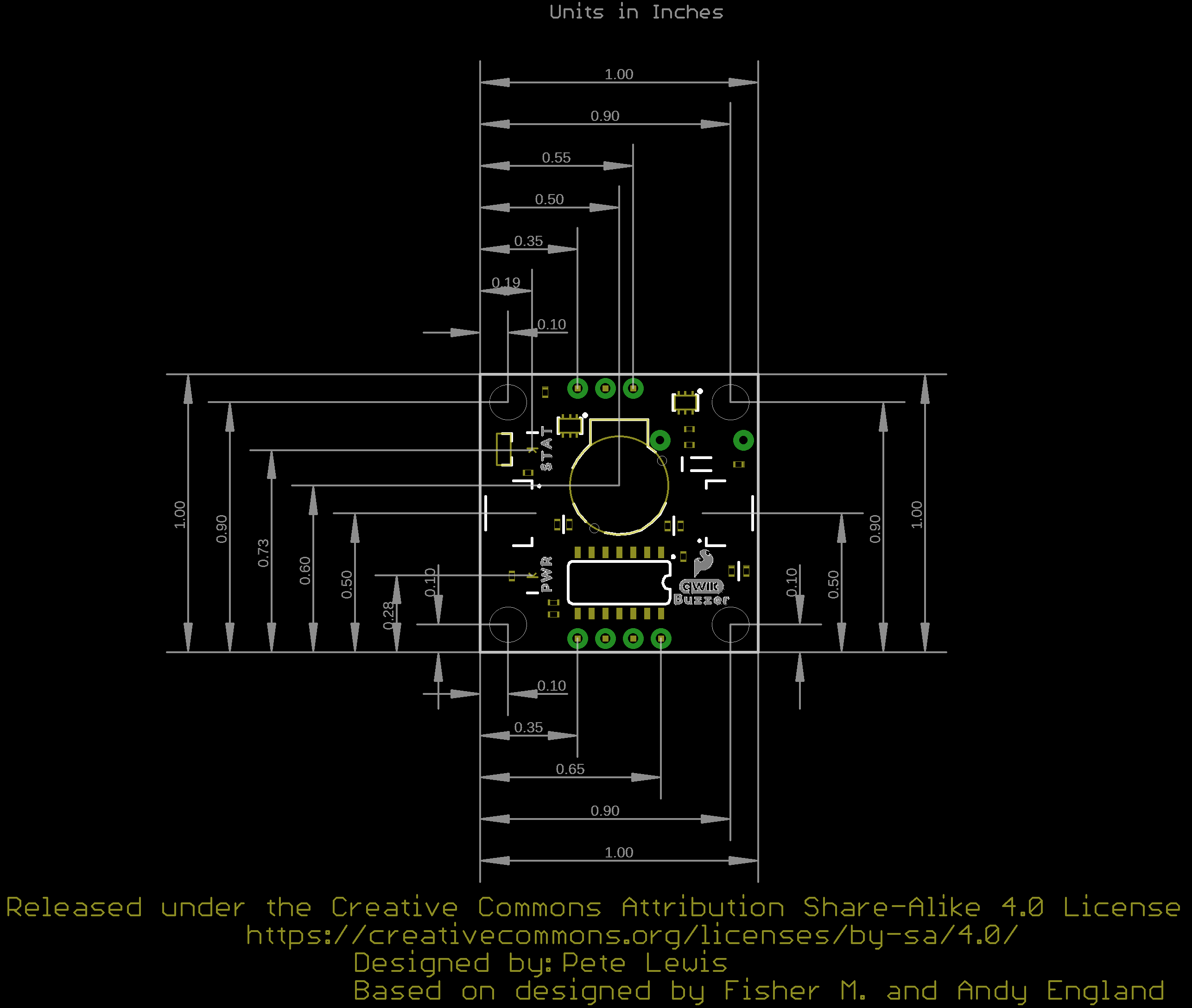
- Board Dimensions: 1.0in. x 1.0in. (25.4mm x 25.4mm)
- Weight: 2.85g
Documents:
- Schematic
- Eagle Files
- Board Dimensions
- Datasheet
- Hookup Guide
- Qwiic Info Page
- Arduino Library
- ReadtheDocs: Qwiic Buzzer
- Qwiic Buzzer Python Package
- GitHub Hardware Repo
Videos
Jargon buster
Plain-language definitions for the technical terms used above.
- I2C
- I2C is a two-wire communication bus used by many sensors and small modules. It matters because several I2C devices can share the same two wires, but each device needs a compatible address and your controller must support I2C.
- LED
- A light-emitting diode (LED) is a small electronic component that emits light when current flows through it in the correct direction. Because it only conducts one way, its polarity matters, and a through-hole LED must be soldered the correct way around to light up.
- PCB
- A printed circuit board (PCB) is a board, usually rigid, with etched copper tracks that connect electronic components together without loose wiring. Components are mounted on the board and signals route between them through the copper layout.
- PTH
- Plated through-hole means the pin holes are metal-lined so solder connects the pad on both sides of the board. It is useful for connectors and headers that need a strong mechanical and electrical connection.
- Qwiic
- Qwiic is a plug-in connector system for I2C devices that uses small 4-pin cables, so you can connect compatible sensors without soldering. It matters because your controller or adapter also needs Qwiic, or you will need a cable or breakout to wire it up.
- RTC
- A Real-Time Clock keeps track of time even when the main processor is asleep or powered down, usually with a small backup battery. It matters for data logging and tracking projects that need accurate timestamps.
Find this product in
Audio & Video
SparkFun Qwiic Buzzer Schematic
Schematic · 180.6 KB · Click any page to view full size
CBT-09427 Magnetic Buzzer Datasheet
Datasheet · 539.7 KB · Click any page to view full size
ATtiny84 Datasheet
Datasheet · 4.4 MB · Click any page to view full size
Supplier page — sparkfun.com
Supplier Description · 743.6 KB · Click any page to view full size
Resources & Downloads
Guides, code examples, and more
Source Code
Open-source libraries, firmware & example projects for this product
Arduino Library for the SparkFun Qwiic Buzzer
b717328
7 months ago
· 127 commits
- .github revert back to original doxygen build method now that issue resolved 7 months ago
- docs one last try on doxy issues 7 months ago
- examples changed second buzzer address to 0x5B over 2 years ago
- src port to the tookit unified API in v1.0 over 1 year ago
- .gitmodules added files for doxygen docs over 1 year ago
- ISSUE_TEMPLATE.md Bringing in copy of button library as starting point almost 3 years ago
- keywords.txt Firmware Version read example over 2 years ago
- library.properties updates for Tk v1.0; structure changes for current pattern; cleanup and more doxy headers over 1 year ago
- LICENSE.md updated license to MIT; added lib versioning to toolkit dependancy and bumped version over 1 year ago
- README.md again - ai suggestion? 7 months ago
Python module for the SparkFun Qwiic Buzzer
09248dc
over 2 years ago
· 49 commits
- docs Update apiref.rst over 2 years ago
- examples changed ex10 to use 0x5B for buzzer2 over 2 years ago
- .readthedocs.yml readthedocs stuff over 2 years ago
- DESCRIPTION.rst some docs updating over 2 years ago
- DOCUMENTATION.md template files over 2 years ago
- LICENSE some docs updating over 2 years ago
- qwiic_buzzer.py indentation fix on docstring for class over 2 years ago
- README.md Update README.md over 2 years ago
- setup.cfg template files over 2 years ago
- setup.py indentation fix on docstring for class over 2 years ago
An I²C-controlled Qwiic device that provides solderless plug-and-play buzzer sounds!
c6be60f
5 months ago
· 99 commits
- .github Update mkdocs.yml 5 months ago
- docs Update hardware_overview.md over 2 years ago
- Firmware updated compiled hex for production over 2 years ago
- Hardware BOM change - control resistors changed to 100 ohm over 2 years ago
- overrides Push initial tutorial for GitHub Pages over 2 years ago
- .gitattributes Push initial tutorial for GitHub Pages over 2 years ago
- .gitignore Layout started almost 3 years ago
- LICENSE.md Push initial tutorial for GitHub Pages over 2 years ago
- mkdocs.yml Update mkdocs.yml 5 months ago
- README.md Update README.md over 2 years ago