SparkFun
SparkFun Pulsed Coherent Radar Sensor - Acconeer XM125 (Qwiic)
·
Forget ultrasonic and infrared sensors; the SparkFun Qwiic Pulsed Coherent Radar Sensor - Acconeer XM125 brings powerful 60 GHz radar technology to your pr...
Get notified when back in stock
Forget ultrasonic and infrared sensors; the SparkFun Qwiic Pulsed Coherent Radar Sensor - Acconeer XM125 brings powerful 60 GHz radar technology to your projects. This sensor isn't limited to surface detection; it can see through walls, cabinets, and even pockets (depending on the material), making it perfect for unique applications. Measure distances with millimeter precision, detect motion, the speed of an object, or even gestures!
The XM125 boasts an impressive range of up to 20 meters, allowing you to create long-range sensing projects. The actual measurable distance is dependent on the object size, shape, dielectric properties, and lens (e.g. water level measurements up to 20 meters with lens utilization, human presence detection up to 7 meters with lens-free utilization). Despite its power, the sensor has remarkably low in power consumption, which is ideal for battery-powered applications. The real magic lies in the sensor's ability to do more than measure distance; the XM125 can differentiate between stationary objects and moving targets using pulsed coherent radar. This means you can sense an object's presence and how fast something is moving!
We've included a USB type-C connector, ESD protection diodes on the USB data lines, and a CH340C USB-to-serial converter to connect the XM125 directly to your computer's COM port. Power is regulated down for the XM125 with the AP2112K 3.3V/600mA and RT9080 1.8V/600mA voltage regulators. Buttons for reset and boot are included when resetting the module or setting the board into bootloader mode. Utilizing our handy Qwiic system, no soldering is required to connect it to the rest of your system. However, we still have broken out 0.1in.-spaced pins if you prefer a breadboard.
We've written an Arduino library when the I2C presence or distance detection firmware is loaded onto the XM125 module. With the I2C presence detection firmware, you can sense when an object is moving in an environment and how far away it is from the sensor. You can detect slow and fast movements with the inter-presence and intra-presence scores, respectively. The I2C distance detection firmware is similar to the presence detector by providing distance measurements. However, distance detection will provide information when it detects objects within range. The distance detection firmware can also adjust the sensor's threshold and sensitivity. The read range can also be configured to a certain distance away with either firmware.
Acconeer has also developed a visualization tool written in Python that demonstrates data collection in real time. The Acconeer Exploration Tool is an incredible resource, especially when starting out with the XM125 module to debug and explore the sensor's capabilities. This allows you to fine-tune the sensor for your application. For example, it will graph distance or presence sensing, giving you a count of the number of sweeps, which communication port data is being sent through, and much more. It will also guide you to the optimal sensor settings and help you fine-tune the data processing for your final product implementation. The tool supports Windows and Linux and requires Python version 3.8 or later. This tool is available through their GitHub Repository. Head on over and take a look!
With the SparkFun Qwiic Pulsed Coherent Radar Sensor, a world of new project possibilities opens up. Imagine creating presence detection systems for smart homes and security applications, parking space occupancy detection, gesture recognition interfaces for unique user control, level measurement (for example, in tanks or waste containers), through-wall imaging systems for search and rescue, or even advanced robotics with object avoidance and navigation.
Note: Due to the higher frequencies, pulsed coherent radar sensors may be regulated in certain countries. Be sure to check local regulations before use.
The SparkFun Qwiic Connect System is an ecosystem of I2C sensors, actuators, shields and cables that make prototyping faster and less prone to error. All Qwiic-enabled boards use a common 1mm pitch, 4-pin JST connector. This reduces the amount of required PCB space, and polarized connections mean you can’t hook it up wrong.
Features:
- 1x USB Type C Connector
- ESD Protection Diodes for USB Data Lines
- CH340C USB-to-Serial Converter
- Voltage: 5V or 3.3V but all logic is 3.3V
- AP2112K 3.3V/600mA Voltage Regulator
- RT9080 1.8V/600mA Voltage Regulator
- Acconeer XM125 Module
- A121
- 60GHz Pulsed Coherent Radar (PCR)
- Integrated Baseband, RF Front-End and Antenna in Package
- Detect Distance, Speed, Motion, and Objects up to 20 Meters** Away
- Millimeter Precise Readings
- Low Power Consumption
- STMicroelectronics STM32L431CBY6
- 32-bit Arm® Cortex® M4 MCU
- Clock Speed: 80 MHz
- Flash: 128kB
- RAM: 68kB
- A121
- 2x Horizontal Qwiic Connectors
- Built-in I2C 2.2kΩ Pull-Up Resistors
- I2C Address: (0x52, Default)
- 2x5 SWD Header Footprint
- Buttons
- Reset
- Boot
- LED
- Power
- Jumpers
- USB Shield (
SHLD) - Power LED (
LED) - I2C Pull-Up Resistors (
I2C) - Wake Up (
WU) - I2C Address (
ADDR)*
- USB Shield (
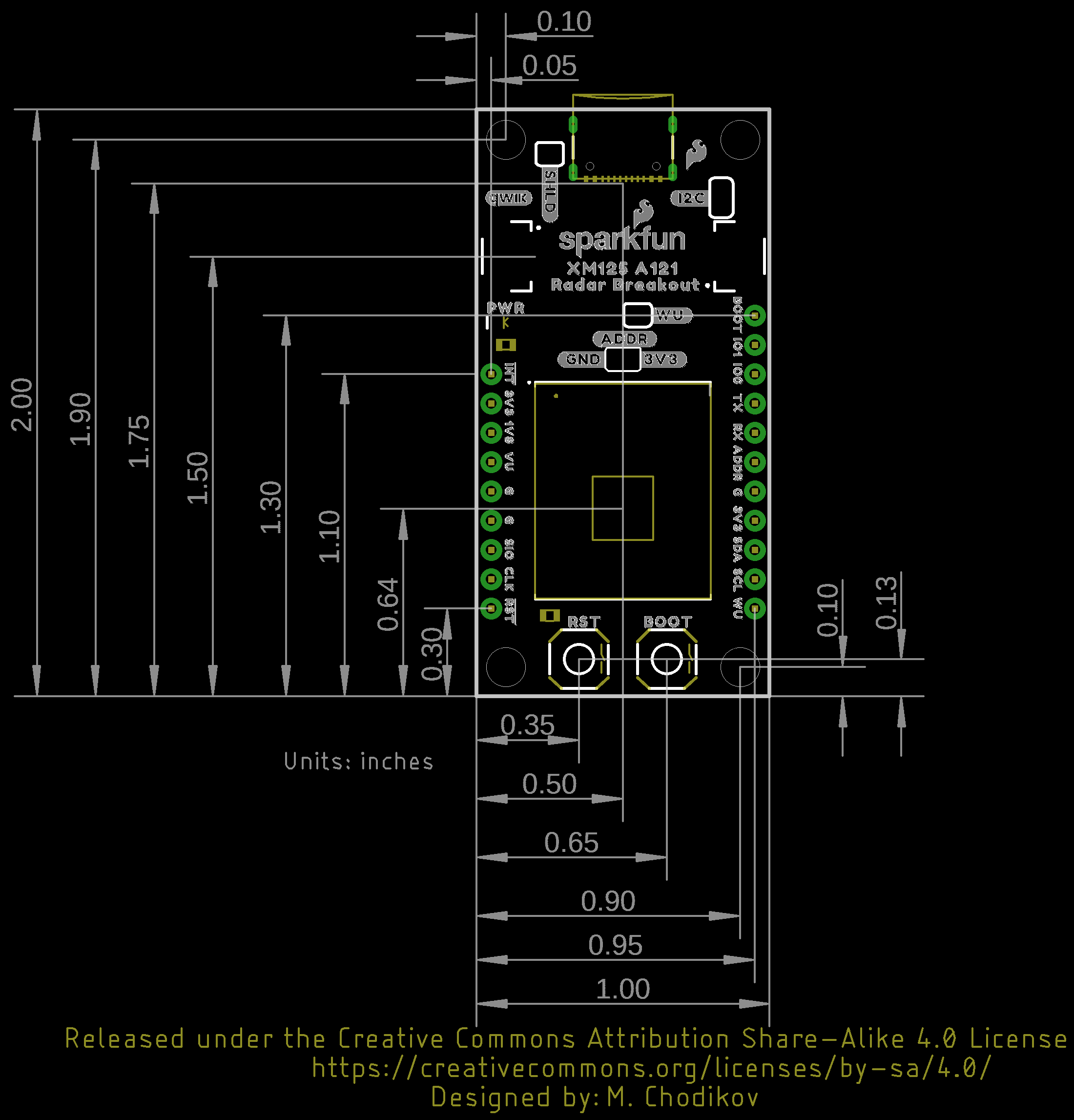
- Board Dimensions: 1.0" x 2.0" (25.4mm x 50.8mm)
- Weight: 6.35g
*Note: Selectable I2C address to be implemented in the future.
**Note: The actual measurable distance is dependent on the object size, shape, dielectric properties, and lens (e.g. water level measurements up to 20 meters with lens utilization, human presence detection up to 7 meters with lens-free utilization).
Documents:
SparkFun Resources
Acconeer Resources
- Datasheets
- User Guides
- Acconeer Getting Started Guide
- Acconeer Python Exploration Tool
- STMicroelectronics STM32CubeProgrammer Software
- XM125 Firmware
Videos
Jargon buster
Plain-language definitions for the technical terms used above.
- AP2112K
- AP2112K is a small low-dropout (LDO) voltage regulator that supplies a stable fixed output (commonly 3.3V) from a higher input such as USB 5V. Its ratings matter for checking the acceptable input voltage range and the maximum current available to the powered electronics.
- Bootloader
- Small starter software on a microcontroller that lets new code be uploaded before the main program runs. Knowing how to enter bootloader mode matters when you need to program the board or recover it after a faulty sketch.
- COM port
- A COM port is how a computer (chiefly under Windows) presents a serial port to software, whether a physical RS-232 port or a virtual port created when a USB-to-serial device is plugged in. Software can then communicate with the connected device over serial using a terminal or configuration program.
- ESD protection
- ESD protection helps protect electronics from damage caused by static electricity discharges. It is useful on development boards because cables, sensors and modules are often plugged and unplugged during prototyping.
- LED
- A light-emitting diode (LED) is a small electronic component that emits light when current flows through it in the correct direction. Because it only conducts one way, its polarity matters, and a through-hole LED must be soldered the correct way around to light up.
- PCB
- A printed circuit board (PCB) is a board, usually rigid, with etched copper tracks that connect electronic components together without loose wiring. Components are mounted on the board and signals route between them through the copper layout.
- Qwiic
- Qwiic is a plug-in connector system for I2C devices that uses small 4-pin cables, so you can connect compatible sensors without soldering. It matters because your controller or adapter also needs Qwiic, or you will need a cable or breakout to wire it up.
- RAM
- RAM (random-access memory) is fast, temporary memory a device uses for working data while it is running; in its common volatile form, its contents are lost when power is removed. Some devices offer a mode that applies settings to RAM only, which is handy for testing changes temporarily because they are not stored permanently and disappear at power-off.
- RF
- RF means radio frequency, referring to signals used for wireless communication and other high-frequency electronics. A low-noise, stable power supply is important for RF circuits because power noise can affect signal quality and measurements.
- Shield
- An add-on board that plugs into a main controller board to give it extra features such as sensing, motor control or communication. Knowing a product supports shields helps you judge whether it can connect neatly into an existing maker-board setup.
- SWD
- Serial Wire Debug (SWD) is a two-wire programming and debugging interface used with many ARM Cortex-M microcontrollers. It provides low-level access to program, recover or debug the microcontroller.
- USB Type-C
- USB Type-C is a small, reversible USB connector used for power, data and sometimes video on many modern devices. The connector itself does not guarantee a particular speed or voltage, so check the supported USB version, data rate and whether it carries more than 5V via USB Power Delivery.
Find this product in
XM125 Datasheet
Datasheet · 903.1 KB · Click any page to view full size
A121 Datasheet
Datasheet · 1.0 MB · Click any page to view full size
SparkFun XM125 Breakout Schematic
Schematic · 332.8 KB · Click any page to view full size
Hardware Integration Guideline for A111 and A121 PCR Sensors
User Guide · 3.1 MB · Click any page to view full size
A121 Presence Detector User Guide
User Guide · 194.9 KB · Click any page to view full size
I2C Presence Detector User Guide
User Guide · 457.3 KB · Click any page to view full size
A121 Distance Detector User Guide
User Guide · 123.8 KB · Click any page to view full size
I2C Distance Detector User Guide
User Guide · 940.6 KB · Click any page to view full size
XM125 Software User Guide
User Guide · 1.1 MB · Click any page to view full size
Supplier page — sparkfun.com
Supplier Description · 836.0 KB · Click any page to view full size
Resources & Downloads
Guides, code examples, and more
Source Code
Open-source libraries, firmware & example projects for this product
Acconeer Exploration Tool
e29f30d
6 months ago
· 3.5k commits
- .github Add list of packages to Github issue template over 4 years ago
- docker docker: Add libusb-1.0-0 from apt 7 months ago
- docs docs: Add a "capability table" to getting started 6 months ago
- examples a121: Refactor UI plot for the Vibration app 8 months ago
- gui Add copyright statement to all python files about 4 years ago
- internal_tools package_standalone_example: Add Python version check for Windows 11 months ago
- portable Add README.txt to portable package about 3 years ago
- src Add instructions for users that forgot "[app]" 6 months ago
- tests Add instructions for users that forgot "[app]" 6 months ago
- user_tools a121: Additions to the Vibration example app 7 months ago
- .gitattributes Disable auto-merging for CHANGELOG.md almost 4 years ago
- .gitignore a121/distance: Add property-based testing of validation over 1 year ago
- .readthedocs.yaml Move docs-dependencies to docs/requirements.txt 6 months ago
- CHANGELOG.md Prepare release v7.18.1 6 months ago
- Jenkinsfile Prepare release v7.18.0 6 months ago
Arduino library for the SparkFun Qwiic Pulsed Coherent Radar Sensor – Acconeer XM125.
4d2d89c
over 1 year ago
· 125 commits
- .github add compile test to this repo over 1 year ago
- docs random link in code over 1 year ago
- examples updated Examples to new API for v2.0 over 1 year ago
- src Merge pull request #14 from sparkfun/develop over 1 year ago
- .gitignore Initial commit almost 3 years ago
- .gitmodules setting up for doxygen generated docs over 1 year ago
- keywords.txt iniital port/move to sparkfun_toolkit v1.0 done - basic readings compile, but no further tests yet over 1 year ago
- library.properties fix para over 1 year ago
- LICENSE.md linker driven cleanup over 1 year ago
- README.md fix doc link over 1 year ago
Tutorial and hardware files for the SparkFun Qwiic Pulsed Coherent Radar Sensor - Acconeer XM125. The board brings powerful 60 GHz radar technology with millimeter precision to your projects.
a049212
4 months ago
· 38 commits
- .github Update mkdocs.yml 4 months ago
- docs Update introduction.md over 1 year ago
- Firmware Changes for reds review completed; panel files added over 2 years ago
- Hardware Final changes; reds ready for ordering! over 2 years ago
- overrides Initial Push Hookup Guide over 2 years ago
- .gitattributes Initial commit almost 3 years ago
- .gitignore Initial commit almost 3 years ago
- CONTRIBUTING.md Initial commit almost 3 years ago
- ISSUE_TEMPLATE.md Initial commit almost 3 years ago
- LICENSE.md Initial commit almost 3 years ago
- mkdocs.yml Update mkdocs.yml 4 months ago
- README.md Update README.md over 2 years ago